Tag Archives: Andorra

EviDNA DNA Cryptography | Jacques Gascuel Memory

Illustration scientifique EviDNA avec double hélice d’ADN stylisée et symboles de sécurité numérique

EviDNA DNA cryptography: Freemindtronic complementary reference memory — EviDNA, Digital DNA, cryptographic genome, cybersecurity and digital trust (CryptPeer / EviSKMS) — July 2026.

© 2026 Jacques Gascuel — Freemindtronic®. All rights reserved. Intellectual property protected. This page is an original literary and scientific work. Its expression, structure, terminology and scientific positioning — including the author’s original framing of a « fourth family of entropy » relative to PRNG, TRNG and QRNG — are protected by copyright. It is not a technical reproduction notice. Unauthorized reproduction of this formulation or appropriation of authorship is prohibited.

EviDNA DNA cryptography — express summary

Read. This express abstract presents the purpose, industrial trajectory, and scope of the dissertation before the detailed executive summary. IP note. Intellectual property protected. The form of expression of this mémoire is protected by copyright (© Jacques Gascuel / Freemindtronic). It is not a technical reproduction notice.

EviDNA cryptography DNA refers to the Freemindtronic trajectory in the cryptographic universe mobilizing the expression “DNA” in the procedural and architectural sense — non-molecular by default. The thesis documents three milestones: EviDNA (human profile, industrialized 2024), DNA Digital and the cryptographic genome (industrialized 2026 in CryptPeer/EviSKMS).

The central thesis is simple. Freemindtronic has been laying an R& R& line since 2022 (Eurosatory, project presentation) D distinct from institutional molecular OTP: trusted material derived from a human profile, segmented material, field use. In 2024 (Eurosatory Lab), this trajectory materialized in DataShielder Defense NFC HSM. In 2026 (Eurosatory), it is generalized in CryptPeer via the cryptographic genome and the TPM/vTPM anchoring.

The thesis establishes documentary comparisons with the state of the art: classic digital trust (FIDO, PKI, Zero Trust), academic genomic data encryption, iDASH/Beacon ecosystem, and CNRS 2026 approach (synthetic DNA, OTP/Vernam). He does not claim any authorship on the third-party works; It specifies distinct technical objects.

The Freemindtronic positioning is treated with methodological caution. The granted international patents WO/2018/154258 (segmented key) and WO/2017/129887 (access control) allow for an enabling public description at the architecture level. Industrialization is documented by observable evidence (product, CryptPeer runtime, time-stamped videos). The internal EviDNA mechanisms, Gen2 extensions and unpublished know-how remain in the B and C registers — see §1.12.

This document is a scientific-industrial memory complementary to the framework predictive intelligence architectures — EviSKMS. It does not claim to be a peer review or product certification.

Playback settings

Reading time express summary: ≈ 4 minutes
Reading time executive summary: ≈ 5 minutes
Estimated full reading time: ≈ 1 h 15
Initial ReleaseJuly 2026
Last updated: 21 July 2026 (pre-filing IP hardening — copyright preserved; technical risk language removed)
Level of complexity Expert / research
Technical density ≈ 78%
Available language EN
Specificity: Complementary thesis on EviDNA, Digital DNA, cryptographic genome, DNA cryptography, CNRS comparisons and CryptPeer
Reading orderExpress Abstract→ Executive Summary → §1 Genome and trajectory → Limitations and falsifiability → Conclusion
Accessibility:Optimized screen readers, internal anchors, and summaries included
Editorial type:Scientific and industrial reference memory
Main topic: EviDNA cryptography DNA
Secondary Topics: EviDNA, Digital DNA, Cryptographic Genome, CNRS, CryptPeer, EviSKMS, Segmented Trust
Criticality Level:High — 8 / 10 — genetic data, cybersecurity and digital identity
Author:Jacques Gascuel, inventor and founder of Freemindtronic®.
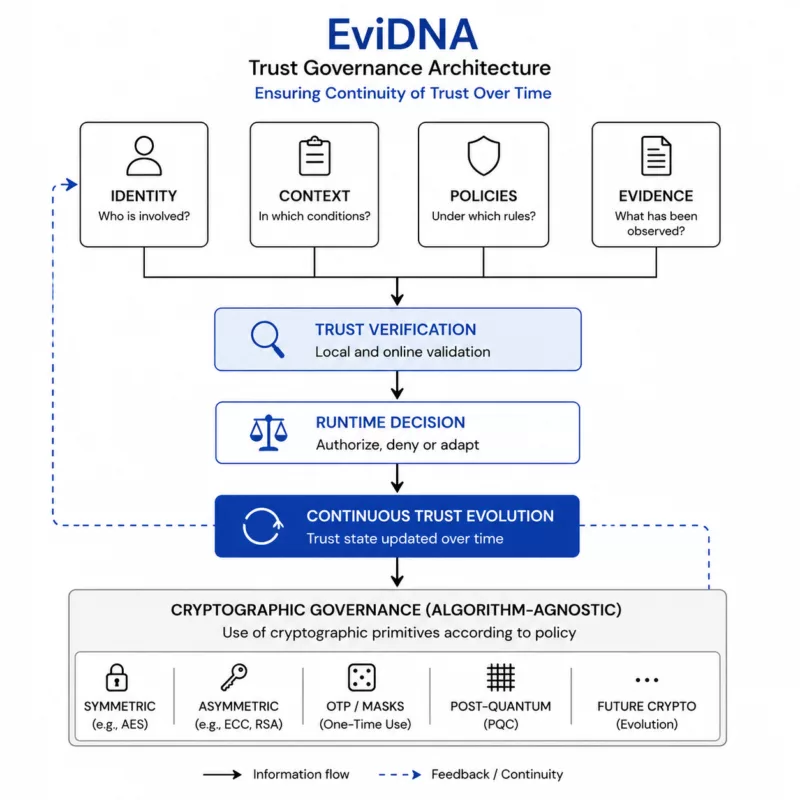
EviDNA DNA Cryptography trust governance architecture showing identity, context, policies, evidence, trust verification, runtime decision, continuous trust evolution and algorithm-agnostic cryptographic governance.

Publish status

This thesis on EviDNA cryptography DNA is a position and reference document Freemindtronic and an original work protected by copyright (© 2026 Jacques Gascuel / Freemindtronic®). It does not constitute a peer review, third-party audit, or product certification. It is a non-enabling publication (register A): it does not disclose unpublished procedural means or enabling reproduction records.

Editorial note. This quick summary presents the objectives, the industrial trajectory (Eurosatory 2022 project → 2024 Defense → 2026 CryptPeer) and the scope of the thesis EviDNA DNA cryptography. It precedes the detailed executive summary and is part of Freemindtronic Andorra’s editorial transparency approach. It distinguishes between state-of-the-art knowledge, observable evidence of industrialization and mechanisms relating to unpublished intellectual property. This content is written in accordance with Freemindtronic Andorra AI Transparency Statement — FM-AI-2025-11-SMD5.

EviDNA DNA cryptography — executive summary

This complementary thesis documents the Freemindtronic trajectory in the cryptographic universe mobilizing the expression “DNA” in the procedural and architectural sense — non-molecular by default: EviDNA (human profile, 2024), ADN Digital, cryptographic genome and industrialization CryptPeer/EviSKMS (2026).

It establishes documentary comparisons with the state of the art: classic digital trust mechanisms (FIDO, PKI, Zero Trust, HSM/TPM), academic genomic data encryption (PROMISE, Varlock), and institutional approach CNRS 2026 (synthetic DNA, OTP/Vernam). He does not claim any authorship on the third-party works; It specifies distinct technical objects. Canonical definition EviDNA: §1.11.

The publication respects the registers A (public), B (confidential) and C (IP): two international patents granted are publicly cited (WO/2018/154258 — segmented key; WO/2017/129887 — access control); no records enabling the reproduction of EviDNA, genome, Gen2 or advanced runtime mechanisms (C registry).

Controlled publication (register A). This limitation is not a documentary gap, but an assumed methodological constraint: the dissertation distinguishes between what can be discussed publicly and what would constitute a reproduction record. It exposes the inventive trajectory, distinct technical objects, observable evidence, and relevant comparisons — including integration into CryptPeer/EviSKMS at a high level — while preserving unpublished internal mechanisms of EviDNA, DNA Digital and the cryptographic genome. See §1.12; Roadmap: §1.15.

For the interdisciplinary framework linking predictive AI, cybersecurity, and cyber-physical trust, see EviSKMS reference memory.

Key Points — EviDNA Cryptography DNA

  • Trajectoire salon : Eurosatory 2022 (projet EviDNA) → 2024 Defense NFC HSM → 2026 CryptPeer/EviSKMS industrialisé.
  • EviDNA canonical definition: §1.11 · Chronology: Appendix A.
  • CNRS 2026 comparisons, academic genomic encryption, iDASH/Beacon, classical digital trust.
  • Publication controlled non-enabling: §1.12 · roadmap§1.15.
  • Add-on predictive intelligence architectures — EviSKMS.

© Author’s positioning — « fourth family of entropy »

Jacques Gascuel authors an original literary-scientific framing that situates the Freemindtronic EviDNA trajectory relative to three established families of randomness sources (PRNG, TRNG, QRNG). The expression « fourth family of entropy » designates that authored positioning — not a recipe, not a technical reproduction notice. © 2026 Jacques Gascuel / Freemindtronic®. Unauthorized reproduction of this formulation or appropriation of authorship is prohibited.


☰ Navigation rapide

🔝 Back to top

Scope and controlled perimeter of this publication

This complementary thesis presents the EviDNA / Digital DNA / cryptographic genome trajectory in a controlled publication framework (register A). It documents the industrialization observable in DataShielder Defense NFC HSM (2024) and CryptPeer/EviSKMS (2026), without providing a technical reproduction notice of internal mechanisms. The form of expression of this mémoire is protected by copyright (© Jacques Gascuel / Freemindtronic).

The document distinguishes clearly between:

  • State‑of‑the‑art references (FIDO, PKI, Zero Trust, TPM/vTPM, CNRS 2026, PROMISE, Varlock, Beacon/iDASH).
  • Observable industrial evidence (product, runtime, tests, logs, time‑stamped demonstrations).
  • Patented foundations publicly citable (WO/2018/154258 segmented key; WO/2017/129887 access control).
  • Unpublished mechanisms (EviDNA internal structures, Digital DNA formats, cryptographic genome Gen2) preserved under IP constraints.

This section clarifies what the thesis covers and what it does not expose, ensuring methodological rigor and compliance with Freemindtronic Andorra’s AI Transparency Statement — FM‑AI‑2025‑11‑SMD5.

EviDNA DNA cryptography — Relation to the “predictive intelligence architectures — EviSKMS”

Document Perimeter
EviSKMS memory/predictive AI Taxonomy of predictive architectures, LAMP-C, agentic memory, causality, benchmarks, applied cyber component (§29.1–§29.13)
ADN / EviDNA Cryptographic Genome, EviDNA, Digital DNA, CryptPeer proofs, CNRS comparisons and digital trust

The two dissertations are complementary: the first sets the broad scientific framework; The second deepens the cryptographic trajectory and state-of-the-art comparisons without diluting the debate on artificial general intelligence.

1. Cryptographic genome, EviDNA and industrial trajectory

Scientific positioning and intellectual property. The cryptographic genome is presented here as a Freemindtronic trajectory articulating a first generation already industrialized in CryptPeer via EviSKMS and an extension of applied research on digital identity evolving over time. This section does not constitute an enabling technical disclosure, as it does not disclose the detailed technical mechanisms, internal structures, verification sequences, transition rules or operational formats that may fall within the scope of intellectual property protections, including pending or future patent filings. The elements presented are also part of a formalization work protected by copyright.

In the context of this thesis, the expression “cryptographic genome” does not refer to biological DNA, nor to a direct exploitation of biometric data, nor to a form of DNA computing. Nor does it refer to a new fundamental cryptographic building block intended to replace existing standards, encryption algorithms, signature mechanisms, PKIs, HSMs, TPMs or digital identity repositories.

It refers to a digital trust architecture approach aimed at organizing, over time, evidence, contexts, policies, states of trust, and local and online verification mechanisms around a continuity of trust. This does not prescribe a single encryption algorithm: it is agnostic with respect to cryptographic bricks — symmetric (including OTP / single-use masks), asymmetric, post-quantum (PQC), etc. — in accordance with the governance policy. It should be understood as a structuring, governance and verifiability, and not as a substitute for existing cryptographic standards.
A first generation of this approach is already industrialized in CryptPeer via EviSKMS. It materializes, at an operational level, a segmented, locally verifiable, policy-driven, and runtime-oriented trust. This Gen1 is a return to industrialization: it demonstrates that an identity, a session, an execution context or a trusted object can be treated not as a simple static identifier, but as a controlled, reassessable and governable trust structure.

Jalon EviDNA — three-step timeline (registry A).

Phase Period Content
1 — Socle commercial 2017 → QR chiffré + NFC sur M24LR 64K NFC (STMicroelectronics) — commercialisé sans couche ADN ; smartphone + papier + puce NFC
1b — R& D EviDNA 2022 Eurosatory — primer / presentation project EviDNA (R& D)
1c — Développement EviDNA 2022–2024 Compatibilité ST25 64K NFC ; couche ADN (EviDNA)
2 — Defense + DNA humain 2024 → Eurosatory LabDataShielder Defense NFC HSM industrialisé ; divulgation mai–juin 2024 (§1.9)
3 — DNA Digital + génome 2024–2026 Eurosatory 2026 — industrialisation CryptPeer/EviSKMS ; TPM/vTPM

Synthetic chronology (text schema, register A).

2017 ──► QR chiffré + NFC M24LR (commercial, sans couche ADN)
           │
2022 ────► Eurosatory — seed / EviDNA project (R& D)
           │
2022-24 ─► ST25 64K +EviDNA Development
           │
2024 ────► Eurosatory Lab — DataShielder Defense NFC HSM (industrialisé)
           │
2024-26 ─► Digital DNA + giscryptographique name
           │
2026 ────► Eurosatory — CryptPeer/EviSKMS industrialisé · TPM/vTPM

Defense / EviDNA detail: §1.11 · Product Proof§1.10. Digital DNA / CryptPeer 2026: §1.7.

To preserve scientific rigor, the qualification of industrialized Gen1 must remain attached to observable elements: code, frozen contracts, tests, runtime flows, implementation logs, technical documentation or product integration. Unpublished implementation details are not set out in this supplementary brief.

1.1. Non-sensitive level of evidence and Gen1</h4 industrialization perimeter> This subsection is part of the same methodological logic: it does not aim to impose recognition by personal authority, but to link an inventor’s intuition to verifiable, non-sensitive and observable elements. The weak and strong signals identified in the field serve here as raw material for a cautious scientific formalization, without enabling disclosure of internal mechanisms.

This thesis does not seek to publish the internal mechanisms of the cryptographic genome. It establishes its scientific and industrial positioning: a segmented, local, temporal and governable digital trust architecture, whose Gen1 and Gen2 are industrialized in CryptPeer via EviSKMS.

In order to avoid any enabling technical disclosure, the evidence mentioned below is formulated at a non-sensitive level. They indicate the scope of industrialization without exposing the detailed mechanisms, internal structures, operational formats, verification sequences or transition rules.

Patented, publishable parentage. The principle of segmented key and conditional reconstitution of trust can be publicly cited under the international patent WO/2018/154258 (FR3063365 B1, EP3586258, US20210136579, CN110402440, JP2020508533, KR1020190120317). This foundation covers segmentation, physical proximity, token, ephemeral volatile memory, segment governance and a variant of the invention — the scrambling module of authentication data — without allowing the disclosure of post-patent extensions not yet registered (genome, detailed EviDNA, advanced runtime).

1.1.1. Jamming module — public variant of patent (WO/2018/154258)

The granted international patent WO/2018/154258 (FR3063365 B1, EP3586258B1) describes, in addition to the segmented key, a variant of the invention relating to a scrambling module authentication data. This mechanism is freely accessible in the public description of the title: when typing on an untrusted channel (keyboard, interface, clipboard), additional characters are inserted at predetermined positions known to the legitimate user, who removes them before transmission. The documented objective is to reduce the exposure of the real secret in the face of a keylogger or any direct observation of the input surface.

Cryptographic positioning (ledger A). This module is not an OTP/Vernam schema: it protects the transient representation of the secret at the time of input, not the content of an encrypted message.

Limits and C.</strong registry> Any auto-extension, runtime generalization, or correlation with EviDNA, cryptographic genome, or EviSKMS falls under the C registry as long as no additional repositories are secured. This paragraph is limited to the variant of the issued title.

Classification legend: A = possible audience in the memory · B = confidential (private file, audit under NDA) · C = reserved IP (before filing or validation by patent advisors).

Observed Element Status Type de preuve Non-sensitive functional description Maturité Classification Synthesis
Brevet clé segmentée documented · Issued brevet · documentation International FR3063365 / WO2018154258 Family: Peering Key Segmentation, Physical Proximity, Conditional Status, Token, and Protected Credentials Industrialized (granted title) A “The architecture is based on the international patent Segmented Key Authentication System, extended in EviSKMS.”
Module de brouillage documented · issued (patent variant) brevet · documentation Variant WO2018154258: Insertion of decoy characters at predetermined positions during input; Documented patented variant (without automatic extension) (§1.1.1) Documented (public patent) · architectural extension A (patented principle) / C (procedural shunting) “The patent describes an anti-keylogger jamming module; The patented variant covers manual jamming on input.
CryptPeer implemented · Tested · Integrated product code · Test · Documentation · deployment Sovereign collaborative platform: license, E2EE, admin, local or Internet transport, packaging and runbooks Industrialisé A “CryptPeer is an industrialized application based on EviSKMS.”
EviSKMS Runtime implemented · Tested · Documented code · Test · Product integration Trust Runtime consumed by CryptPeer: Startup enforcement, state projections, architectural freeze Industrialisé A / C (Core) “The product runs in an EviSKMS trusted runtime.”
Runtime Integrity implemented · Tested · Integrated product code · test · journal Runtime health references, append-only local anchor, fail-closed operator projection Industrialisé A / B / C “Runtime integrity is embodied in verifiable references and traceable local anchoring.” · Runtime Integrity (site)
DRT implemented · Tested · Integrated product code · Test · Contract Distributed Runtime Trust Check on Startup, Persistence Continuity, Restart Tests Industrialized (integration) A / C (gate Core) “CryptPeer has a built-in DRT check at startup with documented v1 freeze.”
RSCC implemented · Tested · Documented code · test Posture-integrated sovereign runtime configuration certificate Integrated A / C “A sovereign runtime certificate accompanies the operational posture.”
Confiance segmentée implemented · Tested · Integrated product code · Testing · brevet Optional software and hardware segmentation; Patent filiation WO2018154258 Integrated/Industrialized A (principe) / C (recomposition) “Trust is segmented between a sovereign software base and optional hardware reinforcements.”
Vérification locale implemented · tested code · test · runtime Doctors operator, log string integrity, readiness without network required Industrialisé A “Local controls validate cryptographic status before mining.”
Continuité runtime implemented · Tested · Documented code · test · journal State Persistence, Regression Detection, Sovereign Backup/Restore Integrated A / C “Runtime trust continuity is monitored across sessions.”
Politiques fail-closed implemented · Tested · Documented code · test · documentation Default deny on startup, authentication, and sensitive modes Industrialisé A “The fail-closed doctrine applies to critical surfaces.”
Anti-rejeu implemented · Tested · Integrated product code · Test · Schema License, API and passwordless protection by nonces and atomic consumption Industrialisé A / B “Anti-replay guardrails cover sensitive surfaces.”
Crypto Governance implemented · Tested · Documented documentation · code · test Gel release, profils crypto, supply-chain licence E2E, coffre de confiance Industrialisé A “Crypto governance combines release freeze and supply-chain acceptance.”
Preuves composées implemented · tested code · test Converge heterogeneous signals into a verifiable snapshot without misleading promotion Integrated A / C “Heterogeneous evidence is converged into a composite state of trust.”
Journaux / ledger / traces implemented · Tested · Integrated product code · test · journal License (DB) logs, JSONL lineage, fingerprint snapshots, passwordless audit, and RI Industrialisé A “Traceability is based on chained newspapers with distinct roles.”
Passwordless Freemindtronic implemented · Tested · gel V1.1 code · Test · Product integration Passwordless Authentication, Trusted Terminal, Local Sovereign Mode Industrialisé A / C “A sovereign passwordless mode is qualified and frozen for documented local execution.”
DDNA Gen1 implemented · Tested · Integrated product code · test Category-normalized footprints, with no raw data in transit Integrated A (categories) / C “The Gen1 base materializes identity proofs by standardized fingerprints.”
Trust Identity implemented · Tested · Integrated product code · test Verifiable Cryptographic Identity Integrated into the Product Integrated A / C “Each actor has a verifiable identity of trust.”
Tests sécurité tested · Documented test · documentation Automated Security Test Campaign (Unpublished Volume) Industrialisé A “An automated security testing campaign covers trust mechanisms.”
Sovereign Deployment implemented · Documented configuration · documentation Docker souverain, agent TPM isolé optionnel, transport sovereign-local, runbooks FQC Integrated/Industrialized A “Deployment artifacts accompany controlled release.”
SVTM implemented · Tested · frozen test · documentation Runtime official sovereign software by default; Optional Hardware Industrialisé A “The sovereign software runtime is the default operational foundation.”
Transport sovereign-local implemented · Tested · frozen V1 code · test · runtime TLS local, gateway HTTPS/WSS, PKI locale, services runtime locaux Industrialisé A / B “A sovereign local execution mode provides TLS and runtime services without required internet.”
Advanced Truth Assessment Module implemented · tested code · test Conjunctival evaluation of high criteria; Safeguards against unsubstantiated insurance claims Integrated A / C “A high-level truth module arbitrates maximum assurance claims.”
Gen2 / genome avancé implemented · Integrated product code · test · documentation Gen2 Genomic Extensions in CryptPeer/EviSKMS; detailed mechanisms in register C Industrialisé A / C Gen2 Genome Extensions Operational in CryptPeer

This matrix does not purport to be a complete technical publication. It establishes a level of maturity that can be read by the scientific reader: the Gen1 and the Gen2 are industrialized in CryptPeer, anchored on an international patent issued for segmentation; the detailed mechanisms of Gen2 fall under the C register.

Full scientific recognition of this approach will require additional publications, intellectual property filings when necessary, as well as comparative evaluations documenting its contributions to traditional authentication, passwordless, PKI, access control and runtime trust mechanisms.

1.2. Towards controlled scientific recognition: evidence, comparisons and publication after PI</h4 securitization> The full scientific recognition of this approach presupposes a complementary step, carried out after securing intellectual property when necessary. This stage will have to articulate three levels: non-sensitive evidence of industrialization, structured comparisons with the state of the art and controlled publication. A first appendix of non-sensitive evidence, resulting from a local analysis of the EviSKMS-CryptPeer repository, now makes it possible to document this first level without exposing the internal mechanisms protected.

Non-sensitive evidence will be able to document the existence of operational implementation without disclosing the protected internal mechanisms. They may include product scope, functional architecture, maturity levels, usage scenarios, general flows, test categories, trust policies, execution logs, and validation criteria.

Comparisons will have to situate the Freemindtronic approach in relation to the existing mechanisms of authentication, passwordless, PKI, HSM, TPM, Zero Trust, WebAuthn/FIDO externally, machine identity, IoT and runtime trust. The objective will not be to replace them with affirmation, but to show where the genomics approach to digital trust brings a different layer: segmentation, local verification, temporal continuity, contextual governance and reassessment of the level of trust. A first comparative document matrix is proposed in §1.4.

The controlled publication can then take the form of a position paper, a scientific white paper, an evaluation report or a documented demonstrator. It should remain non-enabling until intellectual property protections are finalized, while providing sufficient elements to allow scientific discussion: problem addressed, hypotheses, scope, comparison, limitations, use cases and evaluation protocol.

Publication doctrine (register A). This thesis deliberately adopts a controlled publication logic: it documents scientific subject-matter, prior art, state-of-the-art comparisons and evidence of industrialization observable, without disclosing the internal mechanisms that may be the subject of complementary patent filings. This applies in particular to the advanced implementation in CryptPeer/EviSKMS, where only functional effects, architecture principles, and non-sensitive elements are exposed. The rules of derivation, transition, genomic correlation, internal formats and operating parameters remain in the B or C register. Detail: §1.12.

This trajectory makes it possible to clearly distinguish three registers: what is already industrialized, what can be made public without risk to intellectual property, and what must remain reserved for deposits, confidential annexes or evaluations under confidentiality agreements. It thus avoids two opposing pitfalls: an unproven assertion of innovation, or a premature disclosure of protected technical mechanisms.

The Gen2 is implemented in CryptPeer via EviSKMS. It extends the Gen1 trajectory towards an evolving, contextual, memory and verifiable digital identity over time. The detailed technical mechanisms fall under the C registry and are not disclosed in this supplementary submission.

The emergence of predictive artificial intelligence makes this development particularly important. Attacks are no longer just about isolated passwords or certificates. They can target identity continuities: progressive spoofing, deepfakes, session compromise, hijacking of AI agents, cloning of connected objects, context alteration, memory poisoning or behavioral manipulation.

Faced with these risks, one-time authentication becomes insufficient. A future identity architecture will need to verify not only what an entity knows, owns, or is, but also the context in which it operates, the consistency of its interactions, the governance of its rights, the continuity of its evidence, and the reassessment of its level of trust over time.

The cryptographic genome thus constitutes a two-stage trajectory: a Gen1 and a Gen2 industrialized in CryptPeer via EviSKMS. Gen1 embodies segmented, local and runtime-governed trust; Gen2 extends this approach to an evolving and contextual identity. Gen2 technical details are protected when they are likely to fall under additional intellectual property protections.

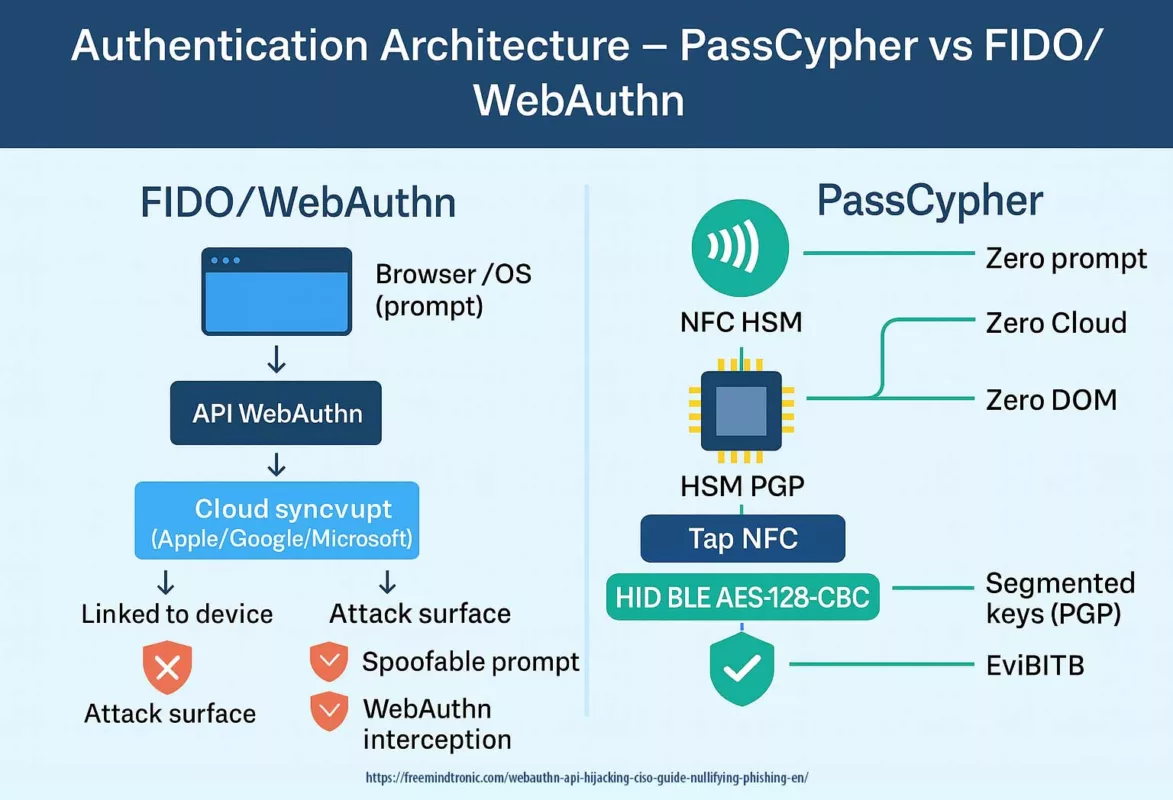
This approach should be thought of as distinct from the FIDO/Passkeys mechanisms, which Freemindtronic does not use as a foundation of trust. It can be situated in relation to existing repositories—NIST SP 800-63-4, Zero Trust, ETSI EN 303 645, Cyber Resilience Act, and, for external comparison, WebAuthn/FIDO—but not limited to or dependent on it.

Freemindtronic is also developing its own passwordless approach, based on EviSKMS and the Gen2 evolution. In order to preserve current or future intellectual property protections, this brief does not disclose the detailed technical mechanisms.

The public positioning can nevertheless be formulated as follows: this digital trusted genomic technology aims for a segmented, local, temporal and verifiable approach to identity and authentication. It is intended to apply to many contexts where it becomes necessary to establish, maintain or reassess a trusted identity: humans, connected objects, software agents, digital services, cyber-physical environments, critical access, secure exchanges and runtime continuity.

Its interest lies in the fact that it no longer considers identity as a simple one-off authentication event, but as a continuity of trust that is evolving, governable and verifiable over time. This orientation becomes especially important in contexts where traditional passwordless mechanisms and traditional authentication are becoming insufficient in the face of predictive AI, autonomous agents, synthetic identities, session compromises, and behavioral attacks.

This perspective is in line with the general axis of this thesis: predictive AI transforms the conditions of trust. The more systems become capable of anticipating, acting and adapting, the more identity itself must become reassessable, memorial, contextual, verifiable and governable over time.


1.3. EviSKMS-CryptPeer</h4 industrialization proof-of-the-mill summary> A synthesis of evidence of industrialization was established from a local analysis of the EviSKMS-CryptPeer repository. It does not reproduce any source code, pseudo-code, operational format, verification sequence, transition rule or repeatable mechanism. Its goal is to provide the scientific reader with proof of existence and maturity, without enabling disclosure.

This appendix confirms that CryptPeer is an integration and operational governance layer aligned with EviSKMS. It documents, at a high level, the existence of a trusted runtime, Runtime Integrity controls, DRT continuity, sovereign runtime certificate (RSCC), fail-closed policies, anti-replay guardrails, chained logs, cryptographic governance, compound proofs, frozen sovereign passwordless mode V1.1, DDNA Gen1 foundation, automated security testing campaign, and sovereign deployment artifacts.

Filiation brevete. The observable industrialization is in line with the international patent Segmented Key Authentication System (WO/2018/154258, FR3063365 B1). This title allows for the public disclosure, without weakening the residual IP, of the principles of segmented key, physical proximity, conditional reconstruction, protection of authentication data and the variant of the jamming module (§1.1.1) — the foundation on which EviSKMS and CryptPeer have been industrialized. The extensions genomic Gen2, the engine DRT complete, the convergence multi-criteria advanced, and non-patented internal mechanisms remain outside the public perimeter.

The scientific value of this synthesis does not lie in the disclosure of internal mechanisms, but in the methodological distinction between three registers:

Registre Definition Formulatable examples in the dissertation
A — Public possible Verifiable elements or already covered by a granted patent; High-level formulation without reproduction Patented segmentation, fail-closed, integrated RI/RSCC/DRT existence, Gen1 (high-level) standardized fingerprints, testing and deployment
B — Confidentiel Evidence to be kept as a private appendix, client file or audit under NDA Operational Runbooks, Red Team Scenarios, Operator Topologies, Enrollment Procedures
C — Réservé PI Elements to be protected before technical publication or supplementary filing Gen2, Fingerprint Normalization (Internal Detail), Runtime Continuity Engine (Internal), Convergence, Runtime Signature (Internal), Secondary Segment Recomposition

Disclosure perimeters (text schema).

                    ┌─────────────────────────────────────┐
                    │ C — Reserved PI │
                    │ Gen2, Continuity Engine (internal), runtime extensions (internal) │
                    │ passwordless, genome transitions │
                    │  ┌───────────────────────────────┐  │
                    │ │ B — Confidential / NDA │ │
                    │  │ runbooks, red team, code privé│  │
                    │  │ ┌─────────────────────────┐   │  │
                    │ │ │ A — Public (memory) │ │ │
                    │  │ │ brevet, fail-closed,    │   │  │
                    │ │ │ │ High-level events │ │ │
                    │  │ └─────────────────────────┘   │  │
                    │  └───────────────────────────────┘  │
                    └─────────────────────────────────────┘

EviSKMS–CryptPeer Stacking (Text Schema, A Register).

Applications / opérateur
        │
        ▼
CryptPeer — governance, integration, sovereign deployment
        │
        ▼
EviSKMS runtime ──┬── Runtime Integrity (RI) / RSCC
                  ├── DRT (continuity of trust)
                  ├── DDNA Gen1 (empreintes normalisées)
                  ├── Passwordless V1.1 (sovereign-local)
                  └── Fail-closed · Anti-Replay · chained newspapers
        │
        ▼
Hardware Anchor: TPM / vTPM (2026) — segments, policies

Directly usable public evidence (Registry A): EviSKMS–CryptPeer architecture; software-sovereign-first ecosystem gel; Runtime Integrity and RSCC as posture artifacts; built-in DRT continuity; multi-surface anti-replay; Logs with separate rolls. passwordless V1.1 qualified sovereign-local; DDNA Gen1 by standardized impressions; security test campaign; Filiation patent WO2018154258.

Do not publish: code, pseudocode, canonical payloads, check sequences, transition rules, red team fixtures, secondary segment details, advanced multi-criteria composition, Gen2.

This separation supports the credibility of the brief — and the associated industry communications — without turning the public document into a technical reproduction record. It establishes that the Gen1 of the cryptographic genome has a double anchor: an international patent granted on segmentation, and industrialization observable in CryptPeer via EviSKMS.

The exact scope of this evidence is deliberately limited: it does not constitute independent scientific validation or peer review. However, it constitutes a sufficient documentary basis for a controlled publication, a white paper, an evaluation report or a client file, after securing the patentable elements that have not yet been filed. The limits and conditions of falsifiability of the brief specify what this proof does not establish.

1.4. Structured comparison — digital trust and identity

This subsection responds to the need, formulated in §1.2, of an explicit comparison with the state of the art in terms of digital trust. It is not a quantified performance benchmark, nor a third-party audit, but a documentary positioning at a non-enabling level.

Scope compared. The following are compared, at a high level: WebAuthn / FIDO / Passkeys (external comparison — Freemindtronic does not use FIDO as a trust base), PKI / X.509, Zero Trust (NIST framework), HSM / TPM, OAuth / Federated OIDC, and EviSKMS Gen1 / CryptPeer as documented in the A</strong register> in this supplementary submission and the Appendix C.

Qualitative rating: Low · Medium · Strong · Very strong · N/A (not applicable to the perimeter).

Critère WebAuthn / FIDO PKI / X.509 Zero Trust (cadre) HSM / TPM OAuth / OIDC EviSKMS Gen1 / CryptPeer
Strong Authentication Spot Very strong Fort Medium (frame) N/A Fort Fort
Continuous Trust over time Faible Faible Moyen Faible Faible Fort
Trust Segmentation Faible Moyen Moyen Fort Faible Very strong
Conditional Trust Faible Faible Faible Moyen Faible Fort (filiation brevet WO2018154258)
Sovereign Local Verification (without cloud required) Moyen Moyen Faible Fort Faible Very strong
Verifiable Runtime Integrity Faible Faible Moyen Moyen Faible Fort
Runtime fail-closed policy Faible Faible Moyen Moyen Faible Fort
Anti-rejeu multi-surface (licence, API, auth) Faible Moyen Moyen Faible Moyen Fort
Role-Complementary Trusted Logs Faible Moyen Moyen Faible Faible Fort
Machine Identity / IoT / Agent (General Framework) Faible Moyen Moyen Moyen Moyen Moyen (Gen1/Gen2 — continuité temporelle)
Broad Ecosystem Interoperability Very strong Very strong Fort Fort Very strong Low/medium
Standardisation normative mature Very strong Very strong Fort Fort Very strong Low (proprietary, patent granted)
Documented Evidence of Public Industrialization (2026) Fort Very strong Fort Fort Very strong Means (non-sensitive annex, not to that third party)

Methodological reading. This table does not classify EviSKMS as “superior” on all axes. It shows a difference in function:

  • FIDO/OAuth/PKI excel at interoperability, standardization and large-scale one-time authentication
  • Zero Trust provides a framework for governance and policies, but is not a local sovereign trust runtime on its own.
  • HSM / TPM reinforce the material anchor, often in addition to other layers.
  • EviSKMS Gen1 aims for an layer additive: trust segmented, continuous over time, verifiable locally and governed to the runtime, as an extension of the segmented key patent — at the cost of less immediate interoperability and independent scientific validation still to be conducted.

What the comparison does not establish. It does not demonstrate the operational superiority of EviSKMS over FIDO or PKI in all contexts. It does not replace comparative numerical trials, published red team campaigns or certification. It situates the Freemindtronic positioning for a structured scientific and industrial discussion.

1.5. Cryptographic genome vs. point identity (time T)

Verification of the distinction. Recent institutional work on synthetic DNA and OTP (CNRS communication April 2026, HAL hal-05560338) describe a protocol where two correspondents have identical copies of synthetic DNA sequences, then just before a communication select and sequence fragments to produce a common binary key at time T — key distribution logic synchronized to an event, not a identity architecture evolving over time. The classic authentication mechanisms (password, certificate, WebAuthn, point biometrics) obey the same functional structure: prove “it’s me” at the moment T, then grant or deny access.

The Freemindtronic cryptographic genome is part of a different technical object: a digital trust architecture that organizes, over time, proofs, contexts, policies, runtime states, normalized fingerprints (DDNA Gen1), session continuity, fail-closed reevaluation and — in Gen2 — contextual identity, Memory and governable. This is not a marketing metaphor for molecular DNA: the expression refers to a procedural structuring of trust (segments, inheritances, dependencies, traceability), publicly formalized in this thesis and initiated by EviDNA (2024) then ADN Digital (2026).

Dimension Instant Authentication / OTP (generic, incl. Synthetic DNA OTP 2026) Génome cryptographique Freemindtronic (Gen1/Gen2)
Horizon temporel Point event: Evidence or key at time T Continuity: reassessable trust between T₀ and Tn
Protected Object Message, Session, or Immediate Access Trusted Identity, Mission, Runtime, Trajectory
Rôle de l’ADN Molecular material source of shared entropy, synchronized at time T (CNRS 2026) EviDNA (2024): human profile, trusted material (detail of B/C register); Digital DNA/genome (2024–2026)
Proof of implementation Experimental protocol / application for academic patents Sources publiques 2024 + dépôt GitHub privé DataShielderHSM (registre B) · Gen1 CryptPeer 2026

Time horizon: time T vs continuity (text diagram).

 punctual auth / CNRS OTP (time T) Cryptographic genome (continuity)
────────────────────────────────────          ────────────────────────────────────

    T₀ T₀ T₁ T₂ Tn
     │                                                │         │         │         │
 [Proof] ──► Granted or refused?       [Confidence inValuable ─────────────►]
     │                                                │
     ✕ (end of event) fail-closed · DDNA · DRT · segments

Synthèse. This precise distinction between distinct technical objects: the CNRS mobilizes synthetic DNA to a single scheme (OTP/Vernam at a given time); The Freemindtronic trajectory can also produce OTP keys, but in a broader architecture — segmented and continuous trust over time, with interchangeable mechanisms. The Freemindtronic Public Disclosures (2018–2026), the online submission (freemindtronic.com) and the patent WO/2018/154258 are elements of documented prior art on this trajectory. For the CNRS approach as publicly formulated, see §1.6.

1.6. Documentary synthesis — CNRS DNA cryptography (external reference, register A)

Status. This subsection does not claim any authorship on CNRS work. It faithfully transcribes, for documentary comparison purposes, what third-party public sources (institutional popularization video, press release of 01/04/2026, preprint HAL hal-05560338) describe the Franco-Japanese “DNA cryptography” approach. Freemindtronic welcomes this research and reminds us that the technical objects differ from EviDNA (2024) and the cryptographic genome (2026).

What the corporate video exposes (non-empowering summary).

A Franco-Japanese team (Gulliver, CNRS/ESPCI Paris — PSL laboratory: Matthieu Labousse, Yannick Rondelez; XLIM, University of Limoges: Philippe Gaborit; partner University of Tokyo) presents cryptography by DNA as a new chapter in the The history of encryption.

  1. Material. The DNA here is fully synthetic produced outside of any biological process. Four bases A, T, C, G form a “quaternary language” analogous to the binary (0/1): an ordered sequence encode information.
  2. Cryptographic property sought. Synthesis is used to generate statistically random sequences — source of entropy for cryptography.
  3. Encryption scheme. The protocol chosen is the (OTP — One-Time Pad): a random mask, as long as the message, used once; combined with the binary message to encrypt; recombined on the recipient side to decrypt. Theoretical safety is based on the randomness of the mask.
  4. Role of the molecule (explicit video wording). The synthesized DNA molecule does not contain the message: it carries the future encryption key. Two identical samples are prepared (Tokyo / France demonstration); Each matching sequence their sample just before the communication to get the same binary key.
  5. Operational chain. Sequencing (reading nanopore: differential current per base A/T/C/G) → software reading of the ATGC sequence → conversion to binary → encryption of the digital message in France → sending of the encrypted message (e.g. email) → decryption in Japan with the identical key.
  6. Applications mentioned. Critical communications: defense, diplomacy, patents, financial exchanges; so-called “unconditional” security in the sense of OTP.

CNRS Operational Chain — Molecular OTP (text diagram, public sources).

 random synthetic DNA
        │
        ▼
Duplication ──► copy France ════ Japan copy
        │
        ▼  (just before the message)
Nanopore sequencing (×2) ──► IdenticalATGC sequence
        │
        ▼
ATGC → binary → OTP mask (|mask| = |message|)
        │
        ▼
Message ⊕ Mask ──► Channel (e.g. email) ──► Encryption ⊕ samemask

Advantages and disadvantages of Vernam encryption (literature review of a classical scheme, register A). The protocol adopted by the CNRS is based on the Vernam encryption (One-Time Pad), the properties of which have been established in the cryptographic literature since the work of Claude Shannon (1949). This reminder, which is unrelated to the Freemindtronic mechanisms, sheds light on the trade-offs of the institutional scheme.

Avantages.

  • Perfect secret proved (perfect secrecy, Shannon): Under its three conditions, the cipher alone does not reveal none information about the clear message.
  • Resistance to any computing power, including a future quantum computer: security is informational, non-computational.
  • Simplicity of operation: The encryption is reduced to a bitwise XOR between message and mask.

Disadvantages (structural constraints).

  • Key as long as the message: encrypting n bytes requires n bytes of mask — hence a storage and distribution cost proportional to the volume exchanged (the press release mentions messages up to several hundred megabytes, so as much key material).
  • Strictly one-time use: Any reuse of a mask breaks the perfect secret (encryption correlation attack).
  • Distribution and synchronization of the mask: both correspondents must have a identical and secret mask before the exchange — this is the central problem that the molecular chain (DNA duplication, physical transport, sequencing “moment T”) seeks precisely to solve.
  • Perfect random required: Any statistical bias of the mask degrades the theoretical guarantee.
  • Lack of intrinsic authentication and integrity: the Vernam cipher but does not prove the origin or non-alteration of the message; it must be supplemented by separate mechanisms (MAC, signatures).

These properties explain why the OTP, although theoretically optimal, remains operationally demanding and lends itself above all to punctual critical communications — a framework claimed by CNRS sources. They also shed light on the cross-reading of §1.6.1: a cryptographically monolithic scheme (an imposed mechanism) is opposed to an agnostic layer admitting several mechanisms depending on the policy.

Vernam Principle / OTP (text schema, classical cryptography).

Émetteur                              Destinataire
────────                              ────────────
clear message (M) encrypted message (C)
random mask (K) ── channel ──► samemask (K)
     │                                      │
     ▼                                      ▼
C = M ⊕ K                            M = C ⊕ K

Conditions: |K| ≥ |M|  ;  K used only once;  K perfectly random

Three “DNA” trajectories — distinct technical objects (text diagram).

         ┌──────────────────┬──────────────────────┬─────────────────────────┐
         │ CNRS 2026 │ EviDNA 2024 │ Genome / Digital DNA │
         │ (réf. externe)   │ (Freemindtronic)     │ 2026 (Freemindtronic)   │
├────────┼──────────────────┼──────────────────────┼─────────────────────────┤
 Source │ Synthetic DNA │ Human DNA Profile │ Procedural Generator │
 Secret │ Tube + Sequencing │ NFC + Paper QR │ TPM/vTPM + runtime │
 Crypto │ Vernam/OTP only │ mechanisms according to policy* │ PQC agnostic layer* │
 Time │ Instant T │ Enrollment + session │ T₀ → Tn (continuity) │
└────────┴──────────────────┴──────────────────────┴─────────────────────────┘
         * OTPs and other mechanisms according to policy — not imposed as a single scheme

What the CNRS press release (01/04/2026) adds. Preparation of duplicated DNA sets of synthetic origin; just before communication key generation by sequencing; Messages up to several hundred megabytes demonstration during the presidential trip to Japan; HAL title: Synchronized DNA sources for unconditionally secure cryptography (Jaudou, Gasnier, Boudjella, et al.).

Dimension CNRS 2026 (video + HAL, external ref) EviDNA Freemindtronic (2024, registre A) Génome / ADN Digital Freemindtronic (2026)
Nature de l’ADN synthetic, random, no biological connection with living DNA Human DNA profile imported (structured file) Generalized DNA Digital procedure; Gen1/Gen2</td governance>
Finalité cryptographique Distribution of symmetrical OTP/Vernam masks (unique) Trusted material derived from a DNA</strong profile> (detail B/C register); Standard Mechanisms according to Policy Segmented trust runtime, continuity, DDNA, fail-closed; OTP and other mechanisms according to governance
Moment d’usage Sequencing and key at time T, before a message Shunt to enrollment; Sharing on demand; Encrypted session Re-evaluation of trust between T₀ and Tn
Support du secret Duplicated physical molecule (tube, transport) M24LR 64K (2017) · ST25 64K (2022–2024) — chiffré STMicroelectronics</td token> TPM / vTPM (2026) — segments, policies, fingerprints (CryptPeer)
Remote Sharing Physical transport of a DNA</td sample> encrypted QR: Paper, email, display — key on NFC only EviSKMS Distributed Governance (CryptPeer)
Support papier No (tube molecule) A4 printing: 16 QR × 2,331 car. Unicode; zero trace of the secret on paper Beyond Paper (Runtime, Continuity)
Message dans l’ADN ? No (key only — video) No (key → profile, not the plaintext) No (procedural metaphor, not molecular storage)
Random generation modality Statistically random molecular DNA synthesis; enzyme duplication; nanopore sequencing at time T; ATGC → binary</td conversion> Derivation from an imported human DNA profile (enrollment) Procedural generator governed by the cryptographic genome (structural inspiration of living things: segments, continuity) — without molecular synthesis
Operational Complexity (Registry A) High: laboratory, sequencing machines, physical transport of samples, biological constraints (noise, bias, interception detection — third-party sources); France-Japan proof of concept Moderate: smartphone + NFC + QR; Three documented actions Weak carrier-side post-configuration (import certificates initial, then transparent — §1.7)
Architectural complexity Moderate at the cryptographic level (OTP/Vernam, single schema); Complexity driven by the molecular chain Product Layer + PKI + RSA/QR</td Share> High: segmented trust, runtime, time continuity, fail-closed; interchangeable cryptographic bricks
fundamental cryptographic brick Vernam/OTP exclusively (CNRS protocol constraint) AES-256 CBC, RSA 4096, ECC, OTP (exemples documentés) Layer agnostic: OTP and any encryption or signature algorithms that are acceptable under the policy — including PQC
Freemindtronic public ance Post-EviDNA 2024 May–June 2024 (web + videos §1.9) July 2026 (memory, Digital DNA)

Read-across (register A, without legal advice). The CNRS video confirms that the 2026 institutional approach is focused on molecular OTP: random synthetic DNA → Vernam mask → physical synchronization of two copies → point sequencing. EviDNA (2024) previously documented another invention: DataShielder Defense NFC HSM product using a human DNA profile (technical detail B/C register). The cryptographic genome and the ADN Digital (2024–2026) extend a third trajectory: time-trusted architecture, beyond the distribution of keys at a given time. The three axes share the word “DNA” but do not cover the same technical object. For the analysis of the generation of randomness and operational complexity respectively, see §1.6.1.

1.6.1. Random Generation and Operational Complexity — Comparative Reading (A-Register)

Purpose of this subsection. Check, using public sources only, whether the two trajectories use comparable of random generation and similar levels of operational complexity. This analysis does not constitute a value judgment on the scientific quality of CNRS work; It specifies distinct technical dimensions useful for cross-reading the dissertation.

What CNRS sources document (April 2026). The Franco-Japanese approach aims to solve a classic constraint of the OTP/Vernam: to produce and synchronize, between distant correspondents, a key perfectly random, as long as the message and single-use. To do this, researchers are mobilizing a molecular and instrumental chain:

  1. Synthesis of entirely artificial DNA, whose order of bases A/T/C/G is statistically random;
  2. Enzymatic duplication in strictly identical copies, kept at the sender’s and recipient’s premises;
  3. Physical transport or pre-distribution of such samples;
  4. Nanopore just before communication, on both sides, to read the same sequence;
  5. Conversion ATGC → binary key → Vernam encryption of the digital message.

Two axes of complexity — non-interchangeable (text schema).

CNRS 2026                              Freemindtronic (ADN Digital / génome)
─────────                              ─────────────────────────────────────

OPERATIONAL COMPLEXITY OPERATIONAL COMPLEXITY
        ▲  ISLEVISE                              ▼  FAIBLE (post-config)
        │ lab · Sequencing │ Smartphone · TPM · runtime
        │ Physical transport │
        │                                      │
CRYPTO Complexity CRYPTO Complexity
        ▼ LOW (OTP only) ▲ HIGH(agnostic layer)
        │ Imposed Vernam │ Multiple mechanisms · continuity

Third-party sources (CNRS press release, IMT Atlantique, press popularization) also highlight biological and instrumental locks: sequencing noise, statistical bias in database pairing, the need to detect an interception of DNA material, sequencing machines and molecular biology protocols. At this stage, it is a proof of concept in a controlled environment, whose processing times are not intended for general public use on mobile devices.

What the Freemindtronic trajectory documents (Digital DNA/genome, registry A). The DNA Digital and the cryptographic genome do not use /strong<> molecular synthesis or biological sequencing. The expression “DNA” here refers to a procedural metaphor: an organization of trust inspired by the structural principles of the living genome (segmentation, inheritance, continuity, reevaluation over time) — without exploitation of biological DNA or DNA computing (see EviSKMS memory §29.6 on the authentication of living beings).

In this trajectory, the generation of random or pseudo-random material for the trusted identity is done by a procedural generator integrated with the cryptographic genome and governed by the EviSKMS/CryptPeer runtime. The internal mechanisms of derivation, genomic transition and digital DNA correlation → segments fall under the C register; in the A register, only the operating result is documented: after the initial import of the certificates, the usage becomes transparent for the operator (§1.7).

Comparative synthesis — two axes of complexity, not interchangeable.

Axis CNRS 2026 (public sources) ADN Digital / génome Freemindtronic (registre A)
Source of randomness Synthetic molecule (ATGC) read by sequencing Software procedure governed by cryptographic genome
Inspiration du vivant No link to human biological DNA; Random molecular Genome structural inspiration (segments, continuity) — not sequencing
Operational Complexity High: lab, duplication, T-sequencing, biophysical constraints Low user-side post-configuration (smartphone/TPM, no lab)
Architectural complexity Moderate cryptographic (classic OTP); Heavy weight carried by the physique High software (continuous trust, runtime, segments, fail-closed)
Finalité Symmetric OTP key at point T to encrypt a message (unique scheme) Segmented and continuous trust over time; multiple mechanisms including OTP if required by policy
fundamental cryptographic brick Vernam/OTP seul (schéma imposé) Polymorphic: OTP, AES, RSA, ECC, PQC, etc. — the genome structures trust and key governance, not limited to a single schema

Documentary conclusion (register A). The CNRS approach is operationally more demanding (molecular infrastructure) and cryptographically monolithic: the public protocol retains only Vernam/OTP. Freemindtronic’s DNA Digital / genome trajectory is based on a software architecture that can be industrialized, capable of producing OTP</strong keys> when the policy requires it, without limitation — and mobilizing other cryptographic bricks according to the governance policy, in a logic of continuous trust beyond the mere distribution of masks at a given time. For a mapping of the other global “DNA + security” families, see §1.6.2.

1.6.2. International mapping — “DNA + security” families and Freemindtronic distinction (Registry A)

Status. This subsection does not claim authorship on the third-party works cited. It synthesizes, from public sources (journals, preprints, research programs), a documentary taxonomy useful for locating the Freemindtronic trajectory (EviDNA, ADN Digital, cryptographic genome, CryptPeer/EviSKMS) in the face of all the global research mobilizing the “DNA” and “security” couple — including cyber, storage and molecular cryptography.

Observation Two recent syntheses (IEEE Access, 2023; iComputing, 2024) converge: the field is fragmented, poorly standardized, and often mixes — in the literature — real molecular approaches, software simulations inspired by DNA, and structural metaphors. The word “DNA” thus covers several non-interchangeable technical objects — which this thesis formalizes to avoid any confusion of authorship or reproducibility.

Seven documentary families (text schema, register A).

F1 Molecular OTP / Synchronized Entropy CNRS 2026 · ANR DNA Sec (in progress)
F2 Origami / Structural Nano Cryptography Zhang 2019 · 3D extensions (lab)
F3 Molecular Steganography Clelland 1999 · NAPDISS 2024 (Cover-Up)
F4 Pseudo-DNA software many articles · especially simulation
F5 DNA Storage + Hybrid Encryption Noise Channels · Massive archiving
F6 DNA Database Security DNA Sec Program (Theft · Tampering)
F7 Freemindtronic Procedural Genomic Cryptography 2018–2026 (≠ molecule)
Family Documented Representatives Statut public Objet technique principal Direct relationship with Freemindtronic
F1 — OTP moléculaire HAL hal-05560338 ; program ANR DNA Sec ; IMT Atlantic France-Japan Demo 2026; ongoing</td program> Duplicated synthetic DNA-synchronized Vernam mask + T</td sequencing> Distinct object: Freemindtronic can produce OTP by political, without a molecular chain (§1.6.1)
F2 — Origami crypto Zhang et al., Nature Communications 2019 ; extension 3D (2025) Proofs of concept laboratory Strand bending wrench; Combinatorial space of nano</TD structures> Distinct: No continuous runtime trust; No documented product industrialization
F3 — Stéganographie Clelland et al. (1999, history); NAPDISS nanopore (2024) Specialized demos Hide a message in or through DNA; Key sometimes = light or structure Distinct: Freemindtronic does not claim the molecular concealment of plaintext
F4 — Pseudo-ADN Littérature « DNA-inspired » (cf. surveys 2023–2024) Especially simulation computer science Biomimetic operations on simulated chains + classic crypto Distinct: The Freemindtronic genome is a trusted architecture, not a simulation of tube</td reactions>
F5 — Stockage cipher DNA storage channel work; Molecular archiving industry Active Search; Few crypto</TD standards> Encryption to survive the noise of the biological storage channel Indirect complementary: Archiving problem ≠ trusted identity over time
F6 — Sécurité bases ADN Objectifs ANR DNA Sec (MoleculArXiv / France 2030) En cours Protect molecular bases against theft, copying, forgery Distinct: Freemindtronic does not use a physical DNA database as a foundation
F7 — Procédural</td genome> Freemindtronic : brevet WO/2018/154258 ; EviDNA 2024 (sous-jalon profil humain) ; ADN Digital / génome 2026 Industrialized (CryptPeer); Post-2018 inventions on deposit forthcoming Trust segmented and continuous; governed procedural generator; agnostic</TD mechanisms> Proper line: see §1.11

Read-across matrix — dimensions that distinguish F7 (Freemindtronic).

Dimension F1–F6 (third-party state of the art, synthesis) F7 — Génome / ADN Digital Freemindtronic
Support matériel Molecule, nano-structure, or purely simulated software Software Runtime + TPM/vTPM anchor (historical NFC option) — no sequencing
Horizon temporel Instant T (key, concealment) or static archiving T₀ → Tₙ : réévaluation, fail-closed, continuité
Mécanisme crypto Often unique (OTP, structure, concealment) or fixed hybrid Polymorphic: OTP, symmetric, asymmetric, PQC — according to policy
Documented public implementation Articles, academic demos, programs Patent segmented key issued + non-sensitive product proofs (§1.3, §1.10)
Industrialisation grand public Limited (lab, heavy infrastructure except F4 software) CryptPeer/EviSKMS: initial friction certificates then transparent use (§1.7)
Cyber / IA prédictive Not explicitly addressed in the molecular DNA literature Reassessable Identity, Agents, Session Compromise — EviSKMS</td Memory Articulation>

Indirect valuation (Ledger A, no legal opinion).

  • Functional coverage. The F1–F3 families cover perfect secret distribution, structural nano and concealment, respectively. None of them publicly documents, to date, an industrialized continuous trust architecture on a terminal — the object of F7.
  • OTP without exclusivity. F1 demonstrates the institutional interest of molecular OTP; F7 can use the OTP as a mechanism among others, without depending on a laboratory or imposing Vernam as a unique scheme (§1.5).
  • Anteriority. The public disclosure EviDNA (May–June 2024) precedes the CNRS communication April 2026 on a different object (human profile vs. synthetic pool) — see §1.9.
  • CNRS program still open. The ANR DNA Sec is also aiming at securing DNA storage databases and a nascent “molecular cryptography”: F7 responds to another problem — governing digital trust over time on sovereign software infrastructure.
  • No copying, no technical convergence. No third-party public source describes the combination procedural genome + industrialized segmented key + runtime continuity + OTP/PQC</strong agnostic layer> as documented at Freemindtronic.

Authorized public implementation — patented parentage (register A). The granted patents WO/2018/154258 (segmentation) and WO/2017/129887 (local access control) allow for an strongenabling description. The CryptPeer/EviSKMS industrialization is based on this observable foundation (runtime, integrity, PKI, TPM) without exposing the mechanisms of the cryptographic genomic generator nor the inventions discovered since the formalization of the genomic cryptography system.

Segmented key post-patent inventions — register C. The following extensions are mentioned as positioning but undisclosed as long as no follow-up filing is secured: correlation DNA Digital → genomic segments; genomic transition rules; procedural derivation of trusted material; extensions Gen2 Advanced runtime couplings discovered as industrialization progresses. This thesis documents their operational effects (continuous trust, fail-closed, OTP possible by policy) — not the parameters, formats, sequences or internal algorithms allowing reproduction.

Anti-Reproduction Doctrine (Register A — editorial intent). This document is written for scientific discussion and state-of-the-art comparison, not as a reverse-engineering notice. Are deliberately absent or aggregated at a non-reconstructive level: derivation graphs, constants, transition sequences, correlation schemes between layers, and any detail equivalent to a parametric recipe of the genome generator. This omission also applies to automated processing (extraction by language models or reverse engineering pipelines): the public text must not provide, by completion or recombination, a sufficient specification to reconstruct inventions classified C. The detailed audit evidence remains in the B register (audit under NDA) or in future filing files.

Documentary conclusion (register A). The F1–F7 mapping shows that Freemindtronic occupies a family of its own (F7): cryptography genomics procedural and trust continues, industrialized, polymorphic on cryptographic mechanisms — distinct from the CNRS molecular OTP (F1), origami (F2), steganography (F3) and software pseudo-DNA (F4). The reinforce</strong comparisons> the distinction without attributing authorship to third-party works; the valuation of Freemindtronic’s trajectory is based on the public anteriority, the industrialization and the two patented titles issued to date for the documented enabling implementation (access control; segmented key).

1.7. Digital Gen1 DNA — TPM/vTPM anchor and CryptPeer user experience (2026, Registry A)

Relevance to Digital DNA and the cryptographic genome. This subsection complete the 2024–2026 trajectory: it describes how the procedural logic ADN Digital / genome Gen1 materializes in CryptPeer/EviSKMS on the operator experience side — without disclosing the mechanisms genomic shunt or transition (B/C registry).

Hardware anchor evolution (2026). In 2026, the industrialized Gen1 in CryptPeer no longer requires dedicated NFC support (M24LR / ST25): the trusted anchor is based on TPM hardware or vTPM, in continuity with the doctrine software-sovereign-first and the elements already documented in Appendix C (optional TPM agent, EviSKMS runtime) — see also EviSKMS Sovereign Runtime Anchors and EviSKMS Core Runtime (Freemindtronic publications, Registry A). The public interview Eurosatory TV (5 Jul 2026) describes, at the product level, the automatic detection of TPM and the deposition of a non-extractable genomic fingerprint in the chip — popularized formulation correlated with the A</strong registry>; the details of the fingerprint formats are the responsibility of the register C (§1.9.1). The trajectory 2017–2024 (NFC chip) and 2026 (TPM/vTPM) illustrates a generalization: from point-in-time hardware evidence to a time-governed runtime trust.

CryptPeer User Experience (Registry A, Product Level).

Étape Documented Behavior User Friction
Mise en route terminal Import initial of trusted certificates/hardware into the trusted terminal (PKI Runtime) Only sticking point explicitly identified at this point
Exploitation locale (100 % sovereign-local) Communication E2EE, passwordless, runtime EviSKMS — usage transparent après mise en route Low (post-configuration)
Exploitation distante TLS via Let’s Encrypt certificates (or public equivalent) for deployments that are not 100% on-premises Weak; blind server pattern: The server does not read the content of the exchanges

After the initial import of the certificates on the terminal, CryptPeer allows transparent use in 100% local mode; in remote mode, transport relies on Let’s Encrypt in a server blind model where the content remains end-to-end encrypted.

CryptPeer Modes of Exploitation (Text Schema, A Register).

                    ┌── Import initial certificats (friction unique)
                    ▼
              Approved Terminal
                    │
        ┌───────────┴───────────┐
        ▼                       ▼
  100 % sovereign-local    Mode distant
  E2EE · passwordless      TLS Let's Encrypt
  Transparent Blind Server Runtime (E2EE)
        │                       │
        └───────────┬───────────┘
                    ▼
        Confiance continue Gen1 (TPM/vTPM · DDNA · RI)

Limits (Registry A). Correlation details DNA Digital → genomic segments → TPM/vTPM anchor, internal formats, and transition rules fall under the C registry. This paragraph does not constitute a reproduction notice. For the published infrastructure layer (doctrine, PKI, anchors, runtime integrity), see §1.8.

1.8. EviSKMS Technology Publications (Freemindtronic.com, Register A)

Freemindtronic has published on its website four technology pages which complete this thesis on the trajectory DNA Digital / Gen1 genome / CryptPeer — without replacing the evidence appendix or disclosing any enabling mechanism (C registry). They articulate the sovereign doctrine, the PKI evidence-bound, the anchor runtime (TPM) and the integrity runtime — pillars of industrialization 2026.

Publication URL Role in the Digital DNA/genome</th trajectory>
EviSKMS Core Runtime — Sovereign Trust Doctrine & Infrastructure freemindtronic.com/technology/eviskms-core-runtime-sovereign-trust-doctrine-infrastructure/ Doctrinal foundation: segmented trust, fail-closed, offline-first, sovereign orchestration — the foundation of the Gen1 cryptographic <>genome in CryptPeer
EviSKMS PKI Runtime — Sovereign Evidence-Bound PKI freemindtronic.com/eviskms-pki-runtime-sovereign-evidence-bound-public-key-infrastructure/ Segmented certificates governance, detached verification, PKI offline-capable — sheds light on the initial friction (import certificates) and then CryptPeer transparency (§1.7)
EviSKMS Sovereign Runtime Anchors freemindtronic.com/eviskms-sovereign-runtime-anchors/ Anchor TPM-assisted, forensic continuity, out of centralized dependency hardware extension 2026 (TPM/vTPM)
EviSKMS Sovereign Runtime Integrity freemindtronic.com/eviskms-sovereign-runtime-integrity/ Integrity runtime, forensic lineage, governance fail-closed — aligned Runtime Integrity and §1.3

Read-across memory ↔ site. The dissertation formalizes the scientific framework and the trajectory DNA / genome; Freemindtronic pages detail the industrialized sovereign trust infrastructure. Together, they document the continuity DataShielder (NFC, 2017–2024)CryptPeer/EviSKMS (TPM, genome, 2024–2026).

1.9. Public Sources of Disclosure and Anticipation

This section lists time-stamped public disclosures prior art of Freemindtronic inventions — cryptographic genome, ADN Digital, EviDNA, segmented trust — without duplication of enabling mechanisms (A registry only). The common thread is the inventive trajectory (2018 patent → CryptPeer implementations → industrialization); The videos and web publications below are the correlated public proofs. Defense fairs (Eurosatory, etc.) are cited as contexts of disclosure, not as the main subject of the dissertation.

Date Jalon Contenu public formulable Sources
2017 Socle QR chiffré + NFCcommercialisé sans ADN Puce M24LR 64K NFC (STMicroelectronics) ; impression papier, scan smartphone, clé sur support NFC Registers B · §1.10
2016–2020 Patent access control (local wireless) Protected Device/Memory/Device <strong<>/strong> access; Local wireless link (NFC in implementation mode); combined factors; Path closed by default WO/2017/129887 · FR3047099 B1 · bib.
2018–2019 Segmented Key International Patent Key Segmentation, Conditional Reconstruction, Physical Proximity, Token, Protected Credentials WO/2018/154258 · FR3063365 B1 · bib.
2022 Eurosatory — primer EviDNA (R& D, project presentation) DNA Reflection + Cryptography; The trajectory starts with EviDNA Trade Show Presentation — Freemindtronic SL</td Chain>
2022–2024 Développement EviDNA + compatibilité ST25 64K Added ST25 64K NFC (STMicroelectronics) in addition to M24LR; EviDNA layer (human DNA profile); Internal validation 02/02/2024 Dépôt GitHub privé Freemindtronic/DataShielderHSM (registre B) · §1.10
14 May 2024 Eurosatory Lab — publication DataShielder Defence Defense industrialized with DNA</td innovation> Annonce Freemindtronic
25 June 2024 Divulgation publique EviDNA Human DNA Demonstration; DataShielder Defense NFC HSM Vidéo 1 · Video 2
2024–2026 ADN Digital + génome cryptographique Procedural generalization; TPM/vTPM anchoring (without NFC required); CryptPeer transparent post-certificates §1.7 · §1.8 · Videos Jul 2026
5 Juil. 2026 DNA Digital and CryptPeer genomics Genome Generator; authentication over time; CryptPeer/EviSKMS Video 1 — Eurosatory TV · synthesis §1.9.1 · Video 2
1er avr. 2026 Communication CNRS — Cryptography on DNA (external reference) DNA synthetic random; OTP/Vernam; Two physical sequenced copies just before the message. molecule = key, not the plaintext — distinct approach of EviDNA 2024 HAL hal-05560338 · CNRS press release 01/04/2026 · §1.6
juil. 2026 Mémoire et annexe d’industrialisation Scientific Formalization; EviSKMS-CryptPeer Evidence Matrix; Public/Confidential/IP</TD Classification> This document · §1.3
2026 (Eurosatory) ADN Digital / génome — industrialisation CryptPeer Presentation of the show; Gen1/Gen2 genome in CryptPeer/EviSKMS; TPM/vTPM §1.7 · Videos Jul 2026
juil. 2026 Thesis published online Public Reference Predictive Intelligence Architectures / EviSKMS freemindtronic.com — mémoire
2026 Publications technologiques EviSKMS (site Freemindtronic) Doctrine Core Runtime ; PKI evidence-bound ; Runtime Anchors (TPM) ; Runtime Integrity Core Runtime · PKI Runtime · Runtime Anchors · Runtime Integrity · §1.8
1.9.1. Interview Eurosatory TV — cryptographic genome (5 July 2026, register A)

Source and rights. Public interview broadcast on the YouTube channel Eurosatory: https://www.youtube.com/watch?v=amwVAGp9LHw — Jacques Gascuel (Freemindtronic SL) and David Amsellem (AMG PRO, distribution). English subtitles (SBV lounge). This synthesis cite and structure public statements; it does not constitute not an enabling record beyond the A register. It sets out the documentary correlation between the oral disclosure at the fair and the present thesis (copyright on the inventor’s formulation; work of formalization protected).

Objet. Verify, after public broadcast, that the interview remains aligned with the formalized trajectory of the dissertation — segmentation, trust over time, ADN Digital, CryptPeer — and specify what is not disclosed (internal mapping, generator parameters, detailed DDNA formats: registry C).

Chronological synthesis (public statements).

Period Formulation interview Memory Reference
2022 DNA Reflection Primer + Cryptography §1.9 · Eurosatory project
2024 Demonstration with his own DNA EviDNA§1.11
2026 Pathway genome; → AUTH, signature, encryption</TD generator> §1.7 · F7</td family>

Technical topics — read-across register A.

Public Theme (interview) Memory Read Registre
Beyond “it’s you”: validity over time, mission, criteria Confiance continue T₀ → Tₙ ; fail-closed A
Imprint genomics; segmentation (entity key + operator key) Clé segmentée WO/2018/154258 A / C
Modification rejected (e.g. GPS drone) Illustration fail-closed A
ADN Digital: human, animal or synthetic import Post-EviDNA</td procedural generalization> A
CryptPeer: clean genome; Digital</TD DNA generation> Industrialisation Gen1 A / C
Detection TPM; Non-Extractable Footprint §1.7 · Runtime Anchors A
eIDAS ; certificats PQC autonomes §1.8 PKI evidence-bound A
Blind server; ephemeral keys CryptPeer Doctrine — §1.7 A

Formulations to be nuanced. “Impossible to falsify”, “inviolable” or “end of cyberattacks” are part of the vulgarisation salon. The brief translates them into falsifiable terms: segmented trust, fail-closed, attack surface reduction — with no absolute guarantee. See Limits and falsifiability.

Out of scope (register C). Internal mapping, generator algorithms, detailed DDNA formats, ASC modules — §1.12.

Documentary conclusion. The interview publicly confirms the 2024 pivot → 2026 and the focus on segmentation and confidence over time — without reproduction instructions. Bibliography: Eurosatory TV 2026.

1.10. EviDNA Proof of Implementation — DataShielder Defense NFC HSM (Registry A)

The commercial base (encrypted QR + NFC, without DNA) is marketed since 2017 on M24LR 64K NFC (STMicroelectronics). Between 2022 and 2024, Freemindtronic is adding the ST25 64K NFC compatibility and the layer EviDNA (human DNA profile → keys). The Defense with human DNA is publicly disclosed in 2024 (web, videos — §1.9). Between 2024 and 2026, the trajectory extends into ADN Digital and cryptographic genome (CryptPeer/EviSKMS).

Material filiation (register A).

Period Composant NFC (STMicroelectronics) Rôle
2017 → M24LR 64K NFC Encrypted QR Business Base + Hardware Key — without DNA layer
2022–2024 + ST25 64K NFC (compatibility added) Layer support EviDNA; encrypted hardware token (B/C registry detail)
2024 → M24LR + ST25 (Defense) DataShielder Defense NFC HSM — Operational Human DNA

Public Proof of Anteriority (Registry A). The demonstrations and publications of May–June 2024 (§1.9) establish the existence of a product DataShielder Defense NFC HSM mobilizing a human DNA profile for cryptographic trust, without this brief reproducing the detailed technical chain (derivation, encapsulation, sharing) — this is the responsibility of the B/C registry as long as no additional repositories are secured.

What Registry A allows to formulate. Commercial product; NFC hardware support (M24LR / ST25); EviDNA layer publicly documented in 2024; accesscontrol architecture to protected memories (WO/2017/129887) and segmented key (WO/2018/154258); field use without molecular infrastructure. What remains unpublished: derivation parameters profile → trusted material, internal formats, detailed sharing schemes, encrypted QR capabilities, code module names.

Source anchor — two evidentiary registers.

Registre What is established Accès
A — Public Web publication May 14, 2024; videos June 25, 2024; present memoir; Anteriority product without detailed technical chain Third Party Verifiable Without Code Access
B — Internal / confidentiel Code source DataShielder Defense NFC HSM (dépôt GitHub privé Freemindtronic/DataShielderHSM) ; commercialisation socle 2017 (M24LR) ; compatibilité ST25 2022–2024 ; archives produit, factures, attestations ; empreintes SHA-256 Audit under Confidentiality Agreement

Important (Registry A). A GitHub repository private is not a public disclosure in the patent sense: it does not replace public sources (web, video, memory), but reinforce the proof of implementation in the B registry.

The detailed implementation (code structure, modules) falls under the B register. Explicit limits (register A). The public anteriority is based on the demonstrations and publications of 2024, prior to the institutional announcements of 2026; the detailed proof of implementation (private repository, commits, code) falls under the B registry.

Distinction vs CNRS 2026 (registry A). EviDNA mobilizes an imported human DNA <> as a trusted material for encryption and signature (B/C registry detail) — it is not nor a pool of duplicated synthetic DNA, ni a molecular OTP synchronization “just before the message” as described by the CNRS. The cryptographic genome (2026) extends this trajectory towards a trust governed over time; it can produce OTP</strong keys> depending on the governance policy, without limitation to this scheme — beyond the point-in-time identity “it’s me” at time T (§1.5).

Distinction méthodologique 2024 / CNRS 2026 / Freemindtronic 2026. The milestone EviDNA (2024) documents a implemented invention: DataShielder Defense NFC HSM product (technical detail registry B/C), with public disclosure by time-stamped videos (§1.9). The CNRS communication of April 2026 describes a distinct approach (synthetic DNA, OTP/Vernam, HAL hal-05560338). The 2026 Freemindtronic milestone documents the Digital DNA and the cryptographic genome in CryptPeer/EviSKMS. Gen2 is implemented in CryptPeer; mechanisms detailed in register C.

Perceived proximity and risk of confusion. Reading institutional press releases, listening to interviews or watching videos, the public can perceive a strong semantic proximity between “DNA” and “cryptography”. This media proximity must not lead to confusion of authorship or to the absorption of previous inventive trajectories — in particular the cryptographic genome, which aims at a trust continuous over time, distinct from the identity punctual at the time T (“it’s me” at the time of authentication or the generation of OTP keys). See §1.5. For the canonical definition of EviDNA, its direct comparisons and its patented parentage, see §1.11

1.11. EviDNA — technical object, patented parentage and direct comparisons register

© Author’s positioning — « fourth family of entropy »

Jacques Gascuel authors an original literary-scientific framing that situates the Freemindtronic EviDNA trajectory relative to three established families of randomness sources (PRNG, TRNG, QRNG). The expression « fourth family of entropy » designates that authored positioning — not a recipe, not a technical reproduction notice. © 2026 Jacques Gascuel / Freemindtronic®. Unauthorized reproduction of this formulation or appropriation of authorship is prohibited.

Purpose of this section. Centralize, at a non-enabling level, everything that specifically concerns the invention EviDNA (2024): definition, stacking with the segmented key patent, operator pathway, comparisons with the neighboring state of the art, bridge to Digital DNA (2026), limits and regulatory positioning. The internal mechanisms of derivation profile → trusted material fall .

1.11.1. Canonical definition — what EviDNA is (and what it is not)

EviDNA refers to the Freemindtronic layer (public milestone May–June 2024) that mobilizes an imported human DNA profile — a structured file provided by the operator — as trusted material to produce cryptographic material (encryption, signature; mechanisms according to policy — detail registry B/C). It is industrialized in the product DataShielder Defense NFC HSM, on an encrypted QR pad + NFC</strong token> (STMicroelectronics M24LR / ST25).

Affirmation (registre A) Précision
Entrée Human DNA profile imported (enrollment) — no molecular sequencing in the product
Sortie Trusted Hardware for Crypto Operations (Retail B/C)
Support matériel Jeton NFC HSM (clé segmentée sur puce) + QR chiffré sur papier + smartphone
Horizon temporel Enrollment and then sessions — no OTP synchronization “just before the message” (CNRS)
What it isn’t synthetic DNA in pool; molecular origami; DNA steganography; cloud-based genomic storage/analysis platform; Live biometrics at each session

Sub-milestone in the F7.</strong family> In the mapping §1.6.2, EviDNA is the sub-milestone “human profile + NFC product”; DNA Digital / genome (2026) is the procedural generalization without breaking philosophy (materialized trust, not molecule).

1.11.2. Patented parentage and technical stacking (register A)

Patented stack — three separate layers (A register).

Layer Title issued Rôle public dans DataShielder NFC HSM (dont Defense)
Access Control WO/2017/129887 (FR3047099 B1) standalone (serverless) access to a memory or protected device; local wireless communication — NFC in documented embodiment. combined factors; Path closed by default
Segmentation crypto WO/2018/154258 Segmented key, physical proximity, token, conditional reconstruction, scrambling variant (§1.1.1)
Matériau EviDNA Registers B/C Human DNA Profile → Trusted Material — non publicly empowered to date

The industrialization DataShielder (M24LR / ST25, including Defense) combines layer access control (conditional opening of the chip’s protected memories via NFC token terminal ↔ local link) and layer segmentation (154258). Other wireless protocols local (Wi-Fi, Bluetooth, etc.) can extend the sameprinciple depending ondeployment; the NFC mode is the documenté for EviDNA 2024 (§1.10).

2016-2020 WO/2017/129887 — Access control · Local wireless · Protected memory
2018-2019 WO/2018/154258 — segmented key · Proximity · NFC token
        │
2017 ─────┴──► Encrypted QR Base + M24LR NFC (Commercial, DNA-Free)
        │
2022-24 ───► ST25 Compatibility +EviDNA Layer Development 
        │
2024 ──────► EviDNA: Human DNA Profile → Trusted Material
        │         DataShielder Defense NFC HSM
        │
2024-26 ───► Digital DNA + giscryptographique name (gisnisralisation)
        │
2026 ──────► CryptPeer/EviSKMS · TPM/vTPM (NFC non obligatoire)

The EviDNA layer does not replace patents: it stacks on the access control + segmentation base. No parametric correlation profile → segments is published here.

1.11.3. Operator journey — “three gestures” (register A)

Publicly documented (videos §1.9, press sheet): smartphone + paper + NFC chip. The secret of the reconstruction does not lie on paper: the encrypted QR allows remote sharing (email, display) while the hardware key remains on the NFC token only (physical proximity — patented principle).

 Legitimate Operator
     │
     ├─► QR scan (paper or screen) ──► no raw secrets on paper
     │
     ├─► NFC approach (M24LR / ST25) ──► conditional reconstruction (patent)
     │
 └─► Costed/ signed  session ──► memechanisms according to policy (B/C)

Paper printing (A register). A4 support with multiple encrypted QRs; The 2024 press release and demonstrations document a without exposing the secret on paper exchange capability — consistent with the segmented patent doctrine.

1.11.4. Comparison — encryption/computation on genomic data (Registry A)

Another branch of research protects the genomic file itself (cloud storage, homomorphic computation, allele masking) — EviDNA’s distinct object, which uses a profile as crypto trust material, not as a hosted medical database.

Dimension Academic Genomics Encryption EviDNA Freemindtronic (2024)
Protected Object VCF/BAM file, alleles, variants — health data Trusted Material for encryption/signature
Architecture Cloud + HE/masking/selective decryption tokens Terminal + NFC HSM; No Claimed Cloud Genomics Platform
Rôle du profil ADN Content to encrypt, hide, or scan Enrollment Input to Trusted Material (B/C)
Exemples documentés PROMISE ; Varlock ; outsourcing HE génomique DataShielder Defense NFC HSM ; divulgation 2024
Industrialisation produit Clinical trials / research prototypes Commercial since 2017 base; Defence 2024
1.11.5. Comparison — live biometrics and point identity (register A)
Dimension Biometrics / WebAuthn (external comparison) EviDNA
Proof at session Physiological trait live (finger, face) or FIDO</td hardware key> Profile imported to enrollment + NFC</td segmented token>
Révocabilité Biometrics difficult to revocable; Passkeys linked to provider Profile change/re-enrollment possible (Operator Policy — Registry A)
Couplage matériel Often software alone (Passkeys) or built-in sensor Proximity NFC explicit (segmented key patent)
Lien §1.4 / §1.5 Authentication at time T Initiates the continued trust trajectory (genome 2026)

Freemindtronic does not use FIDO as a foundation of trust (§1.4); The table above is an external literature comparison, not an interoperability claim.

1.11.6. Pont EviDNA (2024) → ADN Digital / genome (2026)
Dimension EviDNA 2024 ADN Digital / génome 2026
Matériau Profil ADN humain importé Genome<<>procedural genome/td generator>
Ancrage NFC HSM (M24LR / ST25) TPM / vTPM ; NFC optionnel (historique)
Produit phare DataShielder Defense CryptPeer / EviSKMS
Continuité Sessions product; Segmented Trust Primer T₀ → Tn ; DNA; fail-closed runtime
philosophy unchanged: “DNA” = procedural structuring of trust — not molecule or genomic cloud

EviDNA is not obsolete: it remains the documented founding milestone (prior 2024, video evidence) of the F7 lineage; ADN Digital is the industrialized generalization (§1.7).

1.11.7. Regulatory context, use cases and EviSKMS link (Registry A)

Genetic data (without legal advice). The GDPR treats genetic data as special category (art. 9). EviDNA does not claim not the massive hosting of genomes in the cloud: the profile is mobilized under operator control on terminal and token, in line with a sovereign local logic — distinct from DTC models (consumer tests) whose leaks have illustrated the risks of centralization.

Publicly Documented Use Cases.

  • Defense / counter-espionage — public primer 2022 (defense exhibition); version Defense Eurosatory Lab May 2024 (Freemindtronic announcement).
  • Sensitive exchanges — encryption and authentication with portable trusted hardware (NFC + QR).
  • Remote sharing — Encrypted QR without carrying a molecule or key in plain text on paper.

EviSKMS Memory Link. The authentication of living beings — presence, life, context (EviSKMS memory §29.6) deals with the living/artifact distinction; EviDNA, on the other hand, treats the imported profile as a trusted material produced — complementary axes, objects not confused.

1.11.8. Specific limits EviDNA (Registry A)
  • EviDNA does not provide molecular OTP or perfect informational secrecy in the Shannon sense of the CNRS.</li protocol>
  • It does not constitute a genomics research platform, GWAS cloud or homomorphic computation on third-party genomes.
  • It does not replace medical advice, genetic diagnosis or civil identity eIDAS.
  • The quality and provenance of the imported profile are the responsibility of operator governance (outside the public technical perimeter).
  • The dedicated falsifiable hypotheses are in § Limits — EviDNA component; the derivation mechanisms remain in the register C.

Synthesis (Registry A). EviDNA is the Freemindtronic invention that set the first public milestone of cryptography mobilizing a human DNA profile as a trusted material on commercial product, before the molecular OTP (2026) and distinct of encryption of genomic files. Its documented public implementation is based on the key</strong patent>; Its genomic extensions are part of future deposits. For the framework of assumed non-disclosure (including CryptPeer), see §1.12; For competitive reading and renowned laboratories, §1.13.

1.12. Controlled publication — upcoming complementary patents and CryptPeer scope (register A)

Status. This section explains, in scientific language, why the does not disclose everything — including the implementation in CryptPeer/EviSKMS. This is not an unintentional omission, but a methodological choice related to the protection of intellectual property in the process of being secured.

Principe. As long as complementary inventions (EviDNA detailed, Digital DNA, genome generator, Gen2 extensions, advanced runtime couplings) are not securely deposited, any enabling publication would risk anticipating the state of the art and weakening residual IP. The dissertation thus adopts a posture of non-reproducible scientific discussion: it establishes the problem, the trajectory, the distinctions, the proofs of maturity and the limits — without providing the parameters allowing a reconstruction.

Registre What the Brief Exposes What the brief does not expose (upcoming patents / IP)
A — Public Distinct Technical Objects; Anteriority 2017–2026; CNRS, academic, FIDO/PKI comparisons; segmented key patent (WO/2018/154258); CryptPeer proofs nonsensitive (§1.3); operational effects (fail-closed, continuity, E2EE) Bypass key → profile; genomic transitions; Digital DNA correlation → segments; internal formats; fine</TD governance settings>
B — Confidentiel Code, commits, runbooks, detailed proofs of implementation — auditing under NDA
C — PI Enabling mechanisms for post-patent inventions 2018; extensions discovered during the industrialization of CryptPeer

CryptPeer Perimeter (Registry A). The industrialization CryptPeer/EviSKMS is documented as proof existence and maturity runtime: integrity, evidence-bound PKI, TPM anchors, sovereign passwordless, DRT continuity, test campaign — without genomic core reproduction instructions. The reader can verify that a product exists and works; he cannot, from the dissertation alone, reconstruct inventions classified C. This frontier also applies to automated processing (LLM, assisted reverse engineering).

Closing Wording (Register A). As it stands, the granted international patents WO/2018/154258 and WO/2017/129887 allow for a public description enabling at the architectural level (segmentation; local access control). The derivation EviDNA and the genome remain attested (product, videos, industrialization) but not fully published — pending IP security. This reservation will be gradually lifted by controlled deposits and complementary publications (§1.2).

1.13. Competitive landscape, renowned laboratories and indirect valorization of EviDNA (Registry A)

Objet. Situate EviDNA in relation to the solutions and laboratories which, by their reputation and advancement, structure the “security + DNA / genome” market — without any claim of absolute superiority or legal opinion. The desired effect is a enhancement by documentary contrast: the more credible and active the adjacent state of the art, the more readable the distinct technical object of EviDNA becomes.

Constat. No identified public source documents, to date, the following combination: human DNA profile imported → operational trusted material→ segmented key HSM NFC token → QR encrypted without secrets on paper → commercial product disclosed in 2024. Renowned players mainly deal with other problems — protection of genomic files, OTP molecular, or centralization DTC — which, through intellectual capitalarity, strengthens EviDNA’s positioning rather than weakening it.

Actor / family Type Objet documenté Statut public Report with EviDNA (Registry A)
CNRS / Gulliver / XLIM / IMT — DNA Sec Laboratoires + ANR program molecular OTP; DNA</TD databases> Demo 2026; Current program Distinct — molecule vs human profile produced (§1.6)
PROMISE (CISPA, Universities DE, Heidelberg…) Consortium research EU Genome + smartphone encryption; Genomics Cloud Research; Non-consumer app Distinct — cloud genomic file, not field trust hardware (bib.)
SQUiD (Columbia / precision medicine ecosystem) Recherche HE on genetic data in the public cloud Publié 2024 Distinct — analyse chiffrée en cloud (bib.)
Varlock Recherche Masking + confidential storage sequenced genomes Publié 2021 Distinct — archivage BAM/VCF (bib.)
GenoGuard (EPFL, Cornell Tech…) Recherche Honey encryption ; biobanque mot de passe IEEE S& P 2015 Distinct — stockage long terme génome (bib.)
TX-Phase Recherche Private genome phasing in TEE Genome Research 2025 Distinct — pipeline bioinformatique (bib.)
GeneLock (A.D.A.M. Innovations) Commercial Platform Announced Distributed Fragmentation of Genomic Data Genomic Protection Offer Distinct — protection of genomic assets, not operational NFC profile→key
PrivDNA Service in development WGS air-gapped; Delivery on FIPS</TD encrypted media> Whitepaper public Distinct — sequencing + file delivery, not EviDNA</td segmented trust architecture>
DTC classique (23andMe, Ancestry, etc.) Commercial grand public Centralized DNA Testing; Cloud</TD databases> Industrialized; Documented Incidents Opposite — centralization vs. local sovereignty operator
EviDNA Freemindtronic Product + genome trajectory Human profile → trusted material; NFC HSM + QR; Defence 2024 Commercial; previous public disclosure CNRS 2026 Proper line — see §1.11

Indirect valuation reading (register A).

  • Scientific capital effect. The activity of prestigious laboratories (CNRS/ESPCI, CISPA, Columbia/Broad, EPFL, Genome Research) confirms that the “genome + security” boundary is strategic — but according to technical objects different from that of EviDNA.
  • No documented direct competition. None of the players mentioned publicly claims the same product stack (human profile + segmented NFC key + QR + 2024 defense field use).
  • Apparent complementarity. Cloud/HE searches could coexist with a operational trust layer on the terminal — objects not merged in this thesis.
  • Enhanced Anteriority. The EviDNA disclosure May–June 2024 precedes several recent public milestones (CNRS 2026, SQUiD 2024 in archiving) on related but not identical problems.

Limitations of this analysis (Register A). The table is not intended to be a comprehensive systematic review; It selects representative and verifiable references to inform positioning. The absence of an actor in the table does not mean the absence of related works not cited. Freemindtronic does not minimize the quality of third-party searches; it specifies the non-recouvreance with the EviDNA object.

Synthesis (Registry A). The global landscape validates the importance of the subject while showing that EviDNA occupies a niche of its own: trusted material derived from a human profile, industrialized, anchored on a segmented key patent — beyond genomic storage, homomorphic cloud and molecular OTP. This reading completes the thesis for a documentary closure of the comparative component. For the “genomic privacy” research ecosystem (iDASH, Beacon), see §1.14.

1.14. Genomic privacy — iDASH, Beacon (Broad/Stanford) and scientific equity (Registry A)

Objet. Complete §1.13 by the research on the sharing and re-identification of genomic data — a field that has been structured for more than fifteen years (MIT, Stanford, Broad Institute, Columbia, NIH/iDASH).

Historical observation. As early as 2008, Homer et al. showed that it was possible to infer the presence of an individual in an aggregated dataset (bib.). The Beacon (GA4GH) network enabled binary queries on research cohorts. In 2015, Shringarpure and Bustamante (Stanford) demonstrated re-identification attacks on these services (bib.). The iDASH Genomic Privacy & Security Workshop 2016 devoted tracks to Beacon mitigation and computation on encrypted genomes (bib.).

Family Institutions Problème vs EviDNA
Inférence statistique MIT, Broad… Re-identification from aggregated data Distinct — bases partagées
Beacon / GA4GH Broad, consortiums Federated Sharing Search Distinct — interrogation cohortes
iDASH NIH, universités Benchmarks HE, MPC, Beacon Distinct — archivage/analyse cloud
EviDNA Freemindtronic Profil → confiance locale Proper line§1.11

Capitalarity (Registry A). The intensity of genomic privacy research confirms the strategic importance of genetic data (GDPR art. 9, §1.11.7). No work cited documents the stacking produced EviDNA (2024). iDASH and Beacon indirectly reinforce its valuation by showing the limits of centralized or federated sharing models.

1.15. Roadmap for future publications (Register A)

Status. What can be published after securing PI — without a timetable commitment. Complete§1.12.

Phase Trigger Deliverables Registre
1 — PI EviDNA repositories, Digital DNA, genome, Gen2 Registered securities CA partiel
2 — Science Secure Titles Position Paper; Non-Enabling White Paper A
3 — Preuves NDA Technical Appendix; Client Audit B
4 — Mémoire Jalons PI Revision of this document; Appendix A A
5 — Démo Operator Policy Documented demonstrator without reproduction instructions A / B

Principe. Each phase expands the public register without transforming the memoir into a reproduction record. CryptPeer remains attested in phases 2–3 as proof of maturity runtime.
[/ux_text]

EviDNA cryptography — Limits, falsifiability and scope of validity

What this memoir doesn’t pretend to prove

  • An independent security audit or a certificate of compliance (eIDAS, Common Criteria, FIPS);
  • A published quantitative benchmark opposing EviSKMS to FIDO or PKI in all contexts;
  • An enabling technical notice allowing the reproduction of Gen2 or detailed EviDNA mechanisms (C registry);
  • An equivalence between the Freemindtronic procedural randomness and the CNRS molecular OTP perfect randomness;
  • Clinical or regulatory validation of the use of imported DNA profiles (EviDNA) beyond documented product demonstrations;
  • A substitution for a cloud genomics vault (PROMISE, Varlock, etc.) — separate search object (§1.11.4).

Falsifiable hypotheses — EviDNA (2024)

H-E1 — NFC Segmentation and Proximity. Utterance. Without an approved NFC token and physical proximity in accordance with the patented model, trust reconstitution for an EviDNA session fails (denied or no operation). Rebuttal. Successful session with QR only, with no expected token present.

H-E2 — Absence of paper secrets. Statement. Inspection of the paper medium (printed QR) does not allow the reconstruction of the trusted material equivalent to the NFC token. Refutation. Extraction of complete secrecy from paper alone, reproducible on documented sample.

H-E3 — Uniqueness of the trusted material. Statement. Two distinct DNA profiles, under the same product policy, do not produce an interchangeable trust material (black-box test on observable outputs). Refutation. Collision or interchangeability demonstrated without knowledge of the internal mechanism.

H-E4 — Distinction vs. Molecular OTP. Statement. EviDNA does not require nanopore sequencing or molecular sample duplication for a documented session. Réfutation. Molecular instrumental dependence identical to the CNRS protocol on the same product scope.

H-E5 — Anteriority product. Statement. The time-stamped public sources of May–June 2024 precede the CNRS communication April 2026 on a separate technical object. Rebuttal. Third-party public source establishing a prior disclosure of the same object (human profile + NFC HSM + QR) by another actor.

Falsifiable hypotheses — digital trust component (EviSKMS Gen1)

H-C1 — Continuity vs. point-in-time authentication. Utterance. A segmented trust architecture that is re-evaluated over time, and governed at runtime, reduces spoofing scenarios compared to point-in-time, comparable friction MFA. Refutation. Lack of measurable gain on a predefined battery of scenarios.

H-C2 — Fail-closed runtime. Utterance. If runtime integrity or continuity regression is detected at startup, the system denies exploitation. Rebuttal. Exploitable without alert after controlled corruption of continuity artifacts.

H-C3 — DDNA Gen1 without raw data exposure. Statement. The Gen1 foundation allows traceability by standardized fingerprints without transit of sensitive raw sequences. Refutation. Reproducible leakage of raw data in transit or logs.

H-C4 — Multi-surface anti-replay. Utterance. Anti-replay guardrails prevent successful reuse of queries that have already been consumed. Refutation. Successful replay attack on a qualified surface.

H-C5 — Documented differentiation vs. standards. Statement. EviSKMS Gen1 provides measurable value on at least two criteria of the comparative table §1.4. Refutation. No favorable deviation observable on the tested perimeter.

EviDNA DNA cryptography: PI</h3 constraint> The publishing strategy (A/B/C registries) strengthens IP protection but reduces immediate external tamperability on mechanisms classified C. See §1.2 and the mapping §1.6.2.

Publicly cited issued titles. The patents WO/2018/154258 (segmented key) and WO/2017/129887 (access control) constitute the two granted titles on which the dissertation can rely for an enabling architecture description. All inventions related to genomic cryptographic generator, detailed EviDNA, ADN Digital, extensions Gen2 and discoveries subsequent to the creation of the genomic cryptography system are included in the C register until further deposit.

Publication vs reverse engineering. The dissertation values observable results (product, runtime, comparisons, anteriority) and public patented filiation, without providing a reconstructive specification of the genomic core. This rule also applies to automated uses (LLM, code extraction, assisted reverse engineering): the A register text must not be sufficient, alone or recombined, to deduce internal parameters, transitions or derivations. Detailed evidence is reserved for the B (NDA) registry or intellectual property files in preparation.

CryptPeer and upcoming patents. Implementation in CryptPeer/EviSKMS is attested at the non-enabling level: architecture, functional effects, evidence of industrialization — not the internal mechanisms of segmented key post-patent inventions. This boundary is explained in §1.12. It does not indicate a deficiency in the memory, but a waiting for PI to be secured before any further disclosure.

Conclusion

This thesis establishes that the Freemindtronic trajectory (EviDNA 2024, ADN Digital, cryptographic genome 2026, CryptPeer/EviSKMS) constitutes a distinct object from recent institutional approaches on synthetic DNA and OTP/Vernam (CNRS 2026), while saluting the corresponding academic research.

It documents an industrialization observable (Gen1/Gen2 in CryptPeer) at a non-enabling level, a patented parentage (WO/2018/154258), the canonical definition EviDNA (§1.11), a controlled publication doctrine (§1.12), a international map, a competitive landscape (§1.13), the ecosystem genomic privacy iDASH/ Beacon (§1.14) and a roadmap complementary publications (§1.15).

GDPR positioning (register A, without legal advice). genetic data falls under the Article 9 of the GDPR (special category). EviDNA is part of a logic of minimization and local control by the operator: profile imported as a trusted material on an approved terminal/hardware, without cloud centralization comparable to DTC players (§1.13). Purpose, security (Art. 5 and 32) and impact assessment (Art. 35) remain the responsibility of the data controller — see §1.11.7.

The broader framework — predictive AI, agentic memory, cyber-physical trust — is developed in the EviSKMS reference memory.

EviDNA DNA cryptography — Selected bibliography

Entries cited in this memoir. Full IA bibliography: EviSKMS memory.

Gascuel, J. — Système de contrôle d’accès / Access Control System (2016–2020).

Links: WO/2017/129887 · FR3047099 B1 · EP3408777 Usage: standalone memory/protected device access control; local wireless communication (documented NFC); DataShielder NFC HSM stacking — §1.11.2 · §1.10.

Gascuel, J. — Segmented Key Authentication System (2018–2019).

Links: WO/2018/154258 · FR3063365 B1 Usage: patented parentage, segmented key, conditional trust reconstruction, variant jamming module (§1.1.1).

NIST SP 800-63-4 — Digital Identity Guidelines.

Links: NIST Usage: identity and authentication framework, external comparison.

NIST SP 800-207 — Zero Trust Architecture.

Liens : NIST Usage : comparaison cadre Zero Trust.

FIDO Alliance — Passkeys.

Links: fidoalliance.org/passkeys Usage: WebAuthn/FIDO external comparison (Freemindtronic does not use FIDO as a base).

W3C — Web Authentication Level 3.

Liens : W3C WebAuthn Usage : comparaison externe authentification forte.

ETSI EN 303 645 — Cyber Security for Consumer IoT.

Usage: comparison of IoT and connected objects.

EU Cyber Resilience Act (2024).

Usage: regulatory framework for connected products.

OWASP Top 10 for LLM Applications (2025).

Usage: AI threat context and continuous trust.

Eurosatory TV (2026) — Interview Jacques Gascuel, cryptographic genome and CryptPeer.

Links: YouTube amwVAGp9LHw Usage: public disclosure salon (5 Jul 2026); segmentation; confidence in time; Digital DNA; TPM; synthesis register A §1.9.1 — without enabling reproduction.

CNRS / HAL hal-05560338 (2026) — Synchronized DNA sources for unconditionally secure cryptography.

Links: HAL hal-05560338 Usage: CNRS external reference — OTP/Vernam, synthetic DNA; documentary comparison without claim of authorship.

Survey — DNA-Based Cryptography and Steganography (IEEE Access, 2023).

Links: doi.org/10.1109/access.2023.3324875 Usage: natural taxonomy / pseudo-DNA / steganography; Framework§1.6.2.

A Review of DNA Cryptography (iComputing / Science Partner J., 2024).

Links: doi.org/10.34133/icomputing.0106 Usage: state of the art, lack of standardized protocols; distinction F4 vs F7.

Zhang et al. — DNA origami cryptography for secure communication (Nature Communications, 2019).

Links: doi.org/10.1038/s41467-019-13517-3 Usage: F2 family — structural nanocryptography; indirect comparison.

ANR — DNA Sec : DNA data and Cybersecurity (ANR-24-CE39-3908).

Links: anr.fr · IMT Atlantique DNASec Usage: current F1/F6 program; Context Franco-Japanese research.

PROMISE — Controlling my genome with my smartphone (2021).

Links: doi.org/10.1007/s00392-021-01942-8 Usage: comparison of cloud genomic encryption + smartphone; distinction vs EviDNA (§1.11.4).

Varlock — Privacy-preserving storage of sequenced genomic data (BMC Genomics, 2021).

Links: doi.org/10.1186/s12864-021-07996-2 Usage: masking and confidential storage of sequenced genomes; separate object of EviDNA.

GDPR — Regulation (EU) 2016/679, Art. 9 (genetic data).

Links: EUR-Lex 32016R0679 Usage: special category frame; cautious positioning EviDNA (§1.11.7) — without legal advice.

Blindenbach et al. — SQUiD: ultra-secure storage and analysis of genetic data (Genome Biology, 2024).

Links: doi.org/10.1186/s13059-024-03447-9 Usage: HE / genomics cloud; distinction vs EviDNA (§1.13).

Huang et al. — GenoGuard: Protecting Genomic Data against Brute-Force Attacks (IEEE S& P, 2015).

Liens : doi.org/10.1109/sp.2015.34 Usage : honey encryption biobanque ; objet distinct stockage long terme.

TX-Phase — Secure phasing of private genomes in a trusted execution environment (Genome Research, 2025).

Links: genome.cshlp.org/content/35/12/2626 Usage: TEE and genomic pipeline; indirect comparison §1.13.

Homer et al. — Resolving individuals contributing trace amounts of DNA (PLoS Genetics, 2008).

Links: doi.org/10.1371/journal.pgen.1000167 Usage: genomic re-identification; §1.14.

Shringarpure & Bustamante — Privacy leaks from genomic data sharing beacons (AJHG, 2015).

Links: doi.org/10.1016/j.ajhg.2015.09.010 Usage: Beacon attack; §1.14.

iDASH — Genomic Privacy & Security Workshop 2016.

Links: humangenomeprivacy.org/2016 Usage: genomic privacy benchmarks; §1.14.

GA4GH — Beacon API.

Links: docs.ga4gh.org/beacon Usage: genomic federated sharing; separate from EviDNA (§1.14).

Glossaire

This glossary sets out the vocabulary of this thesis (EviDNA, Digital DNA, cryptographic genome) without constituting a reproducing-enabling record.

EviDNA
open
Freemindtronic Milestone (2024): Trusted hardware derived from an imported human DNA profile, industrialized under DataShielder Defense NFC HSM. Separate object of the CNRS 2026 molecular OTP — see §1.11.
ADN Digital
open
Software procedure governed by the cryptographic genome, without molecular sequencing. Structurally inspired by living things (segments, continuity) to organize trust over time — §1.7.
Génome cryptographique
open
Digital Trust Architecture: Proofs, Segments, Policies, States, and Time Continuity. Does not refer to biological DNA or a single fundamental cryptographic building block — §1.
Human DNA profile
open
A structured file imported by the user to derive EviDNA trusted hardware. Distinct from a pool of random synthetic DNA (CNRS approach) — §1.6.
Matériel de confiance
open
Support (NFC HSM, TPM/vTPM, runtime) carrying key segments and local proofs, without centralized exposure of secrets — patent WO/2018/154258.
Clé segmentée
open
Authentication by complementary segments (context, medium, evidence, policy) rather than a single static factor — subject matter of public patent WO/2018/154258.
DataShielder Defense NFC HSM
open
Industrialized product presented at Eurosatory Lab 2024: ST25 NFC hardware with the EviDNA layer — §1.10.
CryptPeer / EviSKMS
open
Industrialized platform (Eurosatory 2026) materializing the Gen1/Gen2 cryptographic genome: segmented trust, local runtime, TPM/vTPM anchor — §1.3.
Registres A / B / C
open
A: controlled public publication; B: confidential (NDA, audits); C: Undisclosed intellectual property. Architecture Public Enabling Titles: WO/2018/154258 and WO/2017/129887§1.12.
Publication contrôlée
open
Public discourse that distinguishes what can be discussed from what would constitute a reproduction record, as long as the complementary IP is not secure — §1.12.
Briques cryptographiques
open
Standard mechanisms (OTP/Vernam, symmetric, asymmetric, PQC) mobilized according to policy by the genome — without a single imposed scheme, unlike the monolithic molecular OTP — §1.5.
OTP/Vernam
open
One-time pad encryption. Theoretically optimal but demanding in synchronization; the CNRS 2026 approach retains it as a unique scheme via synthetic DNA — §1.6.1.
Confiance continue
open
Dynamic reappraisal of identity, context, and action on the T₀ horizon → Tn, rather than a one-time validation at time T.
Confiance segmentée
open
Proof of trust is based on several complementary segments (medium, context, policy, environment) rather than a unique identifier.
Fail-closed
open
The system denies access or blocks action when a piece of evidence, context, or trust state is uncertain or invalid.
Empreinte génomique
open
Public metaphor (Eurosatory 2026 interview) for a segmented trust criterion related to the procedural genome — TPM anchoring, continuity over time. Does not refer to a molecular fingerprint or an enabling format (C registry) — §1.9.1.
ADN Digital Gen1
open
First generation industrialized in CryptPeer via EviSKMS: local segmented trust, governed by policies, TPM/vTPM anchor — §1.7.
Runtime de confiance
open
Runtime environment where integrity, policies, and trust decisions are evaluated during use — separate from a simple isolated crypto module.

Appendix A — Synthetic prior art chronology (register A)

Objet. Legal reading and press at a glance — synthesis of §1.9 without enabling reproduction.

Period Jalon Nature Antériorité / distinction
2016–2020 WO/2017/129887 (FR3047099) Patent granted Local Access Control — Public Enabling Title
2017 QR + NFC M24LR commercial Product (DNA-free) Previous hardware base
2018–2019 WO/2018/154258 Patent granted Segmented Key — Public Enabling Title
2022 Eurosatory — amorce EviDNA Project / R& D Start of trajectory named EviDNA
mai–juin 2024 Eurosatory Lab — Defense DataShielder Defense NFC HSM Avant CNRS 2026; Separate Object
2026 (Eurosatory) CryptPeer/EviSKMS Industrialized Genome TPM/vTPM — §1.7
juil. 2026 This Submission Formalisation Documentary closure A

Lecture. Trajectoire salon : Eurosatory 2022 (projet) → 2024 (Defense industrialisée) → 2026 (CryptPeer). Filiation continue 2017 → 2026.
related documents

Freemindtronic Eurosatory 2026 | Sovereign Cyber Defense

Freemindtronic Eurosatory 2026 showcasing sovereign cybersecurity technologies developed in Andorra with AMG PRO for data protection, secure communications, authentication and digital trust continuity


Freemindtronic at Eurosatory 2026

Freemindtronic Eurosatory 2026 marks the third participation of Freemindtronic at the world’s leading defence and security exhibition, together with its French partner AMG PRO.

From 15 to 19 June 2026, visitors will discover Freemindtronic’s latest sovereign cybersecurity and counter-espionage innovations at Eurosatory 2026.
Hall 4 — Stand C286 — Cyber Pole

View Freemindtronic’s official Eurosatory 2026 exhibitor profile

Freemindtronic

Freemindtronic is a research and development company specializing in patented technologies for cybersecurity, security, traceability and dual-use counter-espionage.

The company develops sovereign technologies intended for civilian, industrial, governmental and defense environments.

20 Years of Innovation and R&D

Eurosatory 2026 is expected to be the most ambitious edition ever organized, bringing together global defence, security and resilience stakeholders across more than 185,000 m² of exhibition space.

Over two decades, this journey has resulted in:

  • 42 international patents granted
  • 24 international awards and distinctions
  • Technologies deployed in cybersecurity, cyber safety, traceability and counter-espionage

In 2026, PassCypher received the award for Best Cybersecurity Solution.

Freemindtronic Eurosatory 2026 Technologies

DataShielder

Data protection and encryption technologies.
DataShielder NFC HSM
DataShielder HSM PGP

PassCypher

Award-winning cybersecurity solutions.
PassCypher NFC HSM
PassCypher HSM PGP

EviKey NFC

Contactless trusted authentication technologies.
EviKey NFC Rugged USB Sticks

CryptPeer

Secure peer-to-peer communications.
CryptPeer web site clic here

CryptPeer Defense

Sovereign communications and trust architecture for defense environments.

[/row]

CryptPeer Defense & EviSKMS

CryptPeer Defense integrates EviSKMS, Freemindtronic’s sovereign trust technology designed to support resilient communications, secure identities and autonomous trust services.

Designed for connected, disconnected, hybrid and degraded environments, EviSKMS enables segmented-key management without dependency on centralized infrastructure.
The architecture is intended for defence, critical infrastructure, industrial resilience and autonomous operational environments.
It addresses emerging challenges related to operational resilience, digital sovereignty, secure communications and future autonomous systems.

Visitors interested in evaluating CryptPeer technologies can access a dedicated online environment and discover sovereign communication services designed for trusted operational environments.

EviSKMS combines:

  • Segmented Key Management
  • PKI Compatibility
  • HSM Compatibility
  • TPM Compatibility
  • Sovereign Trust Architecture
  • Offline Operational Capability

From Human DNA to Sovereign Digital Trust

Research initiated in 2022 around Human DNA as a trust material led to the EviDNA program and the exploration of new approaches to digital trust.

In 2024, Freemindtronic demonstrated operational cryptographic workflows using Human DNA Material as a trust foundation.

These works progressively evolved toward broader concepts of:

  • Identity
  • Lineage
  • Inheritance
  • Evolution
  • Continuity

Today these concepts contribute to the development of future sovereign trust architectures designed for resilience, autonomy and trusted digital interactions.

The next evolution of these research works will be discussed during Eurosatory 2026.
Interview Eurosatory 2026

Jacques Gascuel will be interviewed by Aude Leroy during Eurosatory 2026.

The interview will explore the evolution of Freemindtronic’s research from the EviDNA program and Human DNA-based cryptographic trust experiments presented at Eurosatory 2024 to a new generation of sovereign trust technologies that have not yet been publicly disclosed.

This new interview continues the discussion initiated with Aude Leroy at Eurosatory 2024 and highlights the evolution of concepts originally presented around digital identity, cryptographic trust and segmented-key architectures.

Moreover, some of these advances will be discussed publicly for the first time during Eurosatory 2026.
Eurosatory 2024 Interview with Aude Leroy

Watch the official Eurosatory 2024 interview conducted by defence and security journalist Aude Leroy.

During this interview, Jacques Gascuel presented DataShielder Defense, segmented-key technologies, counter-espionage innovations and the EviDNA program, including the use of Human DNA as a cryptographic trust material and the concept of Digital Human DNA.

This interview provides the historical foundation for the technologies and research developments that will be presented at Eurosatory 2026.
Meet Freemindtronic at Eurosatory 2026

Discover CryptPeer Defense live demonstrations and sovereign communication services at Hall 4 – Stand C286.
Hall 4 — Stand C286
AMG PRO — Cyber Pole

Official Eurosatory Exhibitor Profile
Contact CryptPeer Team
Test CryptPeer Online

PassCypher finalista Intersec Awards 2026: gestor offline

PassCypher finalista Intersec Awards 2026 a Dubai. Affiche ultra-réaliste amb el Gestor sense contrasenya resistent a l'impacte quàntic (QRPM), amb la doble representació (PC i mòbil) i el Trofeu Intersec. Freemindtronic Andorra.

PassCypher finalista Intersec Awards 2026 — Gestor sense contrasenya resistent a l’impacte quàntic (QRPM) a la categoria de Millor Solució de Ciberseguretat fixa un nou referent en seguretat sobirana fora de línia. Finalista a l’Intersec Dubai, funciona íntegrament en memòria volàtil —sense núvol ni servidors— i protegeix identitats i secrets per disseny. Com a gestor de contrasenyes fora de línia, PassCypher ofereix criptologia local amb claus PGP segmentades i AES-256-CBC per a operacions robustes en entorns aïllats (air-gapped). A diferència d’un gestor de contrasenyes tradicional, habilita la prova de possessió sense contrasenya a través de navegadors i sistemes amb interoperabilitat universal. El reconeixement internacional queda confirmat al web oficial: llista de finalistes dels Intersec Awards 2026. Freemindtronic Andorra agraeix cordialment  a l’equip d’Intersec Dubai i al seu jurat internacional pel seu reconeixement. PassCypher finalista Intersec Awards 2026.

Resum ràpid — Ecosistema sobirà fora de línia i sense contrasenya (QRPM)

Lectura ràpida (≈ 4 min): La nominació de Freemindtronic Andorra PassCypher finalista Intersec Awards 2026 — valida un ecosistema sobirà complet entre els finalistes dels Intersec Awards 2026 a la Millor Solució de Ciberseguretat al voltant de PassCypher HSM PGP i PassCypher NFC HSM. Dissenyat a partir de patents d’origen francès i pensat per executar-se íntegrament en memòria volàtil (només RAM), permet autenticació sense contrasenya sense FIDO — sense transferència, sense sincronització i sense persistència. Com a gestor sobirà fora de línia, PassCypher aplica PGP segmentat + AES-256-CBC per a seguretat sense contrasenya resistent a l’impacte quàntic, amb traduccions integrades (14 idiomes) per a ús air-gapped. Explora l’arquitectura completa al nostre resum d’gestor de contrasenyes sobirà fora de línia.

⚙ Un model sobirà en acció

PassCypher HSM PGP i PassCypher NFC HSM operen com a veritables mòduls físics de confiança. Executen totes les operacions crítiques localment — xifratge PGP, signatura, desxifratge i autenticació — sense servidor, sense núvol i sense tercers. Aquest model fora de línia i sense contrasenya es basa en la prova de possessió física i en criptologia embeguda, trencant amb enfocaments FIDO o SaaS centralitzats.

Per què PassCypher és un gestor de contrasenyes sobirà fora de línia

PassCypher HSM PGP i PassCypher NFC HSM actuen com a mòduls físics de confiança: tota la criptografia (xifratge, signatura, desxifratge i autenticació PGP) s’executa localment, sense servidor ni núvol. Aquest model sense FIDO es basa en la prova de possessió física i en criptologia embeguda, no pas en intermediaris d’identitat centralitzats.

Abast global

Aquesta distinció situa Freemindtronic Andorra entre les millors solucions de ciberseguretat del món — PassCypher finalista Intersec Awards 2026.

Aquesta distinció situa Freemindtronic Andorra entre les millors solucions de ciberseguretat del món. Reforça el seu paper pioner en protecció sobirana fora de línia i confirma la rellevància d’un model neutral, independent i interoperable — que combina enginyeria francesa, innovació andorrana i reconeixement emiratí a la fira mundial més gran de seguretat i resiliència digital.

Autenticació sense contrasenya sense FIDO — model sobirà fora de línia (QRPM)

PassCypher ofereix accés sense contrasenya sense FIDO/WebAuthn ni federació d’identitat. La validació es fa localment (prova de possessió física), completament fora de línia, sense servidors, sense núvol i sense magatzems persistents — pilar central de la doctrina Quantum-Resistant Passwordless Manager 2026.
  • Prova de possessió — NFC/HID o context local; sense validadors tercers.
  • Criptologia local — PGP segmentat + AES-256-CBC només en RAM (efímer).
  • Interoperabilitat universal — funciona entre navegadors/sistemes sense passkeys ni sincronització.

Paràmetres de lectura

Temps de lectura del resum ràpid: ≈ 4 minuts
Temps de lectura del resum avançat: ≈ 6 minuts
Temps de lectura de la crònica completa: ≈ 35 minuts
Data de publicació: 2025-10-30
Darrera actualització: 2025-10-31
Nivell de complexitat: Expert — Criptologia i sobirania
Densitat tècnica: ≈ 79%
Idiomes disponibles: FR· CAT· EN· ES ·AR
Enfocament específic: Anàlisi sobirana — Freemindtronic Andorra, Intersec Dubai, ciberseguretat fora de línia
Ordre de lectura: Resum → Doctrina → Arquitectura → Impactes → Abast internacional
Accessibilitat: Optimitzat per a lectors de pantalla — àncores i etiquetes estructurades
Tipologia editorial: reportatge especial de premis — PassCypher finalista Intersec Awards 2026 (Millor Solució de Ciberseguretat)
Nivell d’enjoc: 8,1 / 10 — internacional, criptològic, estratègic
Sobre l’autor: Jacques Gascuel, inventor i fundador de Freemindtronic Andorra, expert en arquitectures HSM, sobirania criptogràfica i seguretat fora de línia.

Nota editorial — Aquest article s’anirà enriquint progressivament d’acord amb la normalització internacional dels models sobirans sense contrasenya i les evolucions ISO/NIST relatives a l’autenticació fora de línia. El contingut s’ha redactat conforme a la Declaració de Transparència d’IA publicada per Freemindtronic Andorra FM-AI-2025-11-SMD5

Localització sobirana (fora de línia)

Tant el PassCypher HSM PGP com el PassCypher NFC HSM estan traduïts de manera nativa a més de 13 idiomes, inclòs l’àrab. Les traduccions estan embegudes en el dispositiu (sense crides a serveis de traducció en línia), garantint la confidencialitat i la disponibilitat en entorns aïllats.

🇫🇷 Visuel officiel des Intersec Awards 2026 à Dubaï — PassCypher NFC HSM & HSM PGP de Freemindtronic Andorra finaliste dans la catégorie « Meilleure solution de cybersécurité ». 🇬🇧 Official Intersec Awards 2026 visual — PassCypher NFC HSM & HSM PGP by Freemindtronic Andorra, finalist for “Best Cybersecurity Solution” in Dubai, UAE. 🇦🇩 Imatge oficial dels Intersec Awards 2026 a Dubai — PassCypher NFC HSM i HSM PGP de Freemindtronic Andorra finalista a la categoria « Millor solució de ciberseguretat ». 🇪🇸 Imagen oficial de los Intersec Awards 2026 en Dubái — PassCypher NFC HSM y HSM PGP de Freemindtronic Andorra finalista en la categoría « Mejor solución de ciberseguridad ». 🇸🇦 الصورة الرسمية لجوائز إنترسيك ٢٠٢٦ في دبي — PassCypher NFC HSM و HSM PGP من فريميندترونيك أندورا من بين المرشحين النهائيين لجائزة « أفضل حل للأمن السيبراني ».

2024 2025 2026 Cyber Doctrine Cyberculture

Quantum Threats to Encryption: RSA, AES & ECC Defense

2024 Cyber Doctrine Cyberculture Legal information

ANSSI Cryptography Authorization: Complete Declaration Guide

2024 Cyber Doctrine Cyberculture

Encryption Dual-Use Regulation under EU Law

2025 Cyber Doctrine Cyberculture

Uncodified UK constitution & digital sovereignty

2023 Articles Cyberculture Technologies

NRE Cost Optimization for Electronics: A Comprehensive Guide

2026 Awards Cyberculture Digital Security Distinction Excellence EviOTP NFC HSM Technology EviPass EviPass NFC HSM technology EviPass Technology finalists PassCypher PassCypher

Quantum-Resistant Passwordless Manager — PassCypher finalist, Intersec Awards 2026 (FIDO-free, RAM-only)

2025 Cyberculture Cybersecurity Digital Security EviLink

CryptPeer messagerie P2P WebRTC : appels directs chiffrés de bout en bout

2025 Cyberculture Digital Security

Authentification multifacteur : anatomie, OTP, risques

2024 Cyberculture Digital Security

Russian Cyberattack Microsoft: An Unprecedented Threat

2025 Cyberculture

NGOs Legal UN Recognition

2025 Cyberculture Legal information

French IT Liability Case: A Landmark in IT Accountability

2021 Cyberculture Digital Security Phishing

Phishing Cyber victims caught between the hammer and the anvil

2024 Cyberculture DataShielder

Google Workspace Data Security: Legal Insights

2024 Articles Cyberculture legal Legal information News

End-to-End Messaging Encryption Regulation – A European Issue

Articles Contactless passwordless Cyberculture EviOTP NFC HSM Technology EviPass NFC HSM technology multi-factor authentication Passwordless MFA

How to choose the best multi-factor authentication method for your online security

2024 Cyberculture Digital Security News Training

Andorra National Cyberattack Simulation: A Global First in Cyber Defense

Articles Cyberculture Digital Security Technical News

Protect Meta Account Identity Theft with EviPass and EviOTP

2024 Articles Cyberculture EviPass Password

Human Limitations in Strong Passwords Creation

2023 Articles Cyberculture EviCypher NFC HSM News Technologies

Telegram and the Information War in Ukraine

Articles Cyberculture EviCore NFC HSM Technology EviCypher NFC HSM EviCypher Technology

Communication Vulnerabilities 2023: Avoiding Cyber Threats

Articles Cyberculture NFC HSM technology Technical News

RSA Encryption: How the Marvin Attack Exposes a 25-Year-Old Flaw

2023 Articles Cyberculture Digital Security Technical News

Strong Passwords in the Quantum Computing Era

2023 Articles Cyberculture EviCore HSM OpenPGP Technology EviCore NFC HSM Browser Extension EviCore NFC HSM Technology Legal information Licences Freemindtronic

Unitary patent system: why some EU countries are not on board

2024 Crypto Currency Cryptocurrency Cyberculture Legal information

EU Sanctions Cryptocurrency Regulation: A Comprehensive Overview

2023 Articles Cyberculture Eco-friendly Electronics GreenTech Technologies

The first wood transistor for green electronics

2018 Articles Cyberculture Legal information News

Why does the Freemindtronic hardware wallet comply with the law?

Les publicacions mostrades a dalt ↑ pertanyen a la mateixa secció editorial Distincions i Premis — Seguretat Digital. Amplien l’anàlisi sobre sobirania, neutralitat andorrana i gestió de secrets fora de línia, directament connectada amb el reconeixement de PassCypher a l’Intersec Dubai.

⮞ Preàmbul — Reconeixement internacional i institucional

Freemindtronic Andorra expressa el seu agraïment sincer al jurat internacional i a Messe Frankfurt Middle East, organitzador dels Intersec Awards, per la qualitat, el rigor i l’abast global d’aquest certamen dedicat a la seguretat, la sobirania i la innovació. Atorgada a Dubai — al cor dels Emirats Àrabs Units —, aquesta distinció confirma el reconeixement d’una innovació andorrana amb arrels europees que constitueix un model d’autenticació sobirana, resistent a l’impacte quàntic i sense contrasenya fora de línia. També il·lustra el compromís compartit entre Europa i el món àrab per promoure arquitectures digitals basades en la confiança, la neutralitat i la resiliència tecnològica.

Resum avançat — Doctrina i abast estratègic de l’ecosistema sobirà fora de línia

Intersec 2026 — PassCypher finalista Intersec Awards 2026 (Millor Solució de Ciberseguretat)

L’estatus de finalista als Intersec Awards 2026 en la categoria de Millor Solució de Ciberseguretat diferencia PassCypher no només com a avenç tecnològic, sinó com una doctrina sobirana completa per a seguretat sense contrasenya resistent a l’impacte quàntic.Aquesta nominació marca una doble fita — a la nostra coneixença: (1) primera presència andorrana entre els finalistes dels Intersec Awards, i (2) primer gestor de contrasenyes “passwordless” i fora de línia seleccionat a la categoria «Best Cybersecurity Solution». Segons la llista oficial, PassCypher és un dels cinc finalistes d’aquesta categoria..

↪ Abast geopolític i doctrinal

Aquest reconeixement atorga a Andorra un nou paper: laboratori de neutralitat digital dins l’espai europeu. Freemindtronic impulsa un model d’innovació sobirana — andorrà per neutralitat, francès per herència, europeu per visió. En entrar a Millor Solució de Ciberseguretat, PassCypher simbolitza un equilibri estratègic entre independència criptològica i interoperabilitat normativa.

Seguretat només RAM per a sobirania sense contrasenya (QRPM)

↪ Una arquitectura fora de línia basada en memòria volàtil

L’ecosistema PassCypher es basa en un principi singular: totes les operacions crítiques — emmagatzematge, derivació, autenticació, gestió de claus — es fan exclusivament en memòria volàtil. No s’escriu ni es sincronitza cap dada en emmagatzematge persistent. Per disseny, aquest enfocament elimina vectors d’intercepció, espionatge i compromís postexecució, també sota amenaces quàntiques.

PGP segmentat + AES-256-CBC impulsant operacions sense contrasenya

↪ Segmentació i sobirania dels secrets

El sistema aplica segmentació dinàmica de claus que desacobla cada secret del seu context d’ús. Cada instància PassCypher actua com un micro-HSM autònom: aïlla identitats, verifica drets localment i destrueix instantàniament qualsevol dada després de l’ús. Aquest model d’esborrat per disseny contrasta amb paradigmes FIDO i SaaS, on la persistència i la delegació generen vulnerabilitats estructurals.

↪ Un reconeixement simbòlic per a la doctrina sobirana

Incloure Freemindtronic Andorra entre els finalistes 2026 eleva la sobirania tecnològica com a motor d’innovació internacional. En un panorama dominat per solucions centrades en el núvol, PassCypher demostra que la desconnexió controlada pot convertir-se en un actiu estratègic, assegurant independència regulatòria, alineació amb GDPR/NIS2 i resiliència davant interdependències industrials.

⮞ Reconeixement internacional ampliat

L’abast global de PassCypher s’estén també al domini de la seguretat de defensa. La solució serà presentada per AMG PRO a MILIPOL 2025 — estand 5T158 — com a soci oficial francès de Freemindtronic Andorra per a tecnologies de doble ús civil i militar. Aquesta presència confirma PassCypher com a solució de referència per a ciberseguretat sobirana adaptada a defensa, resiliència i indústries crítiques.

⮞ En síntesi

  • Arquitectura: seguretat només RAM amb claus PGP segmentades + AES-256-CBC.
  • Model: autenticació sense contrasenya sense FIDO, sense servidor, sense núvol, air-gapped.
  • Posicionament: gestor de contrasenyes sobirà fora de línia per a contextos regulats, desconnectats i crítics.
  • Reconeixement: finalista Intersec 2026 a la Millor Solució de Ciberseguretatseguretat sense contrasenya resistent a l’impacte quàntic per disseny.

PassCypher finalista Intersec Awards 2026 — Crònica: sobirania validada a Dubai (passwordless fora de línia)

La selecció oficial de Freemindtronic Andorra com a PassCypher finalista Intersec 2026 a la Millor Solució de Ciberseguretat marca un punt d’inflexió. Aquesta selecció oficial marca una doble fita — a la nostra coneixença: (1) primera presència andorrana entre els finalistes dels Intersec Awards, i (2) primer gestor de contrasenyes “passwordless” i fora de línia seleccionat a la categoria «Best Cybersecurity Solution». Segons la llista oficial, PassCypher és un dels cinc finalistes d’aquesta categoria gestor de contrasenyes sobirà.

↪ Resiliència algorísmica sobirana (resistent a l’impacte quàntic per disseny)

En lloc de confiar en esquemes post-quàntics experimentals, PassCypher aporta resiliència estructural: segmentació dinàmica de claus PGP combinada amb AES-256-CBC, executada íntegrament en memòria volàtil (només RAM). Les claus es divideixen en segments independents i efímers que trenquen rutes d’explotació — incloses les alineades amb Grover o Shor. No és PQC; és un model operatiu resistent a l’impacte quàntic per disseny.

↪ Innovació i independència

La nominació valida una doctrina de resiliència mitjançant la desconnexió: protegir secrets digitals sense servidor, sense núvol, sense rastre. L’autenticació i la gestió de secrets romanen totalment autònomes — autenticació sense contrasenya sense FIDO, sense WebAuthn i sense intermediaris d’identitat — perquè cada usuari conservi el control físic de les seves claus, identitats i perímetre de confiança.

↪ Intersec Awards 2026 — l’ecosistema al focus

Curat per Messe Frankfurt Middle East, Intersec posa en relleu innovacions que equilibren rendiment, compliment i independència. La presència de Freemindtronic Andorra subratlla l’abast internacional d’una doctrina de ciberseguretat sobirana fora de línia desenvolupada en un país neutral i posicionada com a alternativa creïble als estàndards globals.

⮞ Destaquem Intersec 2026

Presència a la gala: Freemindtronic Andorra serà present a Dubai per a l’entrega dels trofeus, representada per Thomas MEUNIER.

  • Esdeveniment: Intersec Awards 2026 — Conrad Dubai
  • Etiqueta oficial: PassCypher finalista Intersec Awards 2026
  • Categoria: Millor Solució de Ciberseguretat
  • Finalista: Freemindtronic Andorra — ecosistema PassCypher
  • Innovació: Gestió sobirana de secrets digitals fora de línia (només RAM, air-gapped)
  • Origen: Patents d’invenció franceses amb concessions internacionals
  • Arquitectura: Memòria volàtil · Segmentació de claus · Sense dependència del núvol
  • Valor doctrinal: Sobirania tecnològica, neutralitat geopolítica, independència criptològica
  • Validació oficial: Llista oficial de finalistes Intersec 2026

Aquesta peça examina la doctrina, els fonaments tècnics i l’abast estratègic d’aquest reconeixement — una validació institucional que demostra que les identitats digitals es poden salvaguardar sense connectivitat.

Punts clau:

  • “Passwordless” sobirà amb 0 núvol / 0 servidor: prova de possessió física.
  • Interoperabilitat universal (web/sistemes) sense dependència de protocols.
  • Resiliència estructural via segmentació de claus + memòria volàtil (només RAM).

Context oficial — Intersec Awards 2026 per a seguretat sense contrasenya resistent a l’impacte quàntic

🇫🇷 Visuel officiel des Intersec Awards 2026 à Dubaï — PassCypher NFC HSM & HSM PGP de Freemindtronic Andorra finaliste dans la catégorie « Meilleure solution de cybersécurité ». 🇬🇧 Official Intersec Awards 2026 visual — PassCypher NFC HSM & HSM PGP by Freemindtronic Andorra, finalist for “Best Cybersecurity Solution” in Dubai, UAE. 🇦🇩 Imatge oficial dels Intersec Awards 2026 a Dubai — PassCypher NFC HSM i HSM PGP de Freemindtronic Andorra finalista a la categoria « Millor solució de ciberseguretat ». 🇪🇸 Imagen oficial de los Intersec Awards 2026 en Dubái — PassCypher NFC HSM y HSM PGP de Freemindtronic Andorra finalista en la categoría « Mejor solución de ciberseguridad ». 🇸🇦 الصورة الرسمية لجوائز إنترسيك ٢٠٢٦ في دبي — PassCypher NFC HSM و HSM PGP من فريميندترونيك أندورا من بين المرشحين النهائيين لجائزة « أفضل حل للأمن السيبراني ».
(https://freemindtronic.com/wp-content/uploads/2025/11/intersec-awards-2026-security-intersec-expo-best-cybersecurity-solution.mp4)” size=”120″]

Celebrats a Dubai, els Intersec Awards s’han convertit, des del 2022, en un referent global en seguretat, ciberseguretat i resiliència tecnològica. La 5a edició, prevista per al 13 de gener de 2026 al Conrad Dubai, distingirà l’excel·lència en 17 categories que cobreixen ciberseguretat, seguretat contra incendis, defensa civil i protecció d’infraestructures crítiques. A la categoria Millor Solució de Ciberseguretat, només cinc finalistes han estat preseleccionats després d’un procés d’avaluació meticulós, liderat per un jurat internacional de 23 experts de cinc països — els Emirats Àrabs Units, Aràbia Saudita, el Regne Unit, Canadà i els Estats Units — que representen les institucions capdavanteres del món en seguretat, defensa civil i ciberseguretat.

Com a context, l’edició anterior — Intersec Awards 2025 — va rebre més de 1.400 propostes internacionals en 15 categories, confirmant l’abast global i la competitivitat de l’esdeveniment. Font oficial: Nota de premsa Intersec 2025 — Messe Frankfurt Middle East.

⮞ Informació oficial

↪ Jurat internacional de prestigi

El jurat 2026 reuneix 23 experts de primer nivell de les principals institucions dels EAU, Aràbia Saudita, el Regne Unit, Canadà i els Estats Units — un reflex de la credibilitat global de l’esdeveniment i de l’equilibri entre expertesa de l’Orient Mitjà i d’Occident.

  • Dubai Civil Defence — Tinent Coronel Dr. Essa Al Mutawa, Cap del Departament d’Intel·ligència Artificial
  • UL Solutions — Gaith Baqer, Enginyer Regulador Sènior
  • NFPA — Olga Caldonya, Directora de Desenvolupament Internacional
  • IOSH (Regne Unit) — Richard Bate, President electe
  • WSP Middle East — Rob Davies i Emmanuel Yetch, Directors Executius
  • ASIS International — Hamad Al Mulla i Yassine Benaman, líders de seguretat sènior

↪ Sobirania algorísmica — Resistència quàntica per disseny

En lloc d’algorismes post-quàntics experimentals, PassCypher aconsegueix resistència estructural mitjançant segmentació dinàmica de claus PGP protegida amb AES-256-CBC, executada íntegrament en memòria volàtil (només RAM). Les claus es divideixen en fragments temporals i aïllats que s’autodestrueixen després de l’ús — eliminant vectors d’explotació, inclosos atacs quàntics teòrics com Grover i Shor. No és PQC en sentit acadèmic, sinó una arquitectura sobirana resistent a l’impacte quàntic per disseny.

↪ PassCypher — Primera suite HSM nativament traduïda a l’àrab

PassCypher és el primer gestor de contrasenyes i suite HSM que ofereix una interfície àrab plenament localitzada amb suport RTL (dreta-esquerra), operant completament fora de línia. Aquest disseny vincula l’enginyeria europea amb la identitat lingüística i cultural àrab, i proporciona un model únic de sobirania digital independent del núvol o de sistemes d’autenticació centralitzats.

↪ Doble fita històrica

Aquesta nominació representa una doble fita històrica:
la primera presència andorrana seleccionada com a finalista en una competició tecnològica internacional als EAU,
i — segons el nostre coneixement — el primer gestor de contrasenyes seleccionat com a
finalista als EAU a la categoria Best Cybersecurity Solution.
Aquesta distinció valida les arquitectures desconnectades com a alternatives globals creïbles als models centralitzats en el núvol.

↪ Convergència euro-emiratiana en seguretat sobirana

El reconeixement 2026 posa en relleu l’emergència d’un diàleg euro-emiratià sobre sobirania digital i arquitectures de resiliència per disseny. PassCypher actua com a pont entre la neutralitat andorrana, l’enginyeria francesa, l’expertesa institucional britànica i el reconeixement de patents transatlàntic — amb tecnologies patentades al Regne Unit, als Estats Units i a la Unió Europea. Aquesta convergència exemplifica com interoperabilitat, confiança i innovació sobirana poden coexistir dins una visió internacional compartida de la seguretat. Amb aquest marc institucional i tecnològic establert, la secció següent explora l’arquitectura sobirana i la doctrina criptogràfica que han merescut el reconeixement internacional d’Intersec Dubai.

PassCypher finalista Intersec Awards 2026 — innovació “passwordless” sobirana fora de línia (QRPM)

En un mercat dominat per stacks al núvol i passkeys FIDO, l’ecosistema PassCypher es posiciona com una alternativa sobirana i disruptiva. Desenvolupat per Freemindtronic Andorra sobre patents d’origen francès, se sustenta en una base criptogràfica executada en memòria volàtil (només RAM) amb AES-256-CBC i segmentació de claus PGP — un enfocament alineat amb l’estratègia Quantum-Resistant Passwordless Manager 2026.
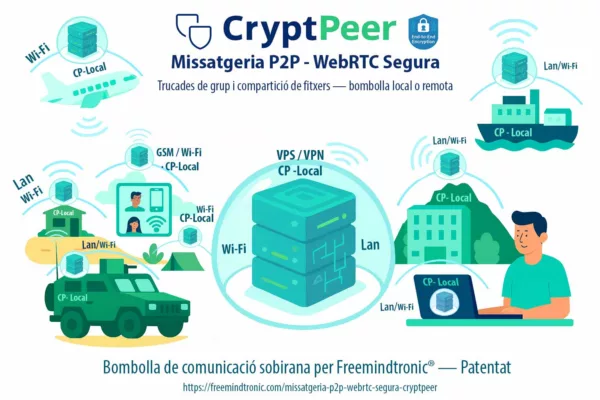
↪ Dos pilars d’un sol ecosistema sobirà

  • PassCypher HSM PGP: gestor sobirà de secrets i contrasenyes per a escriptori, totalment fora de línia. Tota la criptografia s’executa a RAM per a autenticació sense contrasenya i fluxos air-gapped.
  • PassCypher NFC HSM: variant de maquinari portàtil per a Android amb NFC, que converteix qualsevol suport NFC en un mòdul físic de confiança per a autenticació universal sense contrasenya.

Interoperables per disseny, ambdós funcionen sense servidor, sense núvol, sense sincronització i sense confiança en tercers. Secrets, claus i identitats romanen locals, aïllats i temporals — nucli de la ciberseguretat sobirana a Andorra i territoris catalanoparlants.

↪ Localització sobirana — traduccions embegudes (fora de línia)

  • Suport nadiu per a més de 13 idiomes, inclòs l’àrab (UI/UX i ajuda).
  • Traduccions embegudes: sense crides de xarxa, sense telemetria, sense API externes.
  • Compatibilitat RTL completa per a l’àrab, amb tipografia coherent i maquetació segura fora de línia.

↪ Autenticació sobirana sense contrasenya — sense FIDO, sense núvol

A diferència dels models FIDO vinculats a validadors centralitzats o claus biomètriques, PassCypher opera 100% de forma independent i fora de línia. L’autenticació es basa en la prova de possessió física i comprovacions criptològiques locals — sense serveis externs, sense API de núvol, sense cookies persistents. El resultat: un gestor de contrasenyes sense contrasenya, compatible amb tots els principals sistemes operatius, navegadors i plataformes web, i amb NFC d’Android per a ús sense contacte — interoperabilitat universal sense bloqueig per protocols.

⮞ Etiquetat com a “seguretat fora de línia sense contrasenya resistent a l’impacte quàntic”

En el procés oficial d’Intersec, PassCypher es descriu com a seguretat fora de línia sense contrasenya resistent a l’impacte quàntic. Mitjançant AES-256-CBC i una arquitectura PGP multicapa amb claus segmentades, cada fragment és inútil de manera aïllada — interrompent rutes d’explotació algorísmica (p. ex., Grover, Shor). Això no és un esquema PQC; és resistència estructural via fragmentació lògica i efimeritat controlada. Consulta la crònica de la distinció.

↪ Un model d’independència i confiança digital

La ciberseguretat sense núvol pot superar dissenys centralitzats quan l’autonomia del maquinari, la criptologia local i la no-persistència són primers principis. PassCypher restableix la confiança digital al seu fonament — seguretat per disseny — i ho demostra en contextos civils, industrials i de defensa com a gestor de contrasenyes sobirà fora de línia. Amb la base tècnica establerta, la següent secció aborda els orígens territorials i doctrinals que han modelat aquest finalista a Millor Solució de Ciberseguretat.

Innovació andorrana — Arrels europees d’un gestor sobirà sense contrasenya resistent a l’impacte quàntic

Després d’exposar la base tècnica de l’ecosistema PassCypher, cal cartografiar-ne l’abast institucional i territorial. Més enllà de l’enginyeria, l’estatus de finalista a la Millor Solució de Ciberseguretat 2026 confirma una innovació andorrana — d’herència europea i governança neutral — avui visible a l’escenari mundial de la ciberseguretat sobirana.

↪ Entre arrels franceses i neutralitat andorrana

Nascut a Andorra el 2016 i construït sobre patents d’origen francès concedides internacionalment, PassCypher es dissenya, es desenvolupa i es produeix a Andorra. El seu NFC HSM es fabrica a Andorra i França amb Groupe Syselec, soci industrial de llarga trajectòria. Aquesta identitat dual — llinatge franco-andorrà amb governança sobirana andorrana — ofereix un model concret de cooperació industrial europea. Aquesta posició permet a Freemindtronic actuar com a actor neutral, independent de blocs polítics però alineat amb una visió compartida d’innovació de confiança.

↪ Per què la neutralitat importa en un gestor sobirà

La neutralitat històrica d’Andorra i la seva geografia entre França i Espanya creen condicions idònies per a tecnologies de confiança i sobirania. L’enfocament de gestor de contrasenyes a Andorra — només RAM, sense núvol, sense contrasenya — pot adoptar-se sota marcs reguladors diversos sense dependències d’infraestructures estrangeres.

↪ Reconeixement amb abast simbòlic i estratègic

La selecció als Intersec Awards 2026 assenyala un enfocament europeu independent que triomfa en una arena internacional exigent, els Emirats Àrabs Units — centre global d’innovació en seguretat. Demostra que territoris europeus neutrals com Andorra poden equilibrar blocs tecnològics dominants mentre impulsen seguretat sense contrasenya resistent a l’impacte quàntic.

↪ Un pont entre dues visions de sobirania

Europa promou sobirania digital via GDPR, NIS2 i DORA; els EAU impulsen ciberseguretat d’estat centrada en resiliència i autonomia. El reconeixement a Dubai enllaça aquestes visions i prova que la innovació sobirana neutral pot unir el compliment europeu i les necessitats estratègiques emiratianes amb arquitectures sense núvol i interoperables.

↪ Doctrina andorrana de sobirania digital

Freemindtronic Andorra encarna la sobirania digital neutral: innovació al capdavant, independència reguladora i interoperabilitat universal. Aquesta doctrina sustenta l’adopció de PassCypher en sectors públics i privats com a gestor de contrasenyes sobirà que opera fora de línia per disseny.

⮞ Transició

Aquest reconeixement institucional prepara el següent capítol: la primera fita històrica d’un gestor passwordless preseleccionat en una competició tecnològica dels EAU — ancorant PassCypher en la història dels grans premis internacionals de ciberseguretat.

Primera fita històrica — Finalista “passwordless” als EAU (fora de línia, sobirà)

PassCypher NFC HSM & HSM PGP, desenvolupats per Freemindtronic Andorra, són — segons el nostre coneixement — els primers gestors de contrasenyes (de qualsevol tipus: núvol, SaaS, biomètric, codi obert, sobirà, fora de línia) seleccionats com a finalistes en una competició tecnològica als EAU. Aquesta fita segueix esdeveniments clau com GITEX Technology Week (2005), Dubai Future Accelerators (2015) i els Intersec Awards (des de 2022), cap dels quals havia preseleccionat abans un gestor de contrasenyes fins a PassCypher el 2026. Valida una aproximació de quantum-resistant passwordless manager 2026 arrelada en sobirania i disseny fora de línia.

Contrast — Històric de competicions tecnològiques als EAU

Competició Any de creació Abast Gestors de contrasenyes finalistes
GITEX Global / Cybersecurity Awards 2005 Tecnologia global, IA, núvol, ciutats intel·ligents ❌ Cap
Dubai Future Accelerators 2015 Start-ups disruptives ❌ Cap
UAE Cybersecurity Council Challenges 2019 Resiliència nacional ❌ Cap
Dubai Cyber Index 2020 Avaluació del sector públic ❌ Cap
Intersec Awards 2022 Seguretat, ciberseguretat, innovació PassCypher (2026)

Millor gestor sense contrasenya resistent a l’impacte quàntic 2026 — posicionament i casos d’ús

Reconeixent-se a Intersec Dubai, PassCypher es posiciona com el millor gestor “passwordless” resistent a l’impacte quàntic 2026 per a organitzacions que necessiten operacions sobiranes i sense núvol. L’stack combina validació fora de línia (prova de possessió) amb criptologia només a RAM i claus segmentades. Per a context de mercat, consulta la nostra instantània del millor gestor de contrasenyes 2026.

  • Entorns regulats i air-gapped (defensa, energia, salut, finances, diplomàcia).
  • Desplegaments sense núvol on la residència i minimització de dades són obligatòries.
  • Interoperabilitat entre navegadors/sistemes sense dependències FIDO/WebAuthn.

En resum:

Pel nostre coneixement, cap solució al núvol, SaaS, biomètrica, de codi obert o sobirana en aquesta categoria havia arribat a finalista als EAU abans de PassCypher. Aquest reconeixement reforça la posició d’Andorra a l’ecosistema de ciberseguretat dels EAU i subratlla la rellevància d’un gestor de contrasenyes sense contrasenya pensat per a ús sobirà i fora de línia.

PassCypher finalista Intersec Awards 2026 — tipologia doctrinal: allò que aquest gestor sobirà fora de línia no és

Abans de detallar la sobirania validada, convé situar PassCypher per contrast. La matriu següent clarifica la ruptura doctrinal.

Model S’aplica a PassCypher? Per què
Gestor al núvol Sense transferència ni sincronització; gestor sobirà fora de línia.
FIDO / Passkeys Prova de possessió local; sense federació d’identitat.
Codi obert Arquitectura patentada; doctrina sobirana i cadena de qualitat.
SaaS / SSO Sense backend ni delegació; sense núvol per disseny.
Bòveda local Sense persistència; només RAM efímera.
Zero Trust de xarxa ✔️ Complementari Doctrina Zero-DOM: fora de xarxa, identitats segmentades.

Aquest marc destaca PassCypher com a fora de línia, sobirà i universalment interoperable — no és un gestor de contrasenyes convencional lligat al núvol o a FIDO, sinó una arquitectura de quantum-resistant passwordless manager 2026. Consulta la crònica de la distinció.

PassCypher finalista Intersec Awards 2026 — sobirania validada cap a un model independent “passwordless” resistent a l’impacte quàntic

El reconeixement a Freemindtronic Andorra a Intersec confirma més que un èxit de producte: valida una arquitectura sobirana fora de línia dissenyada per a la independència.

↪ Validació institucional de la doctrina sobirana

La preselecció a Millor Solució de Ciberseguretat avala una filosofia de seguretat desconnectada i autònoma: protegir secrets digitals sense núvol, dependències ni delegació, alineant-se amb marcs globals (GDPR/NIS2/ISO-27001).

↪ Resposta a dependències sistèmiques

Mentre moltes solucions assumeixen connectivitat permanent, les operacions en memòria volàtil i la no-persistència de PassCypher eliminen riscos de centralització. La confiança passa de “confiar en un proveïdor” a “no dependre de ningú”.

↪ Cap a un estàndard global

Combinant sobirania, compatibilitat universal i resiliència criptogràfica segmentada, PassCypher marca un camí cap a una norma internacional de seguretat “passwordless” resistent a l’impacte quàntic aplicable a defensa, energia, salut, finances i diplomàcia.
Mitjançant el reconeixement de Dubai, Intersec assenyala un nou paradigma en seguretat digital — on un gestor de contrasenyes sobirà fora de línia pot esdevenir referent de Millor Solució de Ciberseguretat.

⮞ Transició — Cap a la consolidació doctrinal

La secció següent detalla els fonaments criptològics i les arquitectures d’aquest model — memòria volàtil, segmentació dinàmica i disseny resilient a l’impacte quàntic — enllaçant doctrina amb pràctica desplegable.

Abast internacional — cap a un model global de “passwordless” sobirà fora de línia

Allò que va començar com una nominació es converteix ara en la confirmació internacional d’una doctrina europea neutral nascuda a Andorra: una aproximació de quantum-resistant passwordless manager 2026 que redefineix com es pot dissenyar, governar i certificar la seguretat digital com a fora de línia, sobirana i interoperable.

↪ Reconeixement que traspassa fronteres

La distinció als Intersec Awards 2026 a Dubai arriba quan la sobirania digital esdevé prioritat global. Com a finalista de Millor Solució de Ciberseguretat, Freemindtronic Andorra posiciona PassCypher com a referent transcontinental entre Europa i l’Orient Mitjà — un pont entre la tradició europea de confiança i compliment i la resiliència i neutralitat operativa emiratianes. Entre aquests pols, PassCypher actua com a pont d’interoperabilitat segura.

↪ Aparador global per a ciberseguretat desconnectada

Dins el cercle selecte de proveïdors que ofereixen ciberseguretat de confiança fora de línia, Freemindtronic Andorra dona resposta a governs, indústries i defensa que cerquen protecció independent del núvol. El resultat: un camí concret on protecció de dades, neutralitat geopolítica i interoperabilitat tècnica coexisteixen — reforçant la capacitat europea de resiliència digital.

↪ Un pas cap a un estàndard sobirà global

Amb volatilitat de dades (només RAM) i no-centralització com a valors per defecte, PassCypher dibuixa un estàndard sobirà universal per a identitat i gestió de secrets. Organismes transregionals — europeus, àrabs, asiàtics — poden alinear-se al voltant d’un model que reconcilia seguretat tècnica i independència reguladora. El reconeixement d’Intersec actua com un accelerador de convergència normativa entre doctrines nacionals i estàndards emergents.

↪ De la distinció a la difusió

Més enllà de les institucions, l’impuls es tradueix en cooperació industrial i aliances de confiança entre estats, empreses i centres de recerca. La presència en esdeveniments de referència com MILIPOL 2025 i Intersec Dubai reforça el doble focus — civil i militar — i la demanda creixent d’un gestor sobirà fora de línia que és passwordless sense FIDO.

↪ Trajectòria europea d’abast global

El reconeixement d’Andorra a través de Freemindtronic mostra com un microestat neutral pot influir en els equilibris de seguretat globals. A mesura que les aliances es polaritzen, la innovació sobirana neutral ofereix una alternativa d’unitat: una doctrina passwordless resistent a l’impacte quàntic que eleva la independència sense sacrificar la interoperabilitat.

⮞ Transició — cap a la consolidació final

Aquest abast internacional no és honorífic: és la validació global d’un model independent, resilient i sobirà. La secció següent consolida la doctrina de PassCypher i el seu paper en la definició d’un estàndard global de confiança digital.

Sobirania consolidada — cap a un estàndard internacional de confiança “passwordless” sobirana

Per tancar aquest capítol, l’estatus de PassCypher finalista Intersec 2026 és més que honorífic: assenyala la validació global d’un model de ciberseguretat sobirana basat en desconnexió controlada, operacions en memòria volàtil (RAM) i criptologia segmentada. Aquesta trajectòria s’alinea de manera natural amb entorns reguladors diversos — des dels marcs de la UE (GDPR, NIS2, DORA) fins a referències dels EAU (PDPL, DESC, IAS) — i afavoreix la propietat sobirana dels secrets al centre d’una aproximació quantum-resistant passwordless manager 2026.

↪ Compatibilitat reguladora global per disseny

El model de gestor de contrasenyes sobirà fora de línia (sense núvol, sense servidors, prova de possessió) dona suport a objectius de compliment clau en grans jurisdiccions mitjançant minimització de moviment i persistència de dades:

  • Regne Unit: UK GDPR, Data Protection Act 2018 i NCSC CAF.
  • Estats Units: NIST SP 800-53 / 800-171 i Zero Trust SP 800-207; suport a salvaguardes sectorials (HIPAA/GLBA).
  • Xina: principis de CSL, DSL i PIPL.
  • Japó: requisits d’APPI (finalitat, minimització, mitigació) afavorits per operació només RAM.
  • Corea del Sud: PIPA (consentiment, minimització, mesures tècniques/organitzatives) amb ús air-gapped i validació local.
  • Índia: DPDP 2023 (licitud, minimització, seguretat per disseny) amb passwordless sense FIDO i criptologia en dispositiu.

Nota:

PassCypher no reclama certificació automàtica; facilita assolir objectius (segregació de funcions, mínim privilegi, reducció d’impacte) mantenint els secrets locals, aïllats i efímers.

↪ Consolidar una doctrina universal

La doctrina de ciberseguretat sobirana passa del manifest a la pràctica. PassCypher HSM PGP i PassCypher NFC HSM demostren que autonomia criptogràfica, interoperabilitat global i resiliència a amenaces emergents poden coexistir en un gestor sobirà fora de línia. L’interès transregional — Europa, el GCC, el Regne Unit, els EUA i Àsia — confirma una premissa simple: la ciberseguretat fiable exigeix sobirania digital.

↪ Multilingüe per disseny (embegut, fora de línia)

Per donar suport a desplegaments globals i operacions air-gapped, PassCypher incorpora més de 13 idiomes embeguts (inclòs català per a Andorra, Catalunya, Illes Balears, País Valencià i Catalunya Nord). La IU i l’ajuda són totalment fora de línia (sense API externes).

↪ Catalitzador d’estandardització internacional

El reconeixement a Dubai actua com a accelerador d’estandardització i obre el camí a criteris on seguretat desconnectada i protecció d’identitat segmentada siguin propietats certificables.

↪ Sobirania andorrana com a palanca d’equilibri global

La neutralitat i l’agilitat reguladora d’Andorra ofereixen un laboratori d’innovació sobirana que equilibra grans blocs tecnològics.

↪ Un horitzó compartit: confiança, neutralitat, independència

  • confiança — verificació local i prova de possessió;
  • neutralitat — sense intermediaris ni dependència de proveïdor;
  • independència — eliminació de dependències de núvol/servidor.

“PassCypher no és un gestor de contrasenyes. És un estat criptogràfic sobirà, resilient i autònom, reconegut com a finalista dels Intersec Awards 2026.” — Freemindtronic Andorra, Dubai · 13 de gener de 2026

⮞ Senyals febles identificats

  • Patró: demanda creixent de passwordless sense núvol en infraestructures crítiques.
  • Vector: convergència GDPR/NIS2/DORA amb doctrines sobiranes fora de xarxa; imperatius dels EAU PDPL/DESC/IAS; èmfasi regulador UK/US/Àsia en minimització i zero trust.
  • Tendència: fòrums de defensa i sector públic (p. ex., Milipol novembre 2025, esdeveniments GCC) explorant arquitectures només RAM.

⮞ Cas d’ús sobirà | Resiliència amb Freemindtronic

En aquest context, PassCypher HSM PGP i PassCypher NFC HSM neutralitzen:

  • Validació local per prova de possessió (NFC/HID), sense servidors ni núvol.
  • Desxifratge efímer en memòria volàtil (només RAM), zero persistència.
  • Segmentació PGP dinàmica amb aïllament contextual dels secrets.

FAQ — Gestor sense contrasenya resistent a l’impacte quàntic i ciberseguretat sobirana

PassCypher és compatible amb els navegadors actuals sense passkeys FIDO?

Resposta breu

Sí. PassCypher valida l’accés per prova de possessió amb cap servidor, cap núvol i cap WebAuthn.

Per què importa

Com que tot s’executa en memòria volàtil (només RAM), es manté fora de línia, universal i interoperable entre navegadors i sistemes. Dona resposta directa a consultes com autenticació sense FIDO i gestor sobirà fora de línia dins el posicionament PassCypher finalista Intersec 2026.

En una frase

FIDO es basa en WebAuthn i federació d’identitat; PassCypher és sense FIDO, sense servidor i sense núvol, amb PGP segmentat + AES-256-CBC íntegrament a RAM.

Context i recursos

La federació centralitza la confiança i amplia la superfície d’atac. PassCypher la substitueix per criptologia local i material efímer (derivar → usar → destruir). Consulta:
Segrest d’API WebAuthn,
Clickjacking d’extensions DOM (DEF CON 33).
Objectius: seguretat “passwordless” resistent a l’impacte quàntic, gestor sense contrasenya 2026.

Resposta curta

Sí. L’àrab (RTL) i més de 13 idiomes estan embeguts; les traduccions funcionen totalment fora de línia (air-gapped), sense API externes.

Idiomes inclosos

العربية, English, Français, Español, Català, Deutsch, 日本語, 한국어, 简体中文, हिन्दी, Italiano, Português, Română, Русский, Українська — alineats amb el long-tail de gestor sobirà per a desplegaments multiregió (Andorra, Catalunya, Illes Balears, País Valencià, Catalunya Nord, l’Alguer).

Essencials

Sense núvol, sense servidors, sense persistència: els secrets es creen, s’usen i es destrueixen a RAM.

Com funciona

El patró de gestor només RAM i la segmentació de claus eliminen camins d’exfiltració comuns (bases de dades, sincronització, extensions). Nucli de la nostra doctrina gestor sobirà fora de línia.

Ambdós en un sol stack

És un gestor de contrasenyes sobirà fora de línia que també habilita accés sense contrasenya sense FIDO.

Com encaixa

Com a gestor, els secrets només viuen en memòria volàtil. Com a “passwordless”, prova la possessió física entre navegadors i sistemes. Cobreix intencions com millor gestor 2026 fora de línia i gestor sense núvol per a empreses.

Perspectiva operativa

Sí. És sense núvol i sense servidor per disseny, compatible amb escriptori, web i NFC d’Android.

Notes de risc

Sense broker d’identitat, sense tenant SaaS, sense capa d’extensions — coherent amb Zero Trust (verificació local, privilegi mínim). Lectures relacionades:
Debilitats persistents d’OAuth/2FA,
Ús indegut d’App Passwords per APT29.

Què pots esperar

PassCypher no certifica automàticament; facilita resultats (minimització, privilegi mínim, reducció d’impacte) mantenint els secrets locals, aïllats i efímers.

On encaixa

Alineat amb objectius de política a la UE GDPR/NIS2/DORA, EAU PDPL/DESC/IAS, UK (UK GDPR/DPA 2018/NCSC CAF), EUA (NIST SP 800-53/171, SP 800-207 Zero Trust, àmbits HIPAA/GLBA), CN (CSL/DSL/PIPL), JP (APPI), KR (PIPA), IN (DPDP).

Explicació plana

Aquí “resistent a l’impacte quàntic” vol dir resistència estructuralsegmentació i efimeritat en RAM —, no pas nous algorismes PQC.

Elecció de disseny

No substituïm primitives; limitem utilitat i vida del material perquè els fragments aïllats no tinguin valor. S’alinea amb el long-tail de seguretat sense contrasenya resistent a l’impacte quàntic.

Instantània

Evita les capes més atacades: sense WebAuthn, sense extensions de navegador, sense persistència OAuth, sense app-passwords guardades.

Per aprofundir

Lectures recomanades:
Segrest d’API WebAuthn,
DOM extension clickjacking,
Vulnerabilitat persistent d’OAuth (2FA),
APT29 i app-passwords.

Motiu en breu

Per demostrar que la seguretat sobirana, fora de línia i sense contrasenya (només RAM + segmentació) escala globalment — sense núvol ni federació.

Intenció dels premis

Respon a cerques com millor solució de ciberseguretat 2026 i millor gestor de contrasenyes 2026 fora de línia, i reforça el posicionament PassCypher finalista Intersec 2026 amb abast multilingüe (incloent àrab) per a audiències de Dubai i del GCC.

⮞ Aprofundeix — Solucions PassCypher arreu del món

Descobreix on avaluar el nostre gestor de contrasenyes sobirà fora de línia i l’autenticació sense contrasenya sense FIDO a l’EMEA. Aquests enllaços cobreixen opcions de maquinari, aplicacions només RAM i accessoris d’interoperabilitat universal.

AMG PRO (París, França)
KUBB Secure de Bleu Jour (Tolosa, França)
Fullsecure Andorra

Consell: per a enllaçat intern i captura d’intenció de cerca, referencia àncores com /passcypher/offline-password-manager/ i /passcypher/best-password-manager-2026/ quan escaigui.

Això no és un esquema PQC (post-quantum): la protecció prové de la resistència estructural — fragmentació i efimeritat en RAM — descrita com a “resistent a l’impacte quàntic” per disseny.

⮞ Visió estratègica

El reconeixement de Freemindtronic Andorra a Intersec 2026 subratlla que la sobirania és un valor tecnològic universal. En habilitar operacions sense núvol i sense servidor amb autenticació sense contrasenya sense FIDO, l’enfocament Quantum-Resistant Passwordless Manager 2026 traça un camí pragmàtic cap a un estàndard global de confiança digital — nascut a Andorra, reconegut a Dubai, rellevant a l’EMEA, les Amèriques i l’Àsia-Pacífic.

Vulnerabilitat Passkeys: Les Claus d’Accés Sincronitzades no són Invulnerables

Vulnerabilitat Passkeys: Imatge amb clau trencada, ham de phishing i títol DEF CON 33 – Passkeys Pwned, que simbolitza l'atac d'intercepció WebAuthn i la fallada de les claus d'accés sincronitzades.

Vulnerabilitat Passkeys: Una vulnerabilitat crítica, revelada a la DEF CON 33, demostra que les passkeys sincronitzades poden ser objecte de phishing en temps real. De fet, Allthenticate va provar que una sol·licitud d’autenticació falsificable pot segrestar una sessió WebAuthn en viu.

Resum Executiu — La Vulnerabilitat Passkeys i el WebAuthn API Hijacking

▸ Conclusió Clau — Atac de WebAuthn API Hijacking

Oferim un resum dens (≈ 1 min) per a decisors i CISOs. Per a una anàlisi tècnica completa (≈ 13 min), però, hauríeu de llegir l’article sencer.

Imagineu un mètode d’autenticació elogiat com a resistent al phishing — anomenat passkeys sincronitzades — i després explotat en viu a la DEF CON 33 (del 8 a l’11 d’agost de 2025, Las Vegas). Llavors, quina era la vulnerabilitat? Era una fallada de WebAuthn API Hijacking (un atac d’intercepció al flux d’autenticació), que va permetre la falsificació de la sol·licitud de passkeys en temps real.

Aquesta única demostració, de fet, desafia directament la seguretat proclamada de les passkeys sincronitzades al núvol i obre el debat sobre alternatives sobiranes. Vam veure emergir dues troballes clau de recerca a l’esdeveniment: primer, la falsificació de la sol·licitud en temps real (un atac d’intercepció de WebAuthn), i segon, el DOM extension clickjacking. Cal destacar que aquest article se centra exclusivament en la falsificació de la sol·licitud perquè innegablement soscava la promesa “resistent al phishing” per a les passkeys sincronitzades vulnerables.

▸ Resum

El punt feble ja no és la criptografia; en canvi, és el disparador visual. En resum, els atacants comprometen la interfície, no la clau criptogràfica.

Visió Estratègica Aquesta demostració, per tant, exposa una fallada històrica: els atacants poden abusar perfectament d’un mètode d’autenticació anomenat “resistent al phishing” si poden falsificar i explotar la sol·licitud en el moment adequat.

Crònica per llegir
Article to Read
Temps de lectura estimat: ≈ 13 minuts (+4–5 min si mireu els vídeos incrustats)
Nivell de complexitat: Avançat / Expert
Idiomes disponibles: CAT · EN · ES · FR
Accessibilitat: Optimitzat per a lectors de pantalla
Tipus: Article Estratègic
Autor: Jacques Gascuel, inventor i fundador de Freemindtronic®, dissenya i patenta sistemes de seguretat de maquinari sobirans per a la protecció de dades, la sobirania criptogràfica i les comunicacions segures. Com a expert en conformitat amb ANSSI, NIS2, GDPR i SecNumCloud, desenvolupa arquitectures by-design capaces de contrarestar amenaces híbrides i garantir una ciberseguretat 100% sobirana.

Fonts Oficials

TL; DR

  • A la DEF CON 33 (del 8 a l’11 d’agost de 2025), investigadors d’Allthenticate van demostrar un camí de WebAuthn API Hijacking: els atacants poden segrestar passkeys anomenades “resistents al phishing” a través de la falsificació de la sol·licitud en temps real.
  • La fallada no resideix en els algorismes criptogràfics; més aviat, es troba a la interfície d’usuari—el punt d’entrada visual.
  • En última instància, aquesta revelació exigeix una revisió estratègica: hem de prioritzar les passkeys lligades al dispositiu per a casos d’ús sensibles i alinear els desplegaments amb models d’amenaça i requisits reglamentaris.

2026 Digital Security

EviDNA DNA Cryptography | Jacques Gascuel Memory

2022 2026 Digital Security

EviDNA cryptographie ADN | mémoire Jacques Gascuel

2025 2026 Digital Security Technical News

Quantum computer 6100 qubits ⮞ Historic 2025 breakthrough

2025 2026 Digital Security

WhatsApp zero-click vulnerability and runtime compromise

2026 Cyber Doctrine Digital Security

Whisper Leak side-channel and LLM token leakage

2023 2026 Digital Security Phishing

BITB Attacks: How to Avoid Phishing by iFrame

2026 Digital Security

Zero-Knowledge Downgrade Attacks — Structural Risks

2025 Cyberculture Digital Security

Browser Fingerprinting Tracking: Metadata Surveillance in 2026

2023 2026 Digital Security

CVE-2023-32784 : Pourquoi PassCypher protège vos secrets

2023 2026 Digital Security

CVE-2023-32784 Protection with PassCypher NFC HSM

2024 Digital Security

Why Encrypt SMS? FBI and CISA Recommendations

2025 Digital Security

Persistent OAuth Flaw: How Tycoon 2FA Hijacks Cloud Access

2026 Crypto Currency Cryptocurrency Digital Security

Ledger Security Breaches from 2017 to 2026: How to Protect Yourself from Hackers

2025 Digital Security

Bot Telegram Usersbox : l’illusion du contrôle russe

2026 Awards Cyberculture Digital Security Distinction Excellence EviOTP NFC HSM Technology EviPass EviPass NFC HSM technology EviPass Technology finalists PassCypher PassCypher

Quantum-Resistant Passwordless Manager — PassCypher finalist, Intersec Awards 2026 (FIDO-free, RAM-only)

2025 Cyberculture Cybersecurity Digital Security EviLink

CryptPeer messagerie P2P WebRTC : appels directs chiffrés de bout en bout

2025 CyptPeer Digital Security EviLink

Missatgeria P2P WebRTC segura — comunicació directa amb CryptPeer

2025 Digital Security

Russia Blocks WhatsApp: Max and the Sovereign Internet

2025 Digital Security

Spyware ClayRat Android : faux WhatsApp espion mobile

2025 Digital Security

Android Spyware Threat Clayrat : 2025 Analysis and Exposure

2023 Digital Security

WhatsApp Hacking: Prevention and Solutions

2025 Digital Security Technical News

Sovereign SSH Authentication with PassCypher HSM PGP — Zero Key in Clear

2025 Digital Security Tech Fixes Security Solutions Technical News

SSH Key PassCypher HSM PGP — Sécuriser l’accès multi-OS à un VPS

2025 Digital Security Technical News

Générateur de mots de passe souverain – PassCypher Secure Passgen WP

2025 Digital Security Technical News

Ordinateur quantique 6100 qubits ⮞ La percée historique 2025

2025 Cyberculture Digital Security

Authentification multifacteur : anatomie, OTP, risques

2025 Digital Security

Email Metadata Privacy: EU Laws & DataShielder

2025 Digital Security

Chrome V8 confusió RCE — Actualitza i postura Zero-DOM

2025 Digital Security

Chrome V8 confusion RCE — Your browser was already spying

2024 Cyberculture Digital Security

Russian Cyberattack Microsoft: An Unprecedented Threat

2025 Digital Security

Chrome V8 Zero-Day: CVE-2025-6554 Actively Exploited

2025 Digital Security

APT29 Exploits App Passwords to Bypass 2FA

2025 Digital Security

Signal Clone Breached: Critical Flaws in TeleMessage

2025 Digital Security

APT29 Spear-Phishing Europe: Stealthy Russian Espionage

2025 Digital Security

APT44 QR Code Phishing: New Cyber Espionage Tactics

2024 Digital Security

BitLocker Security: Safeguarding Against Cyberattacks

2024 Digital Security

French Minister Phone Hack: Jean-Noël Barrot’s G7 Breach

2024 Digital Security

Cyberattack Exploits Backdoors: What You Need to Know

2021 Cyberculture Digital Security Phishing

Phishing Cyber victims caught between the hammer and the anvil

2024 Digital Security

Google Sheets Malware: The Voldemort Threat

2024 Articles Digital Security News

Russian Espionage Hacking Tools Revealed

2024 Digital Security Spying Technical News

Side-Channel Attacks via HDMI and AI: An Emerging Threat

2024 Digital Security Technical News

Apple M chip vulnerability: A Breach in Data Security

Digital Security Technical News

Brute Force Attacks: What They Are and How to Protect Yourself

2023 Digital Security

Predator Files: The Spyware Scandal That Shook the World

2023 Digital Security

5Ghoul: 5G NR Attacks on Mobile Devices

2024 Digital Security

Europol Data Breach: A Detailed Analysis

Digital Security EviToken Technology Technical News

EviCore NFC HSM Credit Cards Manager | Secure Your Standard and Contactless Credit Cards

2024 Cyberculture Digital Security News Training

Andorra National Cyberattack Simulation: A Global First in Cyber Defense

Articles Digital Security EviVault Technology NFC HSM technology Technical News

EviVault NFC HSM vs Flipper Zero: The duel of an NFC HSM and a Pentester

Articles Cryptocurrency Digital Security Technical News

Securing IEO STO ICO IDO and INO: The Challenges and Solutions

Articles Cyberculture Digital Security Technical News

Protect Meta Account Identity Theft with EviPass and EviOTP

2024 Digital Security

Cybersecurity Breach at IMF: A Detailed Investigation

2023 Articles Cyberculture Digital Security Technical News

Strong Passwords in the Quantum Computing Era

2024 Digital Security

PrintListener: How to Betray Fingerprints

En Ciberseguretat Sobirana ↑ Aquest article forma part de la nostra secció de Seguretat Digital, continuant la nostra recerca sobre els exploits de maquinari de confiança zero i les contramesures.

▸ Punts Clau

  • Vulnerabilitat Confirmada: Les passkeys sincronitzades al núvol (Apple, Google, Microsoft) no són 100% resistents al phishing.
  • Nova Amenaça: La falsificació de la sol·licitud en temps real explota la interfície d’usuari en lloc de la criptografia.
  • Impacte Estratègic: Les infraestructures crítiques i les agències governamentals han de migrar a credencials lligades al dispositiu i a solucions sobiranes fora de línia (NFC HSM, claus segmentades).

Què és un Atac de WebAuthn API Hijacking?

Un atac d’intercepció de WebAuthn a través d’una sol·licitud d’autenticació falsificable (WebAuthn API Hijacking) consisteix a imitar en temps real la finestra d’autenticació mostrada per un sistema o navegador. Per tant, l’atacant no busca trencar l’algorisme criptogràfic; en lloc d’això, reprodueix la interfície d’usuari (UI) en el moment exacte en què la víctima espera veure una sol·licitud legítima. Els enganys visuals, el cronometratge precís i la sincronització perfecta fan que l’engany sigui indistingible per a l’usuari.

Exemple simplificat:
Un usuari creu que està aprovant una connexió al seu compte bancari a través d’una sol·licitud legítima del sistema d’Apple o Google. En realitat, està interactuant amb un quadre de diàleg clonat per l’atacant. Com a resultat, l’adversari captura la sessió activa sense alertar la víctima.
▸ En resum: A diferència dels atacs de phishing “clàssics” a través de correu electrònic o llocs web fraudulents, la falsificació de la sol·licitud en temps real té lloc durant l’autenticació, quan l’usuari té més confiança.

Història de les Vulnerabilitats de Passkey / WebAuthn

Malgrat la seva robustesa criptogràfica, les passkeys — basades en els estàndards oberts WebAuthn i FIDO2 de la FIDO Alliance — no són invulnerables. La història de les vulnerabilitats i les recerques recents confirmen que el punt feble sovint resideix en la interacció de l’usuari i l’entorn d’execució (navegador, sistema operatiu). La indústria va adoptar oficialment les passkeys el 5 de maig de 2022, després d’un compromís d’Apple, Google i Microsoft per estendre el seu suport a les seves respectives plataformes.

Cronologia exhaustiva de l'evolució de les vulnerabilitats Passkey i WebAuthn (2012-2025), des de la creació de FIDO fins als atacs d'IA, destacant solucions com PassCypher per a la ciberseguretat a Andorra i Catalunya.
Evolució Accelerada de les Vulnerabilitats Passkey i WebAuthn (2012-2025): Una cronologia detallada que il·lustra els punts d’inflexió clau en la seguretat de les credencials, des de la fundació de FIDO fins a l’aparició de l’IA com a multiplicador d’amenaces, incloent-hi les revelacions de la DEF CON 33 i l’emergència de solucions sobiranes com PassCypher, crucial per a la protecció digital a Andorra i Catalunya.

Cronologia de la Vulnerabilitat Passkeys

  • SquareX – Navegadors Compromesos (agost 2025):

    A la DEF CON 33, una demostració va mostrar que una extensió o script maliciós pot interceptar el flux de WebAuthn per substituir les claus. Vegeu l’anàlisi de TechRadar i l’informe de SecurityWeek.

  • CVE-2025-31161 (març/abril 2025):

    Salt d’autenticació a CrushFTP mitjançant una condició de carrera. Font Oficial del NIST.

  • CVE-2024-9956 (març 2025):

    Apoderament de comptes mitjançant Bluetooth a Android. Aquest atac va demostrar que un atacant pot desencadenar remotament una autenticació maliciosa a través d’un intent `FIDO:/`. Anàlisi de Risky.Biz. Font Oficial del NIST.

  • CVE-2024-12604 (març 2025):

    Emmagatzematge en text clar de dades sensibles a Tap&Sign, explotant una mala gestió de contrasenyes. Font Oficial del NIST.

  • CVE-2025-26788 (febrer 2025):

    Salt d’autenticació al Servidor FIDO de StrongKey. Font Detallada.

  • Passkeys Pwned – Segrest de l’API basat en el navegador (inicis de 2025):

    Un estudi de recerca va mostrar que el navegador, com a mediador únic, pot ser un punt de fallada. Llegiu l’anàlisi de Security Boulevard.

  • CVE-2024-9191 (novembre 2024):

    Exposició de contrasenyes a través d’Okta Device Access. Font Oficial del NIST.

  • CVE-2024-39912 (juliol 2024):

    Enumeració d’usuaris a través d’una fallada a la biblioteca PHP `web-auth/webauthn-lib`. Font Oficial del NIST.

  • Atacs de tipus CTRAPS (2024):

    Aquests atacs a nivell de protocol (CTAP) exploten els mecanismes d’autenticació per a accions no autoritzades. Per a més informació sobre els atacs a nivell de protocol FIDO, vegeu aquesta presentació de Black Hat sobre les vulnerabilitats de FIDO.

  • Primer Desplegament a Gran Escala (setembre 2022):

    Apple va ser el primer a desplegar passkeys a gran escala amb el llançament d’iOS 16, fent d’aquesta tecnologia una realitat per a centenars de milions d’usuaris. Comunicat de Premsa Oficial d’Apple.

  • Llançament i Adopció de la Indústria (maig 2022):

    La FIDO Alliance, unida per Apple, Google i Microsoft, va anunciar un pla d’acció per estendre el suport de les passkeys a totes les seves plataformes. Comunicat de Premsa Oficial de la FIDO Alliance.

  • Atacs de Cronometratge a keyHandle (2022):

    Una vulnerabilitat que permet la correlació de comptes mesurant les variacions de temps en el processament dels `keyHandles`. Vegeu l’article d’IACR ePrint 2022.

  • Phishing de Mètodes de Recuperació (des del 2017):

    Els atacants utilitzen proxies AitM (com Evilginx, que va aparèixer el 2017) per amagar l’opció de passkey i forçar un retorn a mètodes menys segurs que es poden capturar. Més detalls sobre aquesta tècnica.

  • Black Hat FIDO 2017 → CTRAPS (CTAP Replay / Protocol-level Attacks):

    A la conferència Black Hat USA 2017 es van presentar vulnerabilitats a nivell de protocol CTAP, demostrant la possibilitat de repetir missatges d’autenticació per realitzar accions no autoritzades.
    Vegeu la presentació oficial de Black Hat.

La IA com a Multiplicador de la Vulnerabilitat Passkeys

La intel·ligència artificial no és una fallada de seguretat, sinó un catalitzador que fa que els atacs existents siguin més eficaços. Des de l’aparició dels models d’IA generativa com GPT-3 (2020) i DALL-E 2 (2022), han aparegut noves capacitats per a l’automatització d’amenaces. Aquests desenvolupaments permeten notablement:

  • Atacs a Gran Escala (des del 2022): La IA generativa permet als atacants crear sol·licituds d’autenticació i missatges de phishing personalitzats per a un volum massiu d’objectius, augmentant l’efectivitat del phishing de mètodes de recuperació.
  • Recerca de Vulnerabilitats Accelerada (des del 2023): La IA es pot utilitzar per automatitzar la cerca de fallades de seguretat, com l’enumeració d’usuaris o la detecció de fallades lògiques en el codi d’implementació.
Nota Històrica — Els riscos associats a les sol·licituds falsificables a WebAuthn ja van ser plantejats per la comunitat a l’issue #1965 de W3C GitHub (abans de la demostració de la DEF CON 33). Això demostra que la interfície d’usuari ha estat reconeguda des de fa temps com un punt feble en l’autenticació anomenada “resistent al phishing”.

“Aquestes vulnerabilitats recents i històriques ressalten el paper crític del navegador i del model de desplegament (device-bound vs. synced). Reforcen la crida a arquitectures sobiranes que estiguin desconnectades d’aquests vectors de compromís.”

Vulnerabilitat Passkeys i del Model de Sincronització

Una de les vulnerabilitats de seguretat de les passkeys més debatudes no concerneix el protocol WebAuthn en si mateix, sinó el seu model de desplegament. La majoria de les publicacions sobre el tema diferencien entre dos tipus de passkeys:

  • Passkeys lligades al dispositiu: Emmagatzemades en un dispositiu físic (com una clau de seguretat de maquinari o una Secure Enclave). Aquest model es considera generalment molt segur perquè no es sincronitza a través d’un servei de tercers.
  • Passkeys sincronitzades: Emmagatzemades en un gestor de contrasenyes o un servei al núvol (iCloud Keychain, Google Password Manager, etc.). Aquestes passkeys es poden sincronitzar a través de múltiples dispositius. Per a més detalls sobre aquesta distinció, consulteu la documentació de la FIDO Alliance.

La vulnerabilitat rau aquí: si un atacant aconsegueix comprometre el compte del servei al núvol, podria potencialment obtenir accés a les passkeys sincronitzades a tots els dispositius de l’usuari. Aquest és un risc que les passkeys lligades al dispositiu no comparteixen. La recerca acadèmica, com aquest article publicat a arXiv, explora aquesta qüestió, destacant que “la seguretat de les passkeys sincronitzades es concentra principalment en el proveïdor de passkeys.”

Aquesta distinció és crucial perquè la implementació de passkeys sincronitzades vulnerables contradiu l’esperit mateix d’un MFA anomenat resistent al phishing, ja que la sincronització introdueix un intermediari i una superfície d’atac addicional. Això justifica la recomanació de la FIDO Alliance de prioritzar les passkeys lligades al dispositiu per a la màxima seguretat.

La Demostració de la DEF CON 33 – WebAuthn API Hijacking en Acció

El WebAuthn API Hijacking és el fil conductor d’aquesta secció: expliquem breument el camí d’atac mostrat a la DEF CON 33 i com una sol·licitud falsificable va permetre la presa de control de la sessió en temps real, abans de detallar les proves en viu i els fragments de vídeo.

Passkeys Pwned — La Vulnerabilitat Passkeys a la DEF CON 33

Durant la DEF CON 33, l’equip d’Allthenticate va presentar una xerrada titulada “Passkeys Pwned: Turning WebAuthn Against Itself.”
Aquesta sessió va demostrar com els atacants podien explotar el WebAuthn API Hijacking per comprometre passkeys sincronitzades en temps real utilitzant una sol·licitud d’autenticació falsificable.

Utilitzant la frase provocadora “Passkeys Pwned”, els investigadors van emfatitzar deliberadament que fins i tot les credencials anomenades resistents al phishing poden ser segrestades quan la pròpia interfície d’usuari és el punt feble.

Proves de WebAuthn API Hijacking a la DEF CON 33

A Las Vegas, al cor de la DEF CON 33 (del 8 a l’11 d’agost de 2025), la comunitat de hackers més respectada del món va presenciar una demostració que va fer que molts es remoguessin. De fet, els investigadors d’Allthenticate van mostrar en viu que una passkey sincronitzada vulnerable – malgrat ser etiquetada com a “resistent al phishing” – podia ser enganyada. Llavors, què van fer? Van executar un atac de WebAuthn API Hijacking (falsificació de la sol·licitud del sistema) del tipus de falsificació de la sol·licitud d’autenticació en temps real. Van crear un quadre de diàleg d’autenticació fals, perfectament cronometrat i visualment idèntic a la UI legítima. En última instància, l’usuari creia que estava validant una autenticació legítima, però l’adversari va segrestar la sessió en temps real. Aquesta prova de concepte fa tangible la “Fallada d’Intercepció de WebAuthn de les Passkeys” a través d’una sol·licitud falsificable en temps real.

Fragments de Vídeo — WebAuthn API Hijacking en la Pràctica

Per visualitzar la seqüència, mireu el clip següent: mostra com el WebAuthn API Hijacking sorgeix d’un simple engany de la UI que alinea el temps i l’aparença amb la sol·licitud del sistema esperada, conduint a una captura de sessió sense problemes.

Autors Oficials i Mitjans de la DEF CON 33
Shourya Pratap Singh, Jonny Lin, Daniel Seetoh — investigadors d’Allthenticate, autors de la demo “Your Passkey is Weak: Phishing the Unphishable”.
Vídeo d’Allthenticate a TikTok — explicació directa per l’equip.
Vídeo de la DEF CON 33 Las Vegas (TikTok) — un cop d’ull a la conferència.
Fragments destacats de la DEF CON 33 (YouTube) — incloent la fallada de les passkeys.

▸ Resum

La DEF CON 33 va demostrar que les passkeys sincronitzades vulnerables poden ser compromeses en viu quan una sol·licitud d’autenticació falsificable s’insereix al flux de WebAuthn.

Comparació – Fallada d’Intercepció de WebAuthn: Falsificació de Sol·licitud vs. DOM Clickjacking

A la DEF CON 33, dues grans troballes de recerca van sacsejar la confiança en els mecanismes d’autenticació moderns. De fet, ambdós exploten les fallades relacionades amb la interfície d’usuari (UX) en lloc de la criptografia, però els seus vectors i objectius difereixen radicalment.

Comparació de l'arquitectura de PassCypher i FIDO WebAuthn destacant la resistència al phishing i els riscos de falsificació de sol·licituds
Comparació de les arquitectures de PassCypher i FIDO WebAuthn mostrant per què les Passkeys són vulnerables al WebAuthn API hijacking mentre que PassCypher elimina els riscos de falsificació de sol·licituds.

Falsificació de Sol·licitud en Temps Real

DOM Clickjacking

  • Autors: Un altre equip d’investigadors (DEF CON 33).
  • Objectiu: Gestors de credencials, extensions, passkeys emmagatzemades.
  • Vector: iframes invisibles, Shadow DOM, scripts maliciosos per segrestar l’autocompletat.
  • Impacte: Exfiltració silenciosa de credencials, passkeys i claus de la cartera de criptomonedes.

▸ Conclusió clau: Aquest article se centra exclusivament en la falsificació de sol·licituds, que il·lustra una fallada d’intercepció de WebAuthn important i posa en dubte la promesa de “passkeys resistents al phishing”. Per a un estudi complet sobre DOM clickjacking, consulteu l’article relacionat.

Implicacions Estratègiques – Passkeys i Vulnerabilitats d’UX

Com a resultat, la “Fallada d’Intercepció de WebAuthn de les Passkeys” ens obliga a repensar l’autenticació al voltant de models sense sol·licitud i sense núvol.

▸ Anàlisi
No és la criptografia el que falla, sinó la il·lusió d’immunitat. La intercepció de WebAuthn demostra que el risc resideix en la UX, no en l’algorisme.

Regulacions i Conformitat – MFA i Intercepció de WebAuthn

Documents oficials com la guia de la CISA sobre MFA resistent al phishing o la directiva OMB M-22-09 insisteixen en aquest punt: l’autenticació és “resistent al phishing” només si cap intermediari pot interceptar o segrestar el flux de WebAuthn.
En teoria, les passkeys de WebAuthn respecten aquesta regla. A la pràctica, però, la vulnerabilitat passkeys sincronitzades obre una fallada d’intercepció que els atacants poden explotar a través d’una sol·licitud d’autenticació falsificable.

A Europa, tant la directiva NIS2 com la certificació SecNumCloud reiteren el mateix requisit: cap dependència de serveis de tercers no controlats.

Com a tal, la “Fallada d’Intercepció de WebAuthn de les Passkeys” contradiu l’esperit d’un MFA anomenat resistent al phishing, perquè la sincronització introdueix un intermediari.

En altres paraules, un núvol dels EUA que gestiona les vostres passkeys queda fora de l’abast d’una sobirania digital estricta.

▸ Resum

Una passkey sincronitzada vulnerable pot comprometre el requisit d’un MFA resistent al phishing (CISA, NIS2) quan un atac d’intercepció de WebAuthn és possible.

Estadístiques Europees i Francòfones – Phishing en Temps Real, Intercepció de WebAuthn i la Vulnerabilitat Passkeys

Els informes públics confirmen que els atacs de phishing avançats — incloent tècniques en temps real — representen una amenaça major a la Unió Europea i a la zona francòfona.

  • Unió Europea — ENISA: Segons l’informe Threat Landscape 2024, el phishing i l’enginyeria social representen el 38% dels incidents reportats a la UE, amb un augment notable dels mètodes de Adversary-in-the-Middle i de la falsificació de sol·licituds en temps real, associada a la intercepció de WebAuthn. Font: ENISA Threat Landscape 2024
  • França — Cybermalveillance.gouv.fr: El 2023, el phishing va generar el 38% de les sol·licituds d’assistència, amb més d’1.5M de consultes relacionades amb aquest tipus d’atac. Les estafes de falsos assessors bancaris van augmentar un +78% respecte al 2022, sovint mitjançant sol·licituds d’autenticació falsificables. Font: Informe d’Activitat 2023
  • Canadà (Francòfon) — Centre Canadenc per a la Ciberseguretat: L’Avaluació Nacional d’Amenaces Cibernètiques 2023-2024 indica que el 65% de les empreses esperen patir un atac de phishing o ransomware. El phishing segueix sent un vector preferit per eludir l’MFA, incloent-hi mitjançant la intercepció del flux de WebAuthn. Font: Avaluació Oficial
▸ Lectura Estratègica
La falsificació de sol·licituds en temps real no és un experiment de laboratori; forma part d’una tendència en què el phishing s’adreça a la interfície d’autenticació en lloc dels algorismes, amb un ús creixent de l’atac d’intercepció de WebAuthn.

Cas d’Ús Sobirà – Neutralitzant la Vulnerabilitat Passkeys

En un escenari pràctic, una autoritat reguladora reserva les passkeys sincronitzades per a portals públics de baix risc. Per contra, l’opció PassCypher elimina la causa fonamental de la “Fallada d’Intercepció de WebAuthn de les Passkeys” eliminant la sol·licitud, el núvol i qualsevol exposició al DOM.
Per a sistemes crítics (govern, operacions sensibles, infraestructures vitals), desplega PassCypher en dues formes:

Per què PassCypher Elimina la Vulnerabilitat Passkeys

Les solucions PassCypher contrasten radicalment amb les passkeys FIDO que són vulnerables a l’atac d’intercepció de WebAuthn:

  • Sense sol·licitud del sistema operatiu/navegador — per tant, sense sol·licitud d’autenticació falsificable.
  • Sense núvol — sense sincronització vulnerable ni dependència de tercers.
  • Sense DOM — sense exposició a scripts, extensions o iframes.
✓ Sobirania: En eliminar la sol·licitud, el núvol i el DOM, PassCypher elimina qualsevol punt d’ancoratge per a la fallada d’intercepció de WebAuthn (falsificació de sol·licituds) revelada a la DEF CON 33.

PassCypher NFC HSM — Eliminant el Vector d’Atac de Falsificació de Sol·licituds WebAuthn

L’atac d’Allthenticate a la DEF CON 33 demostra que els atacants poden falsificar qualsevol sistema que depèn d’una sol·licitud del sistema operatiu/navegador. PassCypher NFC HSM elimina aquest vector: no hi ha sol·licitud, ni sincronització al núvol, els secrets estan encriptats de per vida en un nano-HSM NFC, i es validen amb un toc físic. Funcionament per a l’usuari:

  • Toc NFC obligatori — validació física sense interfície de programari.
  • HID BLE Mode AES-128-CBC — transmissió fora del DOM, resistent als keyloggers.
  • Ecosistema Zero-DOM — cap secret apareix mai al navegador.

▸ Resum

A diferència de les passkeys sincronitzades vulnerables, PassCypher NFC HSM neutralitza l’atac d’intercepció de WebAuthn perquè una sol·licitud d’autenticació falsificable no existeix.

WebAuthn Hijacking i la Vulnerabilitat Passkeys Neutralitzats per PassCypher NFC HSM

Tipus d’Atac Vector Estat
Falsificació de Sol·licitud Diàleg fals del sistema operatiu/navegador Neutralitzat (sense sol·licitud)
Phishing en Temps Real Validació capturada en viu Neutralitzat (toc NFC obligatori)
Registre de Tecles Captura de teclat Neutralitzat (HID BLE encriptat)

PassCypher HSM PGP — Claus Segmentades contra el Phishing

L’altre pilar, PassCypher HSM PGP, aplica la mateixa filosofia: sense sol·licitud explotable.
Els secrets (credencials, passkeys, claus SSH/PGP, TOTP/HOTP) resideixen en contenidors encriptats AES-256 CBC PGP, protegits per un sistema patentat de claus segmentades.

  • Sense sol·licitud — per tant, no hi ha finestra per falsificar.
  • Claus segmentades — són inexportables i s’acoblen només a la memòria RAM.
  • Desencriptació efímera — el secret desapareix immediatament després d’utilitzar-lo.
  • Sense núvol — no hi ha sincronització vulnerable.

▸ Resum

PassCypher HSM PGP elimina la superfície d’atac de la sol·licitud falsificada en temps real: proporciona autenticació de maquinari, claus segmentades i validació criptogràfica sense exposició al DOM ni al núvol.

Comparació de la Superfície d’Atac

Criteri Passkeys Sincronitzades (FIDO) PassCypher NFC HSM PassCypher HSM PGP
Sol·licitud d’Autenticació No No
Núvol de Sincronització No No
Clau Privada Exportable No (UI atacable) No No
WebAuthn Hijacking/Intercepció Present Absent Absent
Dependència de l’Estàndard FIDO No No
▸ Anàlisi En eliminar la sol·licitud d’autenticació falsificable i la sincronització al núvol, l’atac d’intercepció de WebAuthn demostrat a la DEF CON 33 desapareix completament.

Senyals Febles – Tendències Relacionades amb la Intercepció de WebAuthn

▸ Senyals Febles Identificats

  • L’adopció generalitzada d’atacs a la UI en temps real, incloent la intercepció de WebAuthn mitjançant una sol·licitud d’autenticació falsificable.
  • Una dependència creixent de núvols de tercers per a la identitat, que augmenta l’exposició de les passkeys sincronitzades vulnerables.
  • Una proliferació d’esquives a través de l’enginyeria social assistida per IA, aplicada a les interfícies d’autenticació.

Glossari Estratègic

Una revisió dels conceptes clau utilitzats en aquest article, per entendre la Vulnerabilitat Passkeys i les solucions.

  • Passkey / Passkeys

    Una credencial digital sense contrasenya basada en l’estàndard FIDO/WebAuthn, dissenyada per ser “resistent al phishing.”

    • Passkey (singular): Es refereix a una única credencial digital emmagatzemada en un dispositiu (p. ex., Secure Enclave, TPM, YubiKey).
    • Passkeys (plural): Es refereix a la tecnologia en general o a múltiples credencials, incloses les passkeys sincronitzades emmagatzemades als núvols d’Apple, Google o Microsoft. Aquestes són particularment vulnerables al WebAuthn API Hijacking (falsificació de la sol·licitud en temps real demostrada a la DEF CON 33).
  • Passkeys Pwned

    Títol de la xerrada a la DEF CON 33 d’Allthenticate (“Passkeys Pwned: Turning WebAuthn Against Itself”). Destaca com el WebAuthn API Hijacking pot comprometre les passkeys sincronitzades en temps real, demostrant que no són 100% resistents al phishing.

  • Passkeys sincronitzades vulnerables

    Emmagatzemades en un núvol (Apple, Google, Microsoft) i utilitzables a través de múltiples dispositius. Ofereixen un avantatge d’UX però una debilitat estratègica: dependència d’una sol·licitud d’autenticació falsificable i del núvol.

  • Passkeys lligades al dispositiu

    Lligades a un sol dispositiu (TPM, Secure Enclave, YubiKey). Més segures perquè no tenen sincronització al núvol.

  • Sol·licitud (Prompt)

    Un quadre de diàleg del sistema o del navegador que demana la validació de l’usuari (Face ID, empremta digital, clau FIDO). Aquest és l’objectiu principal de la falsificació.

  • Atac d’Intercepció de WebAuthn

    També conegut com a WebAuthn API Hijacking, aquest atac manipula el flux d’autenticació falsificant la sol·licitud del sistema/navegador i imitant la interfície d’usuari en temps real. L’atacant no trenca la criptografia, sinó que intercepta el procés de WebAuthn a nivell d’UX (p. ex., una sol·licitud de Face ID o d’empremta digital clonada). Vegeu la especificació oficial de W3C WebAuthn i la documentació de la FIDO Alliance.

  • Falsificació de la sol·licitud en temps real

    La falsificació en viu d’una finestra d’autenticació, que és indistingible per a l’usuari.

  • DOM Clickjacking

    Un atac que utilitza iframes invisibles i Shadow DOM per segrestar l’autocompletat i robar credencials.

  • Zero-DOM

    Una arquitectura sobirana on cap secret s’exposa al navegador o al DOM.

  • NFC HSM

    Un mòdul de maquinari segur que està fora de línia i és compatible amb HID BLE AES-128-CBC.

  • Claus segmentades

    Claus criptogràfiques que es divideixen en segments i només es tornen a muntar en memòria volàtil.

  • Credencial lligada al dispositiu

    Una credencial adjunta a un dispositiu físic que no és transferible ni clonable.

▸ Propòsit Estratègic: Aquest glossari mostra per què l’atac d’intercepció de WebAuthn apunta a la sol·licitud i a l’UX, i per què PassCypher elimina aquest vector per disseny.

FAQ Tècnica (Integració i Casos d’Ús)

  • P: Com podem resoldre la Vulnerabilitat Passkeys?

    R: Sí, la millor manera de mitigar la Vulnerabilitat Passkeys és amb un model híbrid: manteniu FIDO per a casos d’ús comuns i adopteu PassCypher per a l’accés crític per eliminar completament els vectors d’intercepció.

  • P: Quin és l’impacte en la UX sense una sol·licitud del sistema?

    R: L’acció es basa en el maquinari (toc NFC o validació HSM). No hi ha cap sol·licitud o quadre de diàleg d’autenticació falsificable per suplantar, la qual cosa resulta en una eliminació total del risc de phishing en temps real.

  • P: Com podem revocar una clau compromesa?

    R: Simplement revoqueu l’HSM o la clau en si mateixa. No hi ha cap núvol a purgar ni cap compte de tercers a contactar.

  • P: PassCypher protegeix contra la falsificació de sol·licituds en temps real?

    R: Sí. L’arquitectura PassCypher elimina completament la sol·licitud del sistema operatiu/navegador, eliminant així la superfície d’atac explotada a la DEF CON 33.

  • P: Podem integrar PassCypher en una infraestructura regulada per NIS2?

    R: Sí. Els mòduls NFC HSM i HSM PGP compleixen amb els requisits de sobirania digital i neutralitzen els riscos associats a les passkeys sincronitzades vulnerables.

  • P: Les passkeys lligades al dispositiu són completament inviolables?

    R: No, però eliminen el risc d’intercepció de WebAuthn basat en el núvol. La seva seguretat depèn llavors de la robustesa del maquinari (TPM, Secure Enclave, YubiKey) i de la protecció física del dispositiu.

  • P: Un malware local pot reproduir una sol·licitud de PassCypher?

    R: No. PassCypher no es basa en una sol·licitud de programari; la validació es basa en el maquinari i és fora de línia, per la qual cosa no existeix cap visualització falsificable.

  • P: Per què els núvols de tercers augmenten el risc?

    R: Les passkeys sincronitzades vulnerables emmagatzemades en un núvol de tercers poden ser objectiu d’atacs Adversary-in-the-Middle o d’intercepció de WebAuthn si la sol·licitud es veu compromesa.

  • P: Hi ha suport tècnic local a Andorra o Catalunya?

    R: Sí. Com a empresa andorrana, oferim un suport tècnic directe i local, la qual cosa facilita la implementació i la resolució de problemes per a empreses de la regió, garantint una comunicació fluida i una resposta ràpida.

  • P: Com puc adquirir els HSM físics des d’Andorra o Catalunya?

    R: L’adquisició es fa directament a través del nostre lloc web i el procés d’enviament o lliurament in situ està optimitzat per a Andorra i la regió catalana, la qual cosa garanteix una logística ràpida i eficient. No hi ha cap complicació d’importació.

Consell CISO/CSO – Protecció Universal i Sobirana

Per saber com protegir-se de la intercepció de WebAuthn, és important saber que EviBITB (Embedded Browser-In-The-Browser Protection) és una tecnologia integrada a PassCypher HSM PGP, inclosa la seva versió gratuïta. Detecta i elimina automàticament o manualment els iframes de redirecció utilitzats en atacs BITB i de falsificació de sol·licituds, eliminant així el vector d’intercepció de WebAuthn.

  • Desplegament Immediat: És una extensió gratuïta per als navegadors Chromium i Firefox, escalable per a un ús a gran escala sense una llicència de pagament.
  • Protecció Universal: Funciona fins i tot si l’organització encara no ha migrat a un model sense sol·licituds.
  • Compatibilitat Sobirana: Funciona amb PassCypher NFC HSM Lite (99 €) i el PassCypher HSM PGP complet (129 €/any).
  • Sense Contrasenya Complet: Tant PassCypher NFC HSM com HSM PGP poden reemplaçar completament FIDO/WebAuthn per a tots els camins d’autenticació, amb zero sol·licituds, zero núvol i 100% sobirania.

Recomanació Estratègica:
Desplegueu EviBITB immediatament a totes les estacions de treball per neutralitzar la falsificació de BITB/sol·licituds, i després planifiqueu la migració de l’accés crític a un model PassCypher complet per eliminar permanentment la superfície d’atac.

FAQ CISOs/CSOs

P: Quin és l’impacte regulador de la Vulnerabilitat Passkeys?

R: Aquest tipus d’atac pot comprometre el compliment dels requisits de MFA “resistent al phishing” definits per la CISA, NIS2 i SecNumCloud. L’existència d’una Vulnerabilitat Passkeys en el vostre sistema fa que l’organització s’enfronti a sancions del GDPR (i de la Llei 29/2021 d’Andorra) i a una qüestió sobre les seves certificacions de seguretat.

P: Existeix una protecció universal i gratuïta contra la Vulnerabilitat Passkeys?

R: Sí. EviBITB és una tecnologia integrada a PassCypher HSM PGP, inclosa la seva versió gratuïta. Bloqueja els iframes de redirecció (Browser-In-The-Browser) i elimina el vector de sol·licitud d’autenticació falsificable explotat en la intercepció de WebAuthn. Es pot desplegar immediatament a gran escala sense una llicència de pagament.

P: Hi ha solucions per a la Vulnerabilitat Passkeys?

R: Sí. PassCypher NFC HSM i PassCypher HSM PGP són solucions completes i sobiranes sense contrasenya que aborden directament la Vulnerabilitat Passkeys: permeten l’autenticació, la signatura i l’encriptació sense infraestructura FIDO, amb zero sol·licituds falsificables, zero núvols de tercers i una arquitectura 100% controlada.

P: Quin és el pressupost mitjà i el ROI d’una migració a un model sense sol·licitud?

R: Segons l’estudi Temps Dedicat als Mètodes d’Autenticació, un professional perd una mitjana de 285 hores/any en autenticacions clàssiques, la qual cosa representa un cost anual d’uns 8.550 $ (basat en 30 $/h). PassCypher HSM PGP redueix aquest temps a ~7 h/any, i PassCypher NFC HSM a ~18 h/any. Fins i tot amb el model complet (129 €/any) o l’NFC HSM Lite (99 € de compra única), el punt d’equilibri s’assoleix en pocs dies o poques setmanes, i l’estalvi net supera 50 vegades el cost anual en un context professional.

P: Com podem gestionar una flota híbrida (llegat + moderna)?

R: Manteniu FIDO per a usos de baix risc mentre els substituïu gradualment per PassCypher NFC HSM i/o PassCypher HSM PGP en entorns crítics. Aquesta transició elimina les sol·licituds explotables i manté la compatibilitat amb les aplicacions.

P: Quines mètriques hem de seguir per mesurar la reducció de la superfície d’atac?

R: El nombre d’autenticacions a través de sol·licituds del sistema vs. autenticació per maquinari, incidents relacionats amb la intercepció de WebAuthn, temps mitjà de correcció i el percentatge d’accessos crítics migrats a un model sobirà sense sol·licituds.

Pla d’Acció CISO/CSO

Per als professionals de la ciberseguretat a Andorra i Catalunya, la Vulnerabilitat Passkeys és un senyal d’alerta. L’estratègia digital busca la màxima sobirania, i els models sense sol·licitud i sense núvol — encarnats per HSMs sobirans com PassCypher — redueixen radicalment la superfície d’atac.

Acció Prioritària Impacte Esperat
Implementar solucions per a la Vulnerabilitat Passkeys, substituint-les per PassCypher NFC HSM (99 €) i/o PassCypher HSM PGP (129 €/any) Elimina la sol·licitud falsificable, elimina la intercepció de WebAuthn i permet un accés sobirà sense contrasenya amb un període de recuperació de la inversió de dies segons l’estudi sobre el temps d’autenticació
Migrar a un model PassCypher complet per a entorns crítics Elimina tota la dependència de FIDO/WebAuthn, centralitza la gestió sobirana d’accessos i secrets, i maximitza els guanys de productivitat mesurats per l’estudi
Desplegar EviBITB (tecnologia integrada a PassCypher HSM PGP, versió gratuïta inclosa) Ofereix una protecció immediata i sense costos contra BITB i el phishing en temps real mitjançant la falsificació de sol·licituds
Endurir la UX (signatures visuals, elements no clonables) Complica els atacs a la UI, el clickjacking i la recuperació
Auditar i registrar els fluxos d’autenticació Detecta i segueix qualsevol intent de segrest de flux o d’atacs Adversary-in-the-Middle
Alinear-se amb NIS2, SecNumCloud i GDPR Redueix el risc legal i proporciona proves de conformitat
Alinear-se amb la Llei 29/2021 d’Andorra Reforça la sobirania digital, evita la dependència de tercers i assegura la conformitat amb el marc legal del Principat
Formar els usuaris sobre les amenaces d’interfície falsificable Enforteix la vigilància humana i la detecció proactiva
]

Perspectives Estratègiques davant la Vulnerabilitat Passkeys

El missatge de la DEF CON 33 és clar: la seguretat de l’autenticació es guanya o es perd a la interfície. En altres paraules, mentre l’usuari validi les sol·licituds d’autenticació gràfica sincronitzades amb un flux de xarxa, el phishing en temps real i la intercepció de WebAuthn continuaran sent possibles.

La Vulnerabilitat Passkeys, lligada a la sincronització al núvol, és una preocupació major per a les organitzacions que busquen la sobirania digital.

A curt termini, cal generalitzar l’ús de **solucions lligades al dispositiu** per a aplicacions sensibles. Això és el primer pas per contrarestar la Vulnerabilitat Passkeys. A mitjà termini, l’objectiu és eliminar la UI falsificable dels camins crítics. Finalment, la trajectòria recomanada serà eliminar permanentment la Vulnerabilitat Passkeys dels camins crítics mitjançant una transició gradual a un model PassCypher complet, proporcionant una solució definitiva per a les passkeys vulnerables en un context professional.

EAN Code Andorra: Why It Shares Spain’s 84 Code

Ultra-realistic image illustrating Andorra's shared EAN code with Spain, featuring a barcode starting with 84 and a map connecting Andorra and Spain.
Update: August 29, 2024 Jacques Gascuel discusses the crucial intersection of Telegram and cybersecurity in light of Pavel Durov’s arrest. Featured in our Cyberculture section, this analysis underscores the evolving responsibilities of tech leaders and the importance of balancing privacy with security. Stay informed as this topic may be updated, and thank you for following our Cyberculture updates.

Everything You Need to Know About EAN Codes: Andorra’s Shared 84 Code with Spain

EAN Code Andorra plays a crucial role in identifying products, but why does Andorra, despite being a co-principality with France, share its EAN code with Spain? In this article, we will explore the EAN coding system, explain how it works, and uncover the reasons why Andorra uses the 84 code with Spain. Additionally, you’ll find a complete guide that helps you understand this unique coding arrangement.

2025 Cyber Doctrine Cyberculture

Uncodified UK constitution & digital sovereignty

2025 Cyberculture Cybersecurity Digital Security EviLink

CryptPeer messagerie P2P WebRTC : appels directs chiffrés de bout en bout

2025 Cyber Doctrine Cyberculture

Souveraineté individuelle numérique : fondements et tensions globales

2025 Cyberculture

Louvre Security Weaknesses — ANSSI Audit Fallout

Key Highlights: EAN Code Andorra & Spain’s Shared 84 Code

  1. EAN Code Andorra: All About EAN Codes and Their Importance: Andorra shares the 84 code with Spain, mainly due to strong trade relationships.
  2. What Is an EAN Code and Why Is It Important?: EAN codes play a critical role in global product identification, especially in retail and supply chains.
  3. How EAN Codes Are Structured: The structure of EAN codes consists of a country prefix, product number, and check digit.
  4. Complete List of EAN Codes by Country (Updated in 2024): A comprehensive list of EAN codes for countries with assigned EAN-13 codes, updated for 2024.
  5. Why Does Andorra Share Its EAN Code with Spain?: Andorra shares its EAN code with Spain due to economic ties and logistical efficiency.
  6. Examples of Valid EAN Codes for Andorra: Valid EAN codes for Andorran products, starting with the prefix 84.
  7. How the Shared EAN Code Works: How GS1 manages Andorra’s shared EAN code with Spain.
  8. Benefits of Sharing the Code: Advantages for Andorra in sharing its EAN code with Spain, such as cost reduction and logistical efficiency.
  9. How to Verify the Validity of EAN and UPC Codes: Methods for checking the validity of EAN and UPC codes using the check digit.
  10. UPC and EAN: Differences and Correspondence: The difference between UPC and EAN codes and how they correspond.
  11. Alternatives to GS1 for Obtaining EAN Codes: Exploring alternatives like resellers, online platforms, and local agencies for obtaining EAN codes.
  12. Finding the Best EAN Code Solution for Your Business: Determining the right EAN code acquisition strategy depending on your business needs.

All About EAN Codes and Their Importance

EAN Code Andorra illustrates how the EAN (European Article Number) system operates on a global scale. GS1 actively manages this system, which ensures that every product crossing international borders has a unique identifier. Over 100 countries rely on EAN codes to track and identify goods efficiently.

Businesses that engage in international trade must assign EAN codes to their products. These codes play a critical role in streamlining logistics and improving product traceability. By adopting this system, companies guarantee that their products are correctly identified, no matter where they are shipped or sold. As a result, they meet global standards, enhancing both their credibility and operational efficiency in the global market.

What Is an EAN Code and Why Is It Important?

An EAN code allows businesses to identify and track products globally with ease. These codes play a critical role in retail, supply chain management, and product traceability systems. By using EAN codes, businesses automate inventory management and streamline commercial transactions. As a result, companies can manage their stock more efficiently, reduce errors, and ensure their products are easily traceable from production to sale. This makes EAN codes indispensable for businesses operating in today’s fast-paced global market.

How EAN Codes Are Structured

An EAN-13 code is made up of the following elements:

  • The first 3 digits are the country prefix, representing where the company is registered.
  • The next 9 digits identify the company and its specific product.
  • The final digit is a check digit, calculated to verify the accuracy of the code.

Complete List of EAN Codes by Country (Updated in 2024)

In this section, you’ll find the complete list of 195 countries, highlighting which ones have their own EAN code and which do not. These EAN codes, managed by GS1, are crucial for identifying products in global commerce. By 2024, around 130 countries have been assigned a unique EAN code, while others either share a code with neighboring countries or do not require one. This table allows you to quickly determine if your country has a unique EAN code or shares one.

Countries with Assigned EAN Codes

Below is the list of countries that have been assigned a specific EAN-13 code by GS1. This assignment ensures proper product identification and traceability, helping businesses streamline international trade and manage stock efficiently. By using these codes, companies can ensure their products comply with global standards for accurate identification across borders.

Country EAN-13 Code
Algeria 613
Andorra (with Spain) 84
Argentina 779
Armenia 485
Australia 93
Austria 90 to 91
Belgium 54
Bolivia 777
Brazil 789 to 790
Bulgaria 380
Canada 00 to 13
Chile 780
China 690 to 695
Colombia 770 to 771
Croatia 385
Cyprus 529
Czech Republic 859
Denmark 57
Egypt 622
El Salvador 741
Finland 64
France 300 to 379
Georgia 486
Germany 400 to 440
Greece 520
Honduras 742
Hungary 599
Iceland 569
India 890
Indonesia 899
Iraq 626
Ireland 539
Israel 729
Italy 80 to 83
Japan 45 and 49
Kazakhstan 487
Kenya 616
Latvia 475
Lithuania 477
Luxembourg 54
Malaysia 955
Malta 535
Mexico 750
Netherlands 87
New Zealand 94
Nicaragua 743
North Macedonia 531
Norway 70
Panama 745
Paraguay 784
Peru 775
Philippines 480
Poland 590
Portugal 560
Romania 594
Russia 460 to 469
Saudi Arabia 628
Serbia 860
Singapore 888
Slovakia 858
Slovenia 383
South Africa 600 to 601
South Korea 880
Spain (with Andorra) 84
Sri Lanka 479
Sweden 73
Switzerland 76
Taiwan 471
Thailand 885
Tunisia 619
Turkey 869
Ukraine 482
United Kingdom 50
United States 00 to 13
Venezuela 759
Vietnam 893

Countries Without Assigned EAN Codes

On the other hand, several countries have not been assigned their own EAN code. In many cases, these countries either do not participate extensively in international trade, or they share a code with a larger neighboring country. For businesses or consumers looking to identify whether their country has a unique EAN code, here is the list of countries that do not have a dedicated EAN code:

Country EAN-13 Code
Afghanistan Not assigned
Albania Not assigned
Antigua and Barbuda Not assigned
Aruba Not assigned
Bahamas Not assigned
Barbados Not assigned
Belize Not assigned
Bhutan Not assigned
Botswana Not assigned
Burundi Not assigned
Cape Verde Not assigned
Central African Republic Not assigned
Chad Not assigned
Comoros Not assigned
Congo (Brazzaville) Not assigned
Congo (Kinshasa) Not assigned
Djibouti Not assigned
Dominica Not assigned
East Timor Not assigned
Eritrea Not assigned
Eswatini (Swaziland) Not assigned
Fiji Not assigned
Gabon Not assigned
Gambia Not assigned
Grenada Not assigned
Guinea Not assigned
Guinea-Bissau Not assigned
Guyana Not assigned
Haiti Not assigned
Jamaica Not assigned
Kiribati Not assigned
Laos Not assigned
Lesotho Not assigned
Liberia Not assigned
Libya Not assigned
Madagascar Not assigned
Maldives Not assigned
Mali Not assigned
Mauritania Not assigned
Micronesia Not assigned
Monaco Not assigned (Shares with France)
Mongolia Not assigned
Montenegro Not assigned
Mozambique Not assigned
Myanmar Not assigned
Namibia Not assigned
Nepal Not assigned
Niger Not assigned
Palau Not assigned
Papua New Guinea Not assigned
Rwanda Not assigned
Samoa Not assigned
Sao Tome and Principe Not assigned
Seychelles Not assigned
Sierra Leone Not assigned
Solomon Islands Not assigned
Somalia Not assigned
South Sudan Not assigned
St Kitts and Nevis Not assigned
St Lucia Not assigned
St Vincent and Grenadines Not assigned
Sudan Not assigned
Suriname Not assigned
Syria Not assigned
Tonga Not assigned
Turkmenistan Not assigned
Tuvalu Not assigned
Uganda Not assigned
Uzbekistan Not assigned
Vanuatu Not assigned
Yemen Not assigned
Zambia Not assigned
Zimbabwe Not assigned

In summary, as of 2024, 130 countries have been officially assigned EAN codes, while the remaining countries either share a code with another nation or have not yet been assigned a code. This distinction helps businesses and consumers understand the status of EAN codes for their respective countries, ensuring that products are correctly identified and managed in the international market.

Why Does Andorra Share Its EAN Code with Spain?

Andorra, though a co-principality with both France and Spain, actively chooses to share Spain’s EAN 84 code rather than having its own unique code. This decision is primarily driven by practical and economic factors.

First and foremost, Andorra maintains strong economic ties with Spain. Over the years, Andorra has relied on Spain for the majority of its imports, including essential goods such as food, fuel, and other products. This long-standing relationship naturally led Andorran businesses to align themselves more closely with Spain in terms of trade and logistics.

In addition, the small size of Andorra’s market makes it less feasible to maintain a unique EAN code. With a relatively small population and limited market activity, it isn’t cost-effective for Andorra to have its own system. Sharing Spain’s code helps reduce costs and streamline processes, enabling Andorran companies to integrate smoothly into Spain’s commercial network.

Moreover, logistical efficiency plays a critical role in this choice. By using Spain’s well-established commercial infrastructure, Andorra simplifies its logistics and stock management processes. This allows Andorran businesses to focus on their core operations without worrying about managing separate systems for product identification. As a result, they ensure compliance with global trade standards and enhance their ability to participate in international markets.

In the end, Andorra’s decision to share the EAN code with Spain reflects practical realities and strategic choices. Leveraging Spain’s infrastructure for logistics and distribution, Andorran companies enjoy smoother operations, lower costs, and easier access to global markets, all while ensuring that their products meet international standards for identification and trade.

Examples of Valid EAN Codes for Andorra

For Andorra, the EAN-13 code starts with 84. Here are some examples of valid EAN codes for products registered in Andorra:

  • 8400000000012
  • 8400000000029
  • 8400000000036

These codes follow the standard EAN-13 structure, with the prefix “84” indicating Andorra/Spain, followed by a product reference number and a calculated check digit.

How the Shared EAN Code Works

GS1 manages the EAN 84 code that Andorra shares with Spain. Andorran companies register their products for international trade and use Spain’s infrastructure to handle logistics and distribution. This setup ensures that Andorran businesses can efficiently enter global markets without needing their own EAN code.

Other small countries, such as Monaco and San Marino, also share EAN codes with larger neighbors like France and Italy. They benefit from the same logistics and distribution advantages, which simplifies their participation in international trade. By sharing these codes, smaller nations ensure full compliance with global standards, while avoiding the complexities of managing their own code.

Benefits of Sharing the Code

There are several advantages to Andorra sharing its EAN code with Spain:

  • Simplified Trade: Andorran products can move freely between Andorra and Spain without needing recoding.
  • Cost Reduction: Companies in Andorra avoid the expense of obtaining and managing a separate EAN code.
  • Efficient Stock Management: Sharing a code allows businesses to use the same product tracking systems as Spanish companies.

How to Verify the Validity of EAN and UPC Codes

Ensuring that your EAN or UPC codes are valid is essential for avoiding errors in product tracking and inventory management. This section explains how to verify codes by calculating the check digit and ensuring compliance with international standards.

Differences Between EAN and UPC Codes

  • UPC (Universal Product Code): This is a 12-digit barcode primarily used in North America.
  • EAN (European Article Number): A 13-digit barcode used internationally, particularly in Europe.

Both codes refer to the same products, but the EAN adds a digit to comply with global standards.

Steps to Verify EAN Codes Using the Check Digit

You can verify the validity of an EAN code by calculating its check digit. Let’s take the example of the EAN code 0659436219502 and follow these steps:

  1. Multiply the digits:
    • Multiply the odd-positioned digits (1st, 3rd, 5th, etc.) by 1.
    • Multiply the even-positioned digits (2nd, 4th, 6th, etc.) by 3.
  2. Add the results: Add the results of your multiplications:
    • (0 * 1) + (6 * 3) + (5 * 1) + (9 * 3) + (4 * 1) + (3 * 3) + (6 * 1) + (2 * 3) + (1 * 1) + (9 * 3) + (5 * 1) + (0 * 3) = 110.
  3. Determine the check digit:
    • Find the number that, when added to your total, will make it a multiple of 10.
    • In this case, the total is 110, which is already a multiple of 10, so the check digit is 0.
  4. Confirm the code:
    • With the check digit 0, the full EAN code 0659436219502 is valid.

How to Verify the Validity of EAN and UPC Codes

Verifying the validity of your EAN or UPC codes is essential for preventing errors in product tracking and inventory management. To confirm that your codes are correct, you can calculate the check digit. This simple process confirms whether the code follows the proper structure. However, to ensure full compliance with global standards, you should consider using tools like Verified by GS1.

By using GS1’s verification service, you can easily check if your product’s code is registered and recognized worldwide. This step not only guarantees that your EAN or UPC code meets international standards, but it also enhances your credibility in the market. As a result, you can ensure smooth operations across the supply chain, minimizing the risk of errors and maintaining trust with your partners and customers.

UPC and EAN: Differences and Correspondence for Andorran Products

While UPC and EAN codes differ in length, they both identify the same product globally. The UPC code typically consists of 12 digits, mainly used in North America, while the EAN code has 13 digits and is used internationally, including in Andorra, which shares the EAN 84 code with Spain.

Here’s how UPC and EAN codes correspond for the same Andorran product:

Product UPC EAN (Andorra)
Andorran Product 1 012345678905 84012345678905
Andorran Product 2 123456789012 84123456789012
Andorran Product 3 234567890123 84234567890123

In these examples, you can see that the EAN codes begin with 84, representing Andorra/Spain, and are structured similarly to UPC codes, with the addition of an extra digit to comply with international standards.

Alternatives to GS1 for Obtaining EAN Codes

While GS1 is the global authority responsible for assigning EAN codes, there are several alternative methods to obtain these codes. These options are often better suited for small businesses or start-ups that may be looking for more cost-effective solutions. Let’s explore these alternatives and their advantages.

EAN Code Resellers

First, you can consider purchasing EAN codes from resellers. These resellers buy unused EAN codes from GS1 and then sell them at a reduced price. As a result, this option can be much more affordable. However, you need to keep in mind that these codes might not be registered under your company in the GS1 database, which could lead to potential issues when it comes to product traceability.

Online Platforms

Another convenient option involves using online platforms like Nationwide Barcode and Buyabarcode.com, which provide EAN codes quickly and at a lower cost. In this case, you benefit from faster access to the codes. However, because these codes might not be directly linked to your company in the official GS1 system, this could cause traceability challenges with larger retailers or international partners.

Local or Regional Solutions

In some regions, local agencies offer EAN codes specifically for use within that country or area. These local solutions are usually cheaper, making them a good choice for businesses that operate regionally. On the downside, these codes may not be recognized internationally, limiting your opportunities for global trade.

Finding the Best EAN Code Solution for Your Business

When you sell products internationally or work with large retailers, obtaining your EAN codes directly from GS1 ensures full recognition and traceability across global markets. This choice provides the highest level of confidence that your products will meet international standards. It helps your business thrive in a competitive environment.

On the other hand, if your business operates primarily in local or regional markets, you should consider exploring more affordable alternatives. You could turn to EAN resellers or local agencies, which offer flexibility at a lower cost. These options still allow you to meet the needs of smaller markets. At the same time, they give you room to scale when necessary. In many cases, this approach proves more cost-effective for businesses that don’t require global compliance right away.

Throughout this guide, you’ve discovered how EAN codes work and learned why Andorra shares the 84 code with Spain. You’ve also found out how to verify code validity. Whether you run a small business with local reach or a large enterprise with global aspirations, understanding the best approach to EAN code acquisition empowers you to make the right decision for your business. In the end, choosing the right path sets your products up for success. It ensures they can be tracked and managed smoothly, no matter where they are sold.

Andorra National Cyberattack Simulation: A Global First in Cyber Defense

A modern cybersecurity control center with a diverse team monitoring national cyber threats during the Andorra National Cyberattack Simulation.

Andorra Leads with a Groundbreaking National Cyberattack Simulation

In an era of constantly evolving cyber threats, the Andorra National Cyberattack Simulation actively demonstrates proactive defense and innovative cybersecurity strategies. With the launch of this landmark simulation imminent, Andorra is set to redefine the standards for digital safety and preparedness.

2025 Cyber Doctrine Cyberculture

Uncodified UK constitution & digital sovereignty

2025 Cyberculture Cybersecurity Digital Security EviLink

CryptPeer messagerie P2P WebRTC : appels directs chiffrés de bout en bout

2025 Cyber Doctrine Cyberculture

Souveraineté individuelle numérique : fondements et tensions globales

2025 Cyberculture

Louvre Security Weaknesses — ANSSI Audit Fallout

Stay informed with our posts dedicated to Cyberculture to track its evolution through our regularly updated topics.

Discover our new Cyberculture article about a country’s independent simulation of cyberattacks, a national event scheduled for April 16, 2024 in Andorra. Authored by Jacques Gascuel, a pioneer in contactless, serverless, databaseless and wireless security solutions, this article offers a unique insight into this revolutionary initiative. Stay informed and safe by subscribing to our regular updates.

Andorra Cybersecurity Simulation: A Vanguard of Digital Defense

Andorra-la-Vieille, April 15, 2024 – Andorra is poised to make history with the first-ever Andorra National Cyberattack Simulation, led by the Agència Nacional de Ciberseguretat d’Andorra. On April 16, in collaboration with Andorra Digital and the Secretariat of State for Digital Transformation and Telecommunications, the country will conduct a comprehensive cyber exercise. This trailblazing initiative is set to redefine global cybersecurity standards.

Andorra National Cyberattack Simulation: An Unprecedented Scale

The Andorra National Cyberattack Simulation will launch a series of attacks on critical national infrastructure, testing Andorra’s resilience and readiness against escalating digital threats. With participants from both public and private sectors, this exercise is unparalleled in its scope and reach.

A Pioneering Approach in the Andorra National Cyberattack Simulation

Unlike the USA and Israel, Andorra emphasizes inclusive national coordination in its simulations. This focus significantly shifts cybersecurity practices. It positions Andorra as a pioneer, integrating comprehensive national efforts into its cybersecurity framework. This strategic move enhances its resilience and sets a new global standard.

International Context of the Andorra National Cyberattack Simulation

Comparing this initiative with global counterparts underscores Andorra’s adoption and adaptation of best practices. This approach highlights the need for tailored cybersecurity strategies to effectively counter specific national security challenges.

Expert Analysis on Cyber Resilience

Cybersecurity experts agree that simulations like the Andorra National Cyberattack Simulation are critical for testing and enhancing national resilience. They stress that such exercises are crucial not only for identifying vulnerabilities but also for heightening national vigilance.

Anticipated Outcomes of the Simulation

This simulation is vital for bolstering the country’s cyber resilience. It will pinpoint vulnerabilities, refine incident response protocols, and strengthen the digital security culture across Andorra.

Post-Exercise Follow-Up

Planners have scheduled a detailed analysis post-exercise to scrutinize the outcomes and lessons learned from the national cyberattack simulation. This evaluation will be crucial in assessing the simulation’s effectiveness and in adjusting future strategies based on the findings, thus providing a comprehensive perspective on its impact and efficiency.

Direct Insights on National Cyber Resilience

Freemindtronic Andorra, designer, developer and manufacturer of innovative dual-use counter-espionage and cyber-resilience solutions, welcomes this exceptional initiative. As a pioneer in the field of contactless encryption of communications systems, Freemindtronic underlines the importance and relevance of this exercise for national security and the advancement of cutting-edge technologies in the fight against cyber threats.

Jacques Gascuel, CEO Freemindtronic, emphasizes the critical role of simulations like Andorra’s upcoming national cyber exercise. “Cyber exercises like the one planned by Andorra are essential to test and strengthen national resilience against digital threats,” he states. Furthermore, Gascuel highlights the unique opportunity these exercises offer. “They allow us to gain feedback to improve or innovate new ways to enhance cybersecurity and resilience at the national level.”

Conclusion

This initiative positions Andorra as a leader in cybersecurity and highlights the significance of thorough national preparedness against cyber threats. Consequently, this cyber exercise might inspire other nations to adopt similar strategies, underscoring the critical importance of cybersecurity in today’s world.

Stay Updated

For more information and updates on this pioneering initiative, stay connected with official sources and local media.

source: https://andorra-digital.com/actualitat/lagencia-ciberseguretat-prepara-simulacio-datac-cibernetic

I encourage you to explore more articles on cyberculture by clicking here.

Dual-Use Encryption Products: a regulated trade for security and human rights

Dual-Use encryption products a regulated trade for security and human rights by Freemindtronic-from Andorra
Dual-use encryption products by Jacques Gascuel: This article will be updated with any new information on the topic.

Dual-use encryption products: a challenge for security and human rights

Encryption is a technique that protects data and communications. Encryption products are dual-use goods, which can have civilian and military uses. The export of these products is controlled by the EU and the international community, to prevent their misuse or diversion. This article explains the EU regime for the export of dual-use encryption products, and how it has been updated.

2025 Cyber Doctrine Cyberculture

Uncodified UK constitution & digital sovereignty

2025 Cyberculture Cybersecurity Digital Security EviLink

CryptPeer messagerie P2P WebRTC : appels directs chiffrés de bout en bout

2025 Cyber Doctrine Cyberculture

Souveraineté individuelle numérique : fondements et tensions globales

2025 Cyberculture

Louvre Security Weaknesses — ANSSI Audit Fallout

The international regulations on dual-use encryption products

The main international regulations that apply to dual-use encryption products are the Wassenaar Arrangement and the EU regime for the control of exports of dual-use goods.

The Wassenaar Arrangement

The Wassenaar Arrangement is a multilateral export control regime that aims to contribute to regional and international security and stability. It promotes transparency and responsibility in the transfers of conventional arms and dual-use goods and technologies. It was established in 1996 and currently has 42 participating states, including the United States, Canada, Japan, Australia, Russia, China and most of the EU member states.

The Wassenaar Arrangement maintains a list of dual-use goods and technologies that are subject to export control by the participating states. The list is divided into 10 categories, with subcategories and items. Category 5, part 2, covers information security, including encryption products. The list of encryption products includes, among others, the following items:

  • Cryptographic systems, equipment, components and software, using symmetric or asymmetric algorithms, with a key length exceeding 56 bits for symmetric algorithms or 512 bits for asymmetric algorithms, or specially designed for military or intelligence use.
  • Cryptanalytic systems, equipment, components and software, capable of recovering the plain text from the encrypted text, or of finding cryptographic keys or algorithms.
  • Cryptographic development systems, equipment, components and software, capable of generating, testing, modifying or evaluating cryptographic algorithms, keys or systems.
  • Non-cryptographic information security systems, equipment, components and software, using techniques such as steganography, watermarking, tamper resistance or authentication.
  • Technology for the development, production or use of the above items.

The participating states of the Wassenaar Arrangement are required to implement national export controls on the items listed in the arrangement, and to report annually their exports and denials of such items. However, the arrangement does not impose binding obligations on the participating states, and each state is free to decide whether to grant or refuse an export license, based on its own policies and national interests.

The EU regime for the control of exports of dual-use goods

The common legal framework of the EU for dual-use goods

The EU regime for the control of exports of dual-use goods is a common legal framework. It applies to all EU member states, and it has two main goals. First, it aims to ensure a consistent and effective implementation of the international obligations of export control. Second, it aims to protect the security and human rights of the EU and its partners. The regime is based on the Regulation (EU) 2021/821, which was adopted in May 2021 and entered into force in September 2021. This regulation replaces the previous Regulation (EC) No 428/2009.

The Regulation (EU) 2021/821: the principles and criteria of export control

The Regulation (EU) 2021/821 establishes a Union list of dual-use goods. These are goods that can have both civilian and military uses, such as software, equipment and technology. These goods are subject to an export authorization, which means that exporters need to obtain a permission from the competent authorities before exporting them. The Regulation also sets out a set of general principles and criteria for granting or refusing such authorization. The Union list of dual-use goods is based on the international export control regimes, including the Wassenaar Arrangement. It covers the same categories and items as the latter. However, the EU list also includes some additional items that are not covered by the international regimes. These are cyber-surveillance items that can be used for internal repression or human rights violations.

The Union list of dual-use goods: the categories and items subject to an export authorization

The Union list of dual-use goods consists of ten categories, which are:

  • Category 0: Nuclear materials, facilities and equipment
  • Category 1: Materials, chemicals, micro-organisms and toxins
  • Category 2: Materials processing
  • Category 3: Electronics
  • Category 4: Computers
  • Category 5: Telecommunications and information security
  • Category 6: Sensors and lasers
  • Category 7: Navigation and avionics
  • Category 8: Marine
  • Category 9: Aerospace and propulsion

Each category contains a number of items, which are identified by a code and a description. For example, the item 5A002 is “Information security systems, equipment and components”. The items are further divided into sub-items, which are identified by a letter and a number. For example, the sub-item 5A002.a.1 is “Cryptographic activation equipment or software designed or modified to activate cryptographic capability”.

The novelties of the Regulation (EU) 2021/821: the due diligence obligation, the catch-all clause, the human security approach and the transparency and information exchange mechanism

The Regulation (EU) 2021/821 also provides for different types of export authorizations. These are individual, global, general or ad hoc authorizations, depending on the nature, destination and end-use of the items. Moreover, the Regulation introduces some novelties, such as:

  • A due diligence obligation for exporters. This means that exporters have to verify the end-use and the end-user of the items, and to report any suspicious or irregular transaction.
  • A catch-all clause. This allows the competent authorities to impose an export authorization on items that are not listed, but that can be used for weapons of mass destruction, a military end-use, human rights violations or terrorism.
  • A human security approach. This requires the competent authorities to take into account the potential impact of the items on human rights, international humanitarian law, regional stability and sustainable development, especially for cyber-surveillance items.
  • A transparency and information exchange mechanism. This requires the competent authorities to share information on the authorizations, denials and consultations of export, and to publish annual reports on their export control activities.

The dual-use encryption products: sensitive goods for security and human rights

The dual-use encryption products are a specific type of dual-use goods that fall under the category 5 of the Union list. These are products that use cryptographic techniques to protect the confidentiality, integrity and authenticity of data and communications. These products can have both civilian and military uses, and they raise important issues for security and human rights.

The dual-use encryption products: a definition and examples

The dual-use encryption products are defined by the Regulation (EU) 2021/821 as “information security systems, equipment and components, and ‘software’ and ‘technology’ therefor, which use ‘cryptography’ or cryptanalytic functions”. The Regulation also provides a list of examples of such products, such as:

  • Cryptographic activation equipment or software
  • Cryptographic equipment for mobile cellular systems
  • Cryptographic equipment for radio communication systems
  • Cryptographic equipment for computer and network security
  • Cryptanalytic equipment and software
  • Quantum cryptography equipment and software

The dual-use encryption products: security issues

The dual-use encryption products can have a significant impact on the security of the EU and its partners. On the one hand, these products can enhance the security of the EU and its allies, by protecting their sensitive data and communications from unauthorized access, interception or manipulation. On the other hand, these products can also pose a threat to the security of the EU and its adversaries, by enabling the encryption of malicious or illegal activities, such as terrorism, espionage or cyberattacks. Therefore, the export of these products needs to be carefully controlled, to prevent their misuse or diversion to undesirable end-users or end-uses.

The dual-use encryption products: human rights issues

The dual-use encryption products can also have a significant impact on the human rights of the EU and its partners. On the one hand, these products can protect the human rights of the EU and its citizens, by safeguarding their privacy and freedom of expression on the internet. On the other hand, these products can also violate the human rights of the EU and its partners, by enabling the repression or surveillance of dissidents, activists or journalists by authoritarian regimes or non-state actors. Therefore, the export of these products needs to take into account the potential consequences of the items on human rights, international humanitarian law, regional stability and sustainable development, especially for cyber-surveillance items.

The modification of the Union list of dual-use goods by the Delegated Regulation (EU) 2022/1

The Union list of dual-use goods is not static, but dynamic. It is regularly updated to reflect the changes in the technological development and the international security environment. The latest update of the list was made by the Delegated Regulation (EU) 2022/1 of the Commission of 20 October 2021, which modifies the Regulation (EU) 2021/821.

The changes made by the international export control regimes in 2020 and 2021

The Delegated Regulation (EU) 2022/1 reflects the changes made by the international export control regimes in 2020 and 2021. These are the Wassenaar Arrangement, the Nuclear Suppliers Group, the Australia Group and the Missile Technology Control Regime. These regimes are voluntary and informal arrangements of states that coordinate their national export control policies on dual-use goods. The EU is a member of these regimes, and it aligns its Union list of dual-use goods with their lists of controlled items. The changes made by these regimes include the addition, deletion or modification of some items, as well as the clarification or simplification of some definitions or technical parameters.

The new items added to the Union list of dual-use goods: the quantum technologies, the drones and the facial recognition systems or biometric identification systems

The Delegated Regulation (EU) 2022/1 also adds some new items to the Union list of dual-use goods. These are items that are not covered by the international export control regimes, but that are considered to be sensitive for the security and human rights of the EU and its partners. These items include:

  • Certain types of software and technology for the development, production or use of quantum computers or quantum cryptography. These are devices or techniques that use the principles of quantum physics to perform computations or communications that are faster or more secure than conventional methods.
  • Certain types of equipment, software and technology for the development, production or use of unmanned aerial vehicles (UAVs) or drones. These are aircraft or systems that can fly without a human pilot on board, and that can be used for various purposes, such as surveillance, reconnaissance, delivery or attack.
  • Certain types of equipment, software and technology for the development, production or use of facial recognition systems or biometric identification systems. These are systems or techniques that can identify or verify the identity of a person based on their facial features or other biological characteristics, such as fingerprints, iris or voice.

The entry into force and application of the Delegated Regulation (EU) 2022/1

The Delegated Regulation (EU) 2022/1 entered into force on 7 January 2022. It applies to all exports of dual-use goods from the EU from that date. The exporters of dual-use goods need to be aware of the changes and updates to the Union list of dual-use goods, and to comply with the export control rules and procedures established by the Regulation (EU) 2021/821. The competent authorities of the member states need to implement and enforce the new Union list of dual-use goods, and to cooperate and coordinate with each other and with the Commission. The Commission needs to monitor and evaluate the impact and effectiveness of the new Union list of dual-use goods, and to report to the European Parliament and the Council.

The national regulations on dual-use encryption products

How some countries have their own rules on dual-use encryption products

The case of the United States

Some countries have their own national regulations on dual-use encryption products, which may differ or complement the existing regimes. For example, the United States has a complex and strict export control system, based on the Export Administration Regulations (EAR). The EAR classify encryption products under category 5, part 2, of the Commerce Control List (CCL). The EAR require an export license for most encryption products, except for some exceptions, such as mass market products, publicly available products, or products intended for certain countries or end-users. The EAR also require that exporters submit annual self-classification reports, semi-annual sales reports, and encryption review requests for certain products.

The case of Andorra

Andorra is a small country between France and Spain. It is not an EU member, but it has a customs union with it. However, this customs union does not cover all products. It only covers those belonging to chapters 25 to 97 of the Harmonized System (HS), which are mainly industrial products. Agricultural products and products belonging to chapters 1 to 24 of the HS are free of import duties in the EU. But they are subject to the most-favored-nation (MFN) treatment in Andorra.

Andorra has adopted the EU list of dual-use goods. It requires an export or transfer authorization for these goods, according to the Regulation (EU) 2021/821. This regulation came into force on 9 September 2021 and replaced the previous Regulation (EC) No 428/2009. Andorra has also adopted the necessary customs provisions for the proper functioning of the customs union with the EU. These provisions are based on the Community Customs Code and its implementing provisions, by the Decision No 1/2003 of the Customs Cooperation Committee.

Andorra applies the EU regulation, as it is part of the internal market. Moreover, Andorra has adopted the Delegated Regulation (EU) 2022/1 of the Commission of 20 October 2021, which modifies the EU list of dual-use goods. This modification reflects the changes made by the international export control regimes in 2020 and 2021. It also adds some new items, such as software and technologies for quantum computing, drones or facial recognition. The Delegated Regulation (EU) 2022/1 came into force on 7 January 2022, and applies to all exports of dual-use goods from the EU from that date.

Andorra entered the security and defense sector for the first time by participating in Eurosatory 2022. This is the international reference exhibition for land and airland defense and security. Andorra became the 96th country with a security and defense industry on its territory. Among the exhibitors, an Andorran company, Freemindtronic, specialized in counter-espionage solutions, presented innovative products. For example, DataShielder Defense NFC HSM, a device to protect sensitive data against physical and logical attacks. It uses technologies such as EviCypher NFC HSM and EviCore NFC HSM, contactless hardware security modules (NFC HSM). The president of Coges events, a subsidiary of GICAT, identified these products as dual-use and military products. They need an export or transfer authorization, according to the Regulation (EU) 2021/821. Freemindtronic also showed its other security solutions, such as EviKey NFC HSM, a secure USB key, a security token. These products were displayed in the Discover Village, a space for start-ups and SMEs innovations.

Switzerland

Switzerland is not an EU member, but it has a free trade agreement with it. Switzerland has adopted the Regulation (EU) 2021/821 by the Ordinance of 5 May 2021 on the control of dual-use goods. Switzerland applies the EU list of dual-use goods and requires an export or transfer authorization for these goods, according to the Regulation (EU) 2021/821. Switzerland has also adopted the Delegated Regulation (EU) 2022/1 of the Commission of 20 October 2021, which modifies the EU list of dual-use goods.

Turkey

Turkey is not an EU member, but it has a customs union with it. Turkey has adopted the Regulation (EU) 2021/821 by the Presidential Decree No 3990 of 9 September 2021 on the control of exports of dual-use goods. Turkey applies the EU list of dual-use goods and requires an export or transfer authorization for these goods, according to the Regulation (EU) 2021/821. Turkey has also adopted the Delegated Regulation (EU) 2022/1 of the Commission of 20 October 2021, which modifies the EU list of dual-use goods.

United Kingdom

The United Kingdom left the EU on 31 January 2020. It has adopted the Regulation (EU) 2021/821 by the Dual-Use Items (Export Control) Regulations 2021, which came into force on 9 September 2021. The United Kingdom applies the EU list of dual-use goods and requires an export or transfer authorization for these goods, according to the Regulation (EU) 2021/821. The United Kingdom has also adopted the Delegated Regulation (EU) 2022/1 of the Commission of 20 October 2021, which modifies the EU list of dual-use goods.

The challenges and opportunities for the exporters of dual-use encryption products

The exporters of dual-use encryption products face several challenges and opportunities in the current context of export control regulations. Among the challenges, we can mention:

  • The complexity and diversity of the regulations, which may vary depending on the countries, the products, the destinations and the end-uses, and which require a deep knowledge and a constant monitoring from the exporters.
  • The costs and delays related to the administrative procedures, which can be high and unpredictable, and which can affect the competitiveness and profitability of the exporters, especially for small and medium enterprises (SMEs).
  • The legal and reputational risks, which can result from an involuntary or intentional violation of the regulations, or from a misuse or diversion of the products by the end-users, and which can lead to sanctions, prosecutions or damages to the image of the exporters.

Among the opportunities, we can mention:

  • The growing demand and innovation for encryption products, which are increasingly used in many sectors and domains, such as finance, health, education, defense, security, human rights, etc.
  • The contribution to the security and human rights of the exporters, their customers and the general public, by enabling the protection of data, privacy, freedom of expression, access to information and democratic participation, thanks to encryption products.
  • The cooperation with the competent authorities, the civil society and the international community, to ensure the compliance and accountability of the exporters, and to support the development and implementation of effective and balanced encryption policies and regulations, that respect the security and human rights of all stakeholders.

Conclusion

Dual-use encryption products can have both civil and military uses. They are subject to export control regulations at different levels: international, regional and national. These regulations aim to prevent the risks that these products can pose for security and human rights. At the same time, they allow the development and trade of these products. Therefore, the exporters of dual-use encryption products must comply with the regulations that apply to their products. They must also assess the impact of their products on security and human rights. The exporters of dual-use encryption products can benefit from the demand and innovation for these products. These products are essential for the digital economy and society. They can also enhance the security and human rights of the exporters, their customers and the public.

Freemindtronic Andorra is a company that specializes in dual-use encryption products. It offers secure and innovative solutions for data, communication and transaction protection. Freemindtronic Andorra respects the export control regulations that apply to its products. It is also committed to promoting and supporting the responsible and lawful use of its products. It follows the principles of security and human rights. Freemindtronic Andorra cooperates with the authorities, the civil society and the international community. It ensures the transparency and accountability of its activities. It also participates in the development and implementation of effective and balanced encryption policies and regulations. It respects the interests and needs of all stakeholders.

DataShielder HSM, la solució Xifratge de dades andorrana de Fullsecure – Freemindtronic, guanya el Premi Fortress 2023

Fullsecure DataShielder HSM Fortress Award Jacques Gascuel inventor CEO de Freemindtronic Andorra el premi fortress 2023 de Business Intelligence Group

DataShielder HSM Xifratge de dades, la solució andorrana de Fullsecure amb tecnologies de Freemindtronic, guanya el Premi Fortress 2023

Estem orgullosos d’anunciar que la nostra solució andorrana DataShielder HSM Xifratge de dades de Fullsecure, desenvolupada per Freemindtronic, ha guanyat el premi Fortress 2023 Cyber Security Award en la categoria de xifratge en productes i serveis. Aquest guardó, atorgat pel Business Intelligence Group, reconeix l’excel·lència i la innovació d’empreses d’arreu del món, així com de productes i persones en l’àmbit de la ciberseguretat. DataShielder HSM de Fullsecure és una solució de xifratge sense servidor que utilitza la tecnologia EviCore HSM OpenPGP de Freemindtronic. Aquesta tecnologia permet crear un H-HSM (Hybrid Hardware Security Module) en qualsevol tipus de dispositiu (ordinador, telèfon, núvol, HD, SSD, SD, suports USB) per xifrar i signar qualsevol dada.

DataShielder HSM Xifratge de dades és una solució innovadora que permet gestionar i generar diversos tipus de fitxes (identificadors, contrasenyes, certificats, claus de xifratge, etc.) en qualsevol suport disponible, estigui connectat o no. Aquesta solució ofereix un alt nivell de seguretat i rendiment, xifrant, signant i autenticant les dades amb claus emmagatzemades en mòduls de maquinari segur creats pel propi usuari. Així, DataShielder HSM està dissenyat per transformar qualsevol dispositiu en un H-HSM, sense servidor, sense base de dades, totalment anònim, inrastrejable i indetectable. La gamma DataShielder H-HSM és un ecosistema complet que cobreix moltes necessitats en termes de seguretat i ciberseguretat, especialment en mobilitat.

DataShielder HSM Xifratge de dades també incorpora la tecnologia EviSign desenvolupada per Freemindtronic, que permet signar electrònicament documents amb un valor legalment reconegut. EviSign utilitza el protocol OpenPGP per assegurar la integritat, l’autenticitat i la no-repudiació de les signatures. EviSign és compatible amb tots els formats de document (PDF, Word, Excel, etc.) i es pot utilitzar amb qualsevol lector NFC o telèfon intel·ligent.

DataShielder HSM Xifratge de dades es va presentar en una versió de doble ús el juny de 2022 a Coges Eurosatory (https://www.eurosatory.com), l’exposició internacional de defensa i seguretat. Aquesta versió permet utilitzar DataShielder H-HSM tant per a aplicacions civils com militars, oferint un nivell de protecció adaptat a cada context. La versió de doble ús de DataShielder H-HSM aviat estarà disponible en una versió civil a finals d’octubre de 2023, per satisfer la demanda creixent de persones i professionals interessats a protegir les seves dades sensibles.

El premi Fortress 2023 Cyber Security Award reconeix la feina i l’expertesa de Freemindtronic, que ofereix solucions innovadores i adaptades als reptes actuals i futurs de la ciberseguretat. Freemindtronic està orgullós d’aquesta distinció i agraeix al jurat del concurs, així com als seus clients i socis, per la seva confiança i suport.

Estem molt orgullosos que DataShielder HSM Xifratge de dades de Fullsecure hagi rebut el premi Fortress 2023 de ciberseguretat”, va dir Christine Bernard, directora de Fullsecure. “La nostra solució aporta una resposta innovadora i adaptada als reptes actuals i futurs de la ciberseguretat. Agraïm al Business Intelligence Group per aquesta distinció, així com als nostres clients i socis per la seva confiança i suport.

També estem molt contents de ser la primera empresa andorrana que ha participat al Fortress Cyber ​​​​​​Security Award creat l’any 2018 pel Business Intelligence Group. El Business Intelligence Group és una organització que reconeix el veritable talent i un rendiment superior al món empresarial. El seu premi Fortress Cyber ​​​​Security té com a objectiu identificar i reconèixer les empreses i productes líders del món que treballen per protegir les nostres dades i actius electrònics contra una amenaça creixent dels pirates informàtics.

Equip andorrà de recerca i desenvolupament del projecte DataShielder

Fortress Cyber security Award 2023 logo
Dylan DA COSTA FERNANDES gerent programador de DataShielder HSM a Freemindtronic premi Fortress Cybersecurity award 2023
Eric Casanova programador de DataShielder HSM a Freemindtronic premi Fortress Cybersecurity award 2023
Hugo Goncalves Oliveira co-gerent programador de DataShielder HSM a Freemindtronic premi Fortress Cybersecurity award 2023
Alex Garcia Sanchez programador de DataShielder HSM a Freemindtronic premi Fortress Cybersecurity award 2023
Victor Gil Feliu programador de DataShielder HSM a Freemindtronic premi Fortress Cybersecurity award 2023
Adrian Serrano Gómez programador de DataShielder HSM a Freemindtronic premi Fortress Cybersecurity award 2023
Jacques Gascuel Inventor de datashielder HSM CEO de Freemindtronic Andorra el Premi Fortress 2023 cat

DataShielder HSM OpenPGP: Una solució de xifratge 100% andorrana

En resum, DataShielder HSM OpenPGP és una solució innovadora que permet crear mòduls de seguretat hardware (H-HSM) en qualsevol tipus de suport (ordinador, telèfon, núvol, HD, SSD, SD, clau USB) per xifrar i signar qualsevol tipus de dada. Aquesta solució utilitza la tecnologia EviCore H-HSM OpenPGP desenvolupada per Freemindtronic, una empresa andorrana titular de patents internacionals i líder en les tecnologies NFC H-HSM. Aquesta tecnologia ofereix un alt nivell de seguretat i rendiment.

Es tracta del primer producte dedicat a la gestió de claus de xifratge i de xifratge per HSM 100% andorrà. En efecte, l’equip de desenvolupament de DataShielder HSM OpenPGP és 100% d’una formació de la Universitat d’Andorra, l’única universitat pública del país. La Universitat d’Andorra és reconeguda per la seva excel·lència acadèmica i la seva recerca innovadora en els àmbits de les ciències, l’enginyeria i les tecnologies de la informació. L’equip de desenvolupament de DataShielder HSM OpenPGP va ser coordinat per un enginyer de programari de la Universitat Politècnica de Catalunya (UPC) i professor de la Universitat d’Andorra. Això fa de DataShielder HSM OpenPGP el primer sistema de xifratge d’origen andorrà a haver rebut un premi internacional, el “Fortress Cybersecurity Award”.

Aquesta solució testimonia el saber fer i el potencial d’Andorra en el camp de la ciberseguretat i el xifratge de les dades. DataShielder HSM OpenPGP és una solució que respon a les necessitats actuals i futures de les empreses i els particulars que volen protegir les seves dades sensibles al núvol o als sistemes informàtics, oferint una nova solució en el camp de la sobirania de les dades.

Aviat podreu conèixer més detalls sobre la línia de productes DataShielder HSM de Fullsecure. Sense esperar, ja podeu conèixer més sobre les tecnologies de Freemindtronic incorporades a DataShielder HSM, fent clic als següents enllaços:

[Fullsecure] [EviCore H-HSM Open PGP] [EviCore NFC H-HSM] [Xifratge sense contacte per NFC H-HSM] [Guia de Seguretat de Dades EviKey NFC H-HSM] [EviSign]

Per conèixer més sobre el premi Fortress 2023 Cyber Security Award i altres guanyadors, podeu visitar els següents llocs web:

[Premi de Ciberseguretat Fortress] [Persones, Empreses i Productes Nomenats als Premis de Ciberseguretat Fortress 2023]

Premsa Nacional d’Andorra

DataShielder HSM de la revista de tecnologia Freemindtronic Fullsecure i incrustada Bondia 29 de setembre de 2023
Diari Andorra dijous 5 octubre del 2023: Fullsecure Guanya el Premi Fortress Andorra national press

Notícies proporcionades pel Premi de Ciberseguretat Fortress® 2023 del Business Intelligence Group.

El Business Intelligence Group va ser fundat amb la missió de reconèixer el veritable talent i la superior performance en el món empresarial. A diferència d’altres programes de premis de la indústria, aquests programes són jutjats per executius empresarials amb experiència i coneixement. El sistema de puntuació propietari i únic de l’organització mesura selectivament el rendiment en diversos àmbits empresarials i recompensa aquelles empreses els èxits de les quals destaquen per sobre dels de les seves competidores.

31 de maig de 2023

Enllaç relacionat: https://www.bintelligence.com/posts/105-people-companies-and-products-named-in-2023-fortress-cyber-security-awards

2025 Cyberculture Cybersecurity Digital Security EviLink

CryptPeer messagerie P2P WebRTC : appels directs chiffrés de bout en bout

2026 Awards Cyberculture Digital Security Distinction Excellence EviOTP NFC HSM Technology EviPass EviPass NFC HSM technology EviPass Technology finalists PassCypher PassCypher

Quantum-Resistant Passwordless Manager — PassCypher finalist, Intersec Awards 2026 (FIDO-free, RAM-only)

2023 Awards Fortress Cyber Security Award

DataShielder HSM Fortress Award 2023: Andorran Data Encryption Solution

2022 Awards Cybersecurity EviCypher Technology

Gold Globee Winner 2022 Cyber Computer NFC

Awards CES Awards Keepser New

Keepser Group Award CES 2022

2022 Events EviCypher NFC HSM Exhibitions Licences Freemindtronic NFC Contactless

Secure Card CES 2022

2021 Cybersecurity Distinction Excellence EviCypher Technology finalists

E&T Innovation Awards Cybersecurity

2021 Awards Communications Distinction Excellence EviCypher Technology finalists IT

E&T Innovation Awards Communications & IT

2021 Distinction Excellence The National Cyber Awards

Highly Commended at National Cyber Awards: Freemindtronic’s 2021 Success

2021 Awards Distinction Excellence finalists

Finalists The National Cyber Awards 2021

Awards EviCypher Technology International Inventions Geneva

Geneva International Exhibition of Inventions 2021

Awards Global Infosec Awards News Press

List of Winners Global Infosec Awards 2021

2021 Awards International Inventions Geneva

EviCypher Gold Medal 2021 of the Geneva International Inventions

Si voleu descarregar imatges, logotip de Freemindtronic, podeu accedir al kit multimèdia Freemindtronic, que conté diversos arxius i informació relacionada amb l’empresa i els seus productes o trofeus. Trobareu l’enllaç al kit multimèdia al final d’aquest article. A més, si prefereixes llegir aquest article en un altre idioma, o descarregar-te la nota de premsa, pots triar entre les següents opcions:

  • Descarrega’t la nota de premsa en català fent clic aquí
  • Una solució andorrana guanya el premi internacional de ciberseguretat Fortress 2023
  • Read this article in English click here

Articles de premsa catalana:

Esperem que aquest article us hagi agradat i que hàgiu après alguna cosa d’interessant sobre Freemindtronic i la seva tecnologia innovadora.

[Kit de mitjans de Freemindtronic]

Finalists The National Cyber Awards 2021

Finalists The National Cyber Awards 2021 Freemindtronic Andorra with EviCypher Technology

Two-time Finalists The National Cyber Awards 2021 Freemindtronic in the “INNOVATION & AI” category with EviCypher HSM Technology.

The Freemindtronic Andorra R&D team is very honored to be twice nominated as finalist for The National Cyber Awards in “The Innovation in Cyber Award 2021” and “The Cyber Defense Product of the Year 2021 “.

We are also proud to represent Andorra at this prestigious UK national competition open internationally.

Finalists The National Cyber Awards :

https://thenationalcyberawards.org/2021-finalists

Category Innovation & AI

The Innovation in Cyber Award 2021

The Cyber Defence Product of the Year 2021

We congratulate all the other finalists.

We thank all the members of the jury for their interest in our latest breakthrough innovation Greentech EviCypher NFC HSM.

https://thenationalcyberawards.org/judges

Based on the invention of Jacques GASCUEL, the EviCypher NFC HSM Card is a keeper of secrets. It is very easy to use and very efficient for contactless, end-to-end encryption from an NFC hardware security module, sensitive data and in particular emails in Webmail services.

Freemindtronic’s Achievement at the National Cyber Awards

Highly Commended at National Cyber Awards, Freemindtronic proudly received this distinction in the Innovation in Cyber Award category at the 2021 National Cyber Awards. This recognition underscores the company’s dedication to cybersecurity innovation and excellence. Additionally, Freemindtronic was a finalist in the Cyber Defence Product of the Year category, demonstrating their comprehensive expertise in cybersecurity.

Why Freemindtronic Stood Out

Freemindtronic’s innovative solutions and commitment to cybersecurity set them apart from other finalists. Sponsored by Raytheon UK, the Innovation in Cyber Award recognized the most groundbreaking advancements in the field. Freemindtronic’s inclusion in this category, alongside prominent organizations like BT plc and HSBC Bank plc, highlights their significant contributions to the industry.

The Significance of the “Highly Commended” Distinction

Being highly commended at the National Cyber Awards is a significant milestone for Freemindtronic. This distinction reflects their relentless pursuit of excellence and innovation, encouraging them to continue developing cutting-edge cybersecurity solutions. The recognition from respected bodies like the Chartered Institute of Information Security and the National Police Chiefs’ Council adds further credibility to their achievements.

Conclusion at Highly Commended at National Cyber Awards

Freemindtronic’s recognition at the 2021 National Cyber Awards is a testament to their leadership and innovation in cybersecurity. The “Highly Commended” distinction not only celebrates their current achievements but also motivates them to continue pushing the boundaries of cybersecurity innovation. For more details about the finalists and winners of the National Cyber Awards 2021, you can visit the official National Cyber Awards website.

Further Information

In addition to being a two-time finalist at the National Cyber Awards 2021, Freemindtronic has been honored with the “Highly Commended” distinction. For those interested in learning more about this commendation, please visit Highly Commended at National Cyber Awards 2021. This page provides detailed information about Freemindtronic’s achievements and recognition at the awards.

The National Cyber Awards 2021 :

Finalist out of 11 categories The Cyberspace Innovation Award 2021

Dual finalist Freemindtronic Andorra top 11 The Innovation in Cyber Award 2021 The national cyber–Awards United Kingdom EviCypher Technology

Finalist out of 4 categories The Cyber Defence Product of the Year 2021

Dual finalist Freemindtronic Andorra top 4 The Cyber Defence Product of the year 2021 The national cyber–Awards United Kingdom EviCypher Technology
PassCypher finalista Intersec Awards 2026: gestor offline

PassCypher finalista Intersec Awards 2026 — Gestor sense contrasenya resistent a [...]

2 Comments

PassCypher Finaliste Intersec Awards 2026 — Souveraineté validée

PassCypher Finaliste officiel des Intersec Awards 2026 dans la catégorie “Best [...]

3 Comments

Quantum-Resistant Passwordless Manager — PassCypher finalist, Intersec Awards 2026 (FIDO-free, RAM-only)

Quantum-Resistant Passwordless Manager 2026 (QRPM) — Best Cybersecurity Solution Finalist by [...]

4 Comments

NEWS PROVIDED BY
The National Cyber ​​Awards 2021
Septembre 2021

SHARE THIS ARTICLE